Posts tagged “design”

Packaging Surprise

sourcreamclosed

online pharmacy order topamax online with best prices today in the USA

sourcreamopen

Daisy Sour Cream has supposedly been offering Fresh Thinking on their foil seals for several years, but I just noticed it, and was pleasantly surprised. They took an opportunity to create a front-of-house experience when I was expecting a back-of-house experience. They’ve used printing technology to enable a richer experience: they aren’t simply reinforcing their logo after you’ve already purchased; they are providing content that plays emotionally at the most emotional point of usage – when the product is first opened (I’d suggest the multisensory stimulus and associated anticipation is more emotional than eating it, even).

The foil seals on our containers do have a functional purpose – to keep our products their absolute freshest and safest for our consumers. But we wanted them to do more than that. So a few years ago, we created our “Fresh Thinking” foil seals, featuring uplifting, positive thoughts from Daisy. We hope you enjoy reading them as much as we do creating them.

Previously:

ChittahChattah Quickies

  • Toilet seat covers, upgraded – Dora Cardenas, Toletta's cofounder and VP of communications, explains: “The product concept came to me and my husband while we were trying to find small travel packs of disposable paper toilet seat covers to use ourselves. Not only was I shocked to learn that travel packs are hard to find, but the products we did find didn’t have any ounce of style or quality tissues. All the products we found looked and felt like something you would find in a camping supply store—not exactly something retail stores and supermarkets would be proud to carry on their shelves.”
  • TOLETTA – Because you never know – TOLETTA is the world's first premium brand of paper toilet seat covers. From the funky music to the edgy and stylish packaging, it's easy to see that we're not your ordinary toilet seat covers. Not only do our products look great, the premium tissue helps women feel better about using public washrooms. So for all you señoras, señoritas, and diva fashionistas, you'll never have to settle for those cheap and flimsy paper toilet seat covers again.
  • John Maeda's mini-manifesto in Esquire – I don't convulse with joy every time Maeda utters something, but I did enjoy this brief piece (despite his use of "the consumer"):

    "Technology is outpacing our ability to use it. And it's the job of designers to restore balance to this equation. Technological advances have always been driven more by a mind-set of "I can" than "I should," and never more so than today. Technologists love to cram maximum functionality into their products. That's "I can" thinking, which is driven by peer competition and market forces. (It's easier to sell a device with ten features than one.) But this approach ignores the far more important question of how the consumer will actually use the device."

  • Nussbaum says "Innovation" is dead but "Transformation" is the new black – The conflation between talking about ideas and discussing their labels is kinda frightening. Glad to see someone cited my latest interactions articles about the power of words to clarify our interactions.
  • Dan Pallotta, author of Uncharitable, on KQED Forum – What I heard was very exciting; Pallotta considers the unquestioned framework (and its history) around how charities operate and challenges these principles. He's extremely knowledgeable, thoughtful, and passionate. This was one of the best discussions of innovation – and its barriers – that I've heard in a long time.
  • Katherine Bennett explores design research methods and find the journey is at least part of the reward – "I'm two-thirds through with my MSID in design research at Art Center, and I feel the need to take stock of where I am. I've been teaching design research to product design students at Art Center since 1991, but since my journey down the path of getting this additional degree I have been traveling over some interesting ground."
  • I only started a blog because steve portigal told me to – "My name is Bria and I am a designer." Nice to see my writing having impact
online pharmacy purchase propecia without prescription with best prices today in the USA

Affordance Control

Affordances for hanging clothes suggested by the fire prevention sprinklers in this Iowa City hotel led to the creation and posting of “no hanging” signs.

hotel1

no-hanging-web1

Nicolas Nova discussed

online pharmacy order prograf without prescription with best prices today in the USA

similar tensions between designed intentions and serendipitous affordances in a recent post on design exhibits.

The need to discourage some uses while encouraging others adds an interesting layer to the design problem space, especially in contexts where there are widely varying types of user.

Skateboard deterrent devices are a common “anti-affordance,” usually retrofit after skaters discover alternate uses for a structure (skaters are virtuosos at finding and exploiting all sorts of affordances).

grinderminders

This particular anti-skate hardware is sold by Grind2aHalt.com.

“The GrinderMinder is intended to maintain the integrity of your beautifully planned landscape design, without detracting from the overall effect of the landscape.”

Grind2aHalt’s product is designed not only to thwart unintended use (skating) but also to support the intentions of the original design — in this case, the aesthetic aspects of that design.

It’s a good reminder of how complex the dynamics of objects, context, and usage are. Even this outwardly simple product is actually operating on many levels.

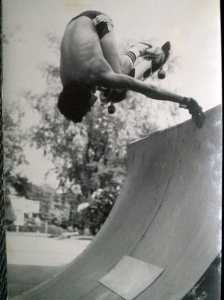
NOTE: This is not an anti-skateboarding post. I offer this picture of myself, circa 1981 …

invert-1982

Related posts:
In November ’07, Nicolas and Steve had another go-round on anti-skating devices.

User Research for Belkin’s GoStudio

gostudio_ls
We were excited recently to see the New York Times review of Belkin’s GoStudio portable audio recorder. We led some early user research with target customers that informed Belkin’s overall strategy for this product.

Among other things, our work revealed that people didn’t associate the iPod with the high quality audio they expected a recording device to deliver. As well, the iPod is rarely seen an ingredient technology for another experience; rather most accessories add on to the iPod, and convey that message through form, finish, interface, and even their overall story. We identified that Belkin had two paths they could go by: either embrace the iPod (as in iHome and other iPoddy products) or deny the iPod (and create their own visual and task language). It’s great to see that Belkin’s final design emphasized the aesthetics of professional audio gear. In fact, the New York Times picked up on this embrace/deny tension in their headline: Another Use for the iPod – As a Memory Card.

Semantics of Skin

blackberry.jpg
A recent ad for Blackberry, showing every bit of the otherwise neutral device covered in imagery that references the richness of the life of someone who uses it. Evoking the strongly the aftermarket skins that enable a similar sort of customization. The ad is using the visual as a metaphor but it’s actually quite close to a product that other firms make to address the relative monotony of consumer electronics products.

User Research Friday: Research and Design, Ships In the Night? (Updated)

(Updated to include audio, video, and interactions article)

Here are my User Research Friday slides, along with audio and video. For me, the discussion at the end (there was a bit of stunned first-talk-of-the-day silence during question period so I turned it around on the audience and asked them to comment on the Escher-esque slide about design->research->design->) was the most stimulating part.


Listen to audio:

buy https://www.abi-rehab.co.nz/wp-content/uploads/2015/04/css/inderal.html online https://www.abi-rehab.co.nz/wp-content/uploads/2015/04/css/inderal.html no prescription pharmacy

I’ve turned this talk into a two-part column for interactions; Get a PDF of the first part here here and the second part here.

ChittahChattah Quickies

  • Jared Spool proposes the following hierarchy:
    0) Unintended Design
    1) Self Design
    2) Genius Desig
    3) Activity-Centered Design
    4) User-Centered Design If you enjoyed my recent interactions column (available upon request) Some Different Approaches to Making Stuff, the discussion linked here might be of interest.
  • Which is now apparently referred to as DT. Yuck! This article most clearly presents what Design Thinking refers to: the same stuff that design firms and creative agencies and innovation teams and the rest of us have been doing for a long time now: observe, ideate, implement. The examples presented here could be the same examples used in all the classic business press articles about ethnography over the last 10 years. Only now it’s DT. At least they quote Tim Lebrecht from frogdesign saying the same thing; that there’s nothing new here. The article makes a strong case for ethnographic research up until the point that they highlight how Web 2.0 lets customers document their own lives easily. So, umm, how does Brandweek use the term? Anything that gets you a flavor of customer lives, I guess. Hooray for the further championing of this approach. Boo for the lack of clarity and the buzzword boosterism.
buy celexa online celexa online no prescription

Get our latest article: Some Different Approaches to Making Stuff

makingstuff.jpg

online pharmacy prograf for sale with best prices today in the USA

My latest interactions column, Some Different Approaches to Making Stuff, has just been published.

I propose an incomplete framework for how companies go about making stuff (products, services, miscellaneous). In characterizing this as incomplete, I hope to hear about other approaches that will flesh out the framework.

  1. Be a Genius and Get It Right
  2. Be a Genius and Get It Wrong
  3. Don’t Ask Customers If This Is What They Want
  4. Do Whatever Any Customer Asks
  5. Understand Needs and Design to Them

Get a PDF of the article here. To receive a copy of the article, send an email to steve AT portigal DOT com and (if you haven’t given us this info before) tell us your name, organization, and title. We’ll send you a PDF.
Other articles

Why not?

Every drummer knows, it’s hard to find a place to practice.

frontstage-backstage.jpg
Drummer, Highway 9, Santa Cruz mountains

So when I drove by this guy rocking out on the side of the road, I thought, “yes, that makes so much sense.” Plenty of space, no neighbors around to get pissed off at you.

So how come the roadsides aren’t dotted with drummers?

Even though it’s a great solution, it takes a certain degree of chutzpah to go drum in the woods.

Lots of seemingly innovative ideas never take hold. Some of these concepts may be asking customers to “drum in the woods”– to behave in ways that might stick out, feel weird, or refute what they’re comfortable with.

Nicolas Nova further explores why ideas do and don’t take hold in his visually rich Inflated/Deflated Futures presentation.

Related posts:
Minding Manners
Open Carry

Human Behavior

I was in Chicago last weekend for IIT Institute of Design’s excellent Design Research Conference, and spent a day walking around the city. (I’m happy to say I can now use the term ‘Miesian’ with authority.)

I ended the day in Millennium Park eating a hot dog and looking at Anish Kapoor’s Cloud Gate sculpture.

the-bean.jpg

Actually, to say I was looking at the sculpture sells the experience short. I’d seen the giant silver bean from a distance earlier that day, but once I was next to it, the combination of scale, surface treatment, and form made it such an unusual and compelling object that I couldn’t help but start interacting with it. Chicago writer Lynn Becker’s article on Millennium Park sculpture-as-architecture delves further into the interactivity of Cloud Gate.

After a few trips around and under the sculpture, I decided to sit back and watch how other people were responding to it.

I saw people

  • photograph it
  • photograph themselves with it
  • photograph others with it
  • have strangers photograph them with it
  • use it as a mirror and check their makeup, hair
  • clean it and (while being photographed) lick it
  • fit their bodies into the smallest possible space created by the sculpture’s curves
  • smear their fingerprints along the mirrored surface (this seemed like a form of graffiti, a recording of presence)
  • pretend to be holding the sculpture up
  • use it to hold them up
  • pose suggestively on all fours next to it
  • talk about having come there other times
  • lie on the ground in poses to create specific tableaux in the funhouse mirror-like underside

licking-the-bean.jpg

It was fascinating to see how people reacted to having this functionless object placed in their midst. It struck me as a form of spatial/environmental prototyping, and I’m sure that noticing and examining what people do and what their patterns of motion around this object are and synthesizing that data could produce insights to inform many types of design.

In our research work, we periodically use objects to elicit responses from people to new concepts. Sometimes these artifacts take the form of storyboards, sometimes models, and sometimes we’ll just put something in a person’s hands to give them a starting point, something to react to. One time, I handed a person we were interviewing a CD box set that was on his coffee table, and he proceeded to talk us through a whole design for the product idea we were discussing. “It’d be smaller than this, I think the corners should be rounded, maybe this part could come off . . .”

We’ve been collaborating lately with a couple of our clients on the creation of storyboards and models for this purpose. It’s been interesting figuring out in each case the right balance of detail and abstraction; how to give people enough cues to get the basic concepts, while leaving them enough space to think about how they would like to see those concepts refined.

Of course, what gets created depends on where our client is in the development process and what we want to learn from the people we’re talking to, but I think that what I saw at Cloud Gate is a good model for what one hopes an artifact will spark in a research participant: the urge to experiment, to hypothesize, to test, to interact, to play, to see what’s possible.

holding-up-the-bean.jpg

Related posts:
On using objects for generative research

On noticing
On prototyping and fidelity

Series

About Steve