Posts tagged “innovation”

Full Nelson

A fun read at Metropolis on the ‘good old days’ at Nelson & Company.

Irving Harper tells a story about developing his iconic Marshmallow sofa:

How did the Marshmallow sofa come about? One weekend, I thought about doing an upholstery unit, and wondered, Is there any way to do a sofa out of reproducible parts that could be done as if fitted out to a frame? I cooked up this model out of a checkers set, and I stuck the checkers disks on a metal frame, and it looked good to me. So I drew it up, brought it in, and that was the birth of it.

Harper’s story is testimony to the power of mocking up an idea. So when you or your team are in an idea-generating mode, go for it. Make ideas visible. Try things out. You never know where the exploration might lead…

body-interface-device4
Prototyping a body-mounted interface device using coat hanger, rubber bands, and Logitech mouse

ChittahChattah Quickies

  • In Recession, Strategy Shifts for Retail – It's hard to parse this piece; it's about a lot of cost-cutting stuff that is happening in retail but the tone suggests that these are innovative ways for companies to be more responsive (better customer service? better localization of products?) and integrated (linking the in-store and online experiences?). I'm skeptical and don't believe the concluding statement that this is happening because we're not spending in stores like we used to, it's too close to the whole "innovate your way out of a recession" talk and I don't think retail is an adaptable industry to take on a frame shift like that.
  • An evolutionary perspective on what we display to others with our consumption (not clear how there's anything new here, though) – Instead of running focus groups and spinning theories,marketers could learn more by administering scientifically calibrated tests of intelligence and personality traits. If marketers understood biologists’ new calculations about animals’ “costly signaling,” they’d see that Harvard diplomas and iPhones send the same kind of signal as the ornate tail of a peacock.

    Sometimes the message is as simple as “I’ve got resources to burn,” the classic conspicuous waste demonstrated by the energy expended to lift a peacock’s tail or the fuel guzzled by a Hummer. But brand-name products aren’t just about flaunting transient wealth. The audience for our signals care more about the permanent traits measured in tests of intelligence and personality, as Dr. Miller explains in his new book, “Spent: Sex, Evolution and Consumer Behavior.”

ChittahChattah Quickies

  • New Yorker profile of Fred Franzia, the rather unpleasant character behind Charles Shaw wine (akaTwo Buck Chuck) – "You tell me why someone's bottle is worth eight dollars and mine's worth two dollars," he says. "Do you get forty times the pleasure from it?" With Two Buck Chuck, Franzia invented a category known as “super-value” wine. Cheap wine – so-called skid-row wine – is noting new; Franzia's idea was to make cheap wine that yuppies would feel comfortable drinking. He put Charles Shaw in a seven-hundred-and-fifty millilitre glass bottle, with a real cork, and used varietal grapes.
  • Offline, accurate quantitative usage data can be tough to capture – Advertisers rely on M.R.I.’s research. It measures how many readers a magazine has, including people who did not buy it but read a friend’s copy or flipped through it at the doctor’s office. It also profiles the readers of all the magazines, including their income levels, attitudes and toothpaste-buying habits.

    M.R.I. divides the country into representative neighborhoods and sends researchers to the zones to conduct a 45-minute interview, with 26,000 people a year, asking them to remember which magazines they have read in the last six months.

    The researchers leave behind a 104-page survey about what sort of television shows people watch, what kind of products they use, and what social or behavioral traits describe them. M.R.I. then tries to adjust its results so they represent the country.

    [But there are accuracy issues] While M.R.I. said Tennis magazine’s readership dropped almost by a third, its subscriptions and newsstand sales rose slightly.

ChittahChattah Quickies

  • Steven Johnson in TIME on Twitter and innovation – The speed with which users have extended Twitter's platform points to a larger truth about modern innovation. When we talk about innovation and global competitiveness, we tend to fall back on the easy metric of patents and Ph.D.s. It turns out the U.S. share of both has been in steady decline since peaking in the early '70s. (In 1970, more than 50% of the world's graduate degrees in science and engineering were issued by U.S. universities.)…

    But what actually happened to American innovation during that period? We came up with America Online, Netscape, Amazon, Google, Blogger, Wikipedia, Craigslist, TiVo, Netflix, eBay, the iPod and iPhone, Xbox, Facebook and Twitter itself. ..if you measure global innovation in terms of actual lifestyle-changing hit products and not just grad students, the U.S. has been lapping the field for the past 20 years.

    How could the forecasts have been so wrong? The answer is that we've been tracking only part of the innovation story.

  • New Yorker on the significant power of storytelling in the unfolding of the Parrot Flu outbreak in 1929-1930 – Press plays role in raising awareness, hype ensues (kill all parrots!), backlash ensues (Americans are hypochondriacs and there's no such thing as Parrot Flu), small but significant number of sicknesses and deaths (pre-antibiotics) occur, scientists triumph, National Institute of Health is founded. Curious to read this right after watching 1950s plague thriller "Panic in the Streets."
online pharmacy buy abilify no prescription online pharmacy
buy propecia online buy propecia online no prescription

ChittahChattah Quickies

  • UX guy complains about AA.com being crap and UX guy from AA.com responds – UX guy reprints email and then attempts to address corporate culture issue; strong opinions follow but most compelling part is the insight from the AA.com UX guy himself (known as Mr. X)

    "But—and I guess here’s the thing I most wanted to get across—simply doing a home page redesign is a piece of cake. You want a redesign? I’ve got six of them in my archives. It only takes a few hours to put together a really good-looking one, as you demonstrated in your post. But doing the design isn’t the hard part, and I think that’s what a lot of outsiders don’t really get, probably because many of them actually do belong to small, just-get-it-done organizations. But those of us who work in enterprise-level situations realize the momentum even a simple redesign must overcome, and not many, I’ll bet, are jumping on this same bandwagon. They know what it’s like."

  • Health management goes for ethnic marketing/customization: Asians and diabetes – Rice is a carbohydrate that is particularly unhealthy in large quantities for people with diabetes. That's why doctors and other health care providers are increasingly trying to develop culturally sensitive ways to treat Asians with diabetes – programs that take into account Asian diets, exercise preferences and even personality traits. "Diabetes is primarily a self-managed disease, and you have to try multiple approaches with different patients. But many of those are not culturally appropriate for Asians."
online pharmacy buy baclofen online cheap pharmacy

ChittahChattah Quickies

  • Survey Says Baby Boomers Think Playing With Your Blackberry During A Meeting Is Rude – The 'tude in the blog entry about the survey is as interesting as the 'tude the survey's creation and content point to. Social norms shift and that gets introduced and changes the way people interact gets put through the social norm filter: is it rude? Is it distracting? Should other people stop doing it? Or should we get over it? This just points to the transition we're going through rather than offering any clear sense of what's going on. Full disclosure: I'm a Gen-Xer and I bolted from a boring presentation a few weeks ago when the person behind me tapped on the shoulder and asked me to stop using my iPhone as she found it distracting [I was discreetly using Google Reader in my lap].
  • Gartner's Hype cycle – a graphic representation of the maturity, adoption and business application of specific technologies – Hype cycles characterize the over-enthusiasm or "hype" and subsequent disappointment that typically happens with the introduction of new technologies.They also show how and when technologies move beyond the hype, offer practical benefits and become widely accepted.

    Five phases of the hype cycle
    1. "Technology Trigger" —A breakthrough, product launch or other event that generates significant press and interest
    2. "Peak of Inflated Expectations" — Frenzy of publicity typically generates over-enthusiasm and unrealistic expectations; There may be some successful applications of a technology, but there are typically more failures
    3. "Trough of Disillusionment" — Fails to meet expectations and becomes unfashionable
    4. "Slope of Enlightenment" —some businesses experiment to understand the benefits and practical application
    5. "Plateau of Productivity" — benefits become widely demonstrated and accepted

Explaining your product puts you ahead of the pack

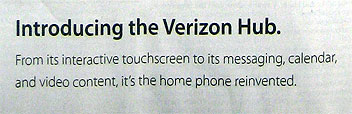
A few weeks ago I saw this full-page newspaper ad for Verizon’s Hub:
murphy

I’ve blown up the smaller text at the bottom:
hub

The phrase “the home phone reinvented” reminds us that explaining a new product in terms of what it is replacing, enhancing, or integrating with is often a very effective way to help ground something new. But the ad works mostly by establishing a physical context (the kitchen) and a use case (distributed family communication and meal planning). The actual functional specs are presented almost as an afterthought in the footer and greatly in service of the “reinvented” aspect.

I was excited by this ad because it does a reasonable job at something crucial that so few companies are actually doing: explaining clearly what their product is and who it is for.

I don’t know if this product is a good idea or a bad idea; it’d be fascinating to see how new users begin to use it and what sense they make it of it. But it seems that this product team Verizon is at least half a step ahead of many technology groups out there who collect a bundle of technology together but fail to create a compelling story about why this matters.

ChittahChattah Quickies

  • Listening to customer feedback? Twenty-Five Years of Post-it Notes (Thx, @susandra) – In '77, 3M decided to test-market. It failed to ignite interest. “When we did the follow-up research, there just weren’t a lot of people saying this was a product they wanted.”
    "We knew the test markets failed, but we just kept saying, ‘Maybe it was us. Maybe we did something wrong. Because it couldn’t be the product—the product was great.”
    To see for themselves how people responded to Post-it Notes, 2 execs cold-called offices, giving away samples and showing people how to use 'em. The responses were more enthusiastic. “Those things really were like cocaine. You got them into somebody’s hands, and they couldn’t help but play around with them.”
    1 more test was in order. They got newspapers to run stories about it. They festooned stationery stores with banner displays and point-of-purchase materials. 1000s of samples were sent to office managers, purchasing agents, lawyers, etc. People demonstrated it to potential customers. It was a huge success, and 3M decided to launch Post-Its.
  • Listening to customer feedback? Peter Arnell Explains Failed Tropicana Package Design – Big outcry over the Tropicana packaging design (which this suggests was NOT tested but that's hard to believe) led to a return to the previous packaging.
  • Listening to customer feedback? Malcolm Gladwell on the Aeron chair – The Aeron chair was originally despised and deemed ugly. It didn’t catch on for 2 years, and then it quickly became the most popular chair. Everyone came to love it. Gladwell concludes that people find responses about some topics extremely difficult to articulate. While they may think they dislike something (like the Aeron chair), in their hearts they may actually like it. There is a disconnect that causes people to express dislike in their heads while they actually like it in their hearts (and vice versa).
  • Listening to customer feedback? Hate Facebook's new look? You'll like it soon enough. – Slate advances the point that people react to change negatively but eventually get used to the change and make it work.
  • Listening to customer feedback? Problems With NBC’s ‘Parks & Recreation’ – When do you listen to negative feedback and when do you follow your vision? I think there's an important middle-ground that is often ignored: understanding what lies beneath that feedback and choosing carefully if and how to respond to it, or how to create supporting activities that help get over the barriers that the rejection points to
online pharmacy https://sleepyheadbeds.org/wp-content/uploads/2018/06/43.html no prescription pharmacy

Where does Twitter go from here?

(Originally posted on Core77)

whatistwitter
It’s an interesting time for Twitter. Although the folks on Twitter are lead user/early adopter types, there is huge buzz about the service. And as with many disruptive innovations, this new-and-different-thing is not well understood and begins to evoke a backlash. The mainstream media (NYT, Daily Show) is enjoying the opportunity to portray the technology – and its adherents – as contributing to a social decline, wasting time, being foolish, self-absorbed, and other cultural sins. But we went through this with cellphones (self-important rich people only), the Walkman (self-absorbed anti-social jerks), and so on. Let’s understand the backlash for what it is: a society grappling with emerging behaviors that challenge social norms. See Evan Williams on Charlie Rose for a discussion of “normal people” using the service.

One way to normalize a new behavior is to think about how it’s going to make money. Because what’s more normal than capitalism, right? So we’ve got all the Skittles buzz recently. We’d rather consider the designed experience that Twitter is facilitating than the marketing, PR, and money stuff, though. For a primer, you can read our previous thoughts here (summary: What the heck is this thing for? You’ve gotta use it for a while and see). Of course, all ideas are brainstorming, and not recommendations. Brainstorming works best when people build on the ideas, so we’d love to see all the builds you can come up with on the issues and the stand-in solutions. Note: some of these things may already be available on Twitter.com; but we see them only when we log out, so not sure how much help that is?!

Out of Box or Is This Thing On?
Just for fun, we went and looked at some of the first tweets (or postings, if you prefer) from people we are connected with on Twitter. Here’s some typical ones

  • taking the plunge
  • ok, i’m here… now what?
  • teaching rissa what twitter is.
  • trying to figure out why i joined twitter

(side note: there’s a lot more exploration of what people’s first tweets are; see this analysis and this part of the My First Tweets project).

There’s nothing wrong with this sort of tweeting, it’s a way for people to explore and test the system out. But it reveals that tentative stage people are in (and some never leave) when first using the system. A general principle here is to give people scaffolding to help them move to a more comfortable, fluid, confident, and rewarding stage of usage. Twitter asks What are you doing? and people can answer that question. But without a more full-fledged model of Twitter, they are always going to be tentative in this stage.

One possibility: give people a backstage mode where they can just try posting stuff, and then once they are ready, turn them “live.” Maybe you get 10 free tweets that no one will see. I’m thinking of Practice Mode in Guitar Hero where the player strums and the disembodied voice urges “great!” “rock on!” “go for it!” Give people permission to play without an audience, and then go live with it.

What Goes Where
Maybe it’d be helpful to provide a diagram that visually explains what you are broadcasting and to whom. What do you see as input on Twitter? Where does what you write go? Who can see it? And sure, if your stuff goes on the public timeline, then “everyone” can see it, but if Twitter is getting (say) 5,000 posts a second, that may change how you feel about your content being put all the way out there. But building that model in a realistic way for people so they understand how public they are being.

The Device Ecocystem
There’s two use cases here (for most of these issues): posting and reading, and you can configure your devices/technologies a few different ways. There’s a cliche of Twitter as a mobile device-only system, but it’s much more flexible than that. You can use IM, SMS, or PC and a combination or multiplicity. That creates a lot of options and customization, but people need a bit of help understanding what the options are, and perhaps why those options would be better for one situation than another (rather than realizing how much it sucks to get 30 texts in 4 minutes).

The External App Ecosystem
We could imagine why Twitter would not want to get involved in telling people about these things, but since they’ve opened up their API there are a ton of other services and applications out there. Designers of these tools are building in the viral aspect so that using this extra service (say, MrTweet which suggests new followers for you) creates a tweet that tells others about the fact that you are using it). But how does a not-so-new user find out what else is available? Sorting through the iPhone apps and desktop apps that let you manage your tweets and followers differently is not an easy task. And no doubt there are websites out there that have captured all that, but why not put it on Twitter.com?

Terminology and Commands
We’ve learned most of this by watching other people. But it took a lot of Twitter use before we were clear about conventions such as @ to reply to another person (and to understand what that looked like to the recipient), D to directly and private contact another person, # for tagging, and RT for ReTweeting (we still aren’t sure if that’s an evolved bit of common language or a command that we can use somehow). Can we help people with this? Sure, help text on the screen, but also some sort of smart tech, like Google’s suggestions during search, or (God forbid) a Clippy-like solution that offers some suggestions based on what it thinks you are trying to do.

Social Norms
One of the consequences of new social media is that it creates unarticulated and emotional expectations on others. People that post too much are rude. People that don’t tweet enough are rude. People that don’t have a bio, or a good user name are rude. People that follow us back too quickly are obsessed. People that don’t follow us back are rude. People that …well, you get the point. We bring expectations about others into this new interactive soup, but we can bet that most people do NOT share those norms, and it can get ugly, or awkward. Twitter is in no position to dictate those social norms to people as they are evolving organically, but Twitter could provide some coaching. Why doesn’t Twitter itself analyze our usage and suggest – something – in a gentle way. Or at least help make us mindful that there are evolving and varying social norms here and we should take it easy on ourselves and with others. Note: David Pogue addressed this issue pretty well here.

What To Use It For
Twitter might not want to go too far with this either. People are inventing all sorts of new use for Twitter all the time. But highlighting some use cases would be interesting and eye-opening for people as they either are thinking about putting their toe in, or after they are users and considering what the heck this thing is really for. Although it’s rather smarmily self-congratulatory, the LinkedIn Blog does this fairly well.

I’m sure we’ve missed a ton of ideas. What do you think?

Note: follow us on Twitter at twitter.com/steveportigal and (new) twitter.com/chittahchattah.

The Head of the Class

yakkay

Yakkay bicycle helmets create a normal

online pharmacy antabuse for sale no prescription

look by camouflaging the protective shell with a cool hat. This product reminded me of a few years ago when we worked with a client in the construction gear business who wanted to produce a premium hard hat, positioning against the near-disposable incumbent. They were already convinced that the value could be increased by solving functional problems (comfort, temperature, sweat), but our research identified that one of the biggest issues was a social one: the way people felt about themselves in their work gear both on and off the job site. Protective eyewear and footwear had recently been redesigned to be fashionable and we encouraged them to explore something similar with hard hats. We even showed a trendy Kangol hat in our presentation.

Unfortunately, this type of insight couldn’t move our gatekeeper away from what he was already imagining as a solution and I remember his audible splutter when we got to the slide with the Kangol hat. I am not sure that image survived into the next version of the presentation, even. But as far as I know, they never launched any product at all. So, best of luck to Yakkay!

See also: Talk To The 5th Guy

Series

About Steve