This Year We Make Contact With 2001 in 1968

Last night we watched the documentary Stanley Kubrick: A Life in Pictures. I was struck by this image, presumably from one of the premieres of 2001.

The visual elements of the movie (including production design, posters, typography, sets, models, special effects) were intended to depict, in 1968, the future. In this picture, there’s a remarkable contrast between the poster for the film, and everything else around it. The surrounding elements tell a story of the 60s – the cars, the signage, everything. And it might as well as be the 50s, or even the 40s. But the poster for the movie itself pops right out. The typography, the layout in the space, still look contemporary if not futuristic.

Looking back more than 40 years later, we can see the discontinuity between the world of what-was-then-today and the design-as-illustration-of-the future. One has to wonder how it felt in 1968. Was it even more dramatic (with the future stuff seeming really really future-y) or was it less dramatic (with the current stuff not seeing so ridiculously dated as it does now)?

ChittahChattah Quickies

  • [from Dan_Soltzberg] The clever furniture designs of OOOMS [Core77] – Some wonderfully playful furniture by Dutch firm OOMS. The "Low-Res Chair" at the bottom of the page is sheer genius.
  • [from julienorvaisas] The art of slow reading [www.guardian.co.uk] – [Will unplugging from technology really help us read more attentively, as the article suggests?] First we had slow food, then slow travel. Now, those campaigns are joined by a slow-reading movement – a disparate bunch of academics and intellectuals who want us to take our time while reading, and re-reading. They ask us to switch off our computers every so often and rediscover both the joy of personal engagement with physical texts, and the ability to process them fully.
  • [from steve_portigal] Pandora, MOG, Apple, and online music’s future [The New Yorker] – [Sasha Frere-Jones writes about the digital listening experience with clarity and insight] No one knows what the future of the music business will look like, but the near future of listening to music looks a lot like 1960. People will listen, for free, to music that comes out of a stationary box that sits indoors. They’ll listen to music that comes from an object that fits in the hand, and they’ll listen to music in the car. That box was once a radio or a stereo; now it’s a computer… Sometimes we will be the d.j.s, and sometimes the machines will be, and we may be surprised by which we prefer.

ChittahChattah Quickies

  • [from Dan_Soltzberg] The Media Equation – The Antenna Uproar – No Hair Shirt for Jobs [NYTimes.com] – [In the case of the missing iPhone signal, traditional publication Consumer Reports had more impact than younger, leading-edge media sources] How did Consumer Reports make Apple blink? In large measure, the article in Consumer Reports was devastating precisely because the magazine (and its Web site) are not part of the hotheaded digital press. Although Gizmodo and other techie blogs had reached the same conclusions earlier, Consumer Reports made a noise that was heard beyond the Valley because it has a widely respected protocol of testing and old-world credibility.
  • [from Dan_Soltzberg] Pop-Up Magazine [website] – [The return of the variety show? Media channel-bending experiment marries a magazine-esque approach to content with the ephemeral nature of live performance.]
  • [from steve_portigal] Concern for Those Who Screen the Web for Barbarity [NYTimes.com] – [Mind you, these consequences serve to reinforce the value of the service] With the rise of Web sites built around material submitted by users, the surge in Internet screening services has brought a growing awareness that the jobs can have mental health consequences for the reviewers. One major outsourcing firm hired a local psychologist to assess how it was affecting its 500 content moderators. The psychologist developed a screening test so the company could evaluate potential employees, and helped its supervisors identify signals that the work was taking a toll on employees. Ms. Laperal also reached some unsettling conclusions in her interviews with content moderators. She said they were likely to become depressed or angry, have trouble forming relationships and suffer from decreased sexual appetites. Small percentages said they had reacted to unpleasant images by vomiting or crying. “The images interfere with their thinking processes. It messes up the way you react to your partner.
online pharmacy buy tamiflu without prescription with best prices today in the USA
online pharmacy buy norvasc with best prices today in the USA

ChittahChattah Quickies

  • [from steve_portigal] Taking Web Humor Seriously, Sort Of [NYTimes.com] – [Another great Rob Walker piece deftly unpacks Internet culture] The more traditional pundits and gurus who talk about the Internet often seem to want to draw strict boundaries between old mass-media culture and the more egalitarian forms taking shape online ­ and between Internet life and life in the physical world. Sometimes the pointless-seeming jokes that spring from the Web seem to be calling a bluff and showing a truth: This is what egalitarian cultural production really looks like, this is what having unbounded spaces really entails, this is what anybody-can-be-famous means, this is what’s burbling in the hive mind’s id. But the real point is that to pretend otherwise isn’t denying the Internet ­ it’s denying reality. Trickster expression, intentional or otherwise, doesn’t propose a solution but jolts you to confront some question that you might prefer to have avoided. Like what, exactly, am I laughing at?
  • [from steve_portigal] Microsoft’s proprietary BlueTrack™ Technology works on more surfaces than both optical and laser mice – [Technology solves problems we didn't know we had, like, mousing on carpet! Thanks, Microsoft!] Now track more accurately on: Granite, Carpet, Wood.

ChittahChattah Quickies

  • [from steve_portigal] Camp Half-Blood, a real camp based on the Percy Jackson books – Fans ask me, “Wouldn’t it be cool to go to Camp Half-Blood for real?” We hope you’ll become a part of our demigod family. We’ll do anything to keep kids interested in reading. Since your kids are such huge Percy Jackson fans and have basically memorized the books I felt that it was more important to create an environment, with engaging backstories, that run parallel to the books without copying. This allows your kids to become their own demigod characters within the world of Percy Jackson. Your demigod will get to have adventures and go on quests as their own story unfolds over the course of their camp session. They’ll learn and utilize critical lateral problem solving skills and use creative play and teamwork to win the day. We try to make meaningful connections between history, mythology, literature, art, science, sports, current events, language and rampant creativity. Oh yeah, sword training, chariot racing, archery, lava wall climbing, and phalanx training are pretty fun too.
online pharmacy with best prices today in the USA

Skill Building for Design Innovators (from CHIFOO)

At CHIFOO in Portland this week, I presented Skill Building for Design Innovators.

How can you broaden your sphere of influence within the field of human-computer interaction? You can start by building your muscles! Steve will take a look at some fundamental skills that underlie the creation and launch of innovative goods and services. He will discuss the personal skills that he considers to be “the muscles of innovators” and the ways you can build these important muscles, including noticing, understanding cultural context, maintaining exposure to pop culture, synthesizing, drawing, wordsmithing, listening, and prototyping. Along the way, he will demonstrate how improving these powerful skills will equip you to lead positive change.

Here are the slides and audio:


online pharmacy cheap pharmacy

Listen to audio:

To download the audio Right-Click and Save As… (Windows) or Ctrl-Click (Mac)

ChittahChattah Quickies

  • [from steve_portigal] Report: EPA kills Chevy Volt’s 230 mpg rating [Autoblog Green] – [Thorny problem about how to give an actual rating of a car's performance when that rating is based on gasoline consumption and the car in question doesn't (really) use gasoline! The whole frame of reference for assessing the comparative economical/ecological performance of a breakthrough product is based on a slightly obsoleting technology. Craziness ensues!]
  • [from steve_portigal] How the Old Spice Videos Are Being Made [ReadWriteWeb] – A team of creatives, tech geeks, marketers and writers gathered in an undisclosed location in Portland, Oregon yesterday and produced 87 short comedic YouTube videos about Old Spice. In real time. Those videos and 74 more made so far today have now been viewed more than 4 million times and counting. The team worked for 11 hours yesterday to make 87 short videos, that's just over 7 minutes per video, not accounting for any breaks taken. Then they woke up this morning and they are still making more videos right now. Here's how it's going down. Old Spice, marketing agency Wieden + Kennedy and actor Isaiah Mustafa are collaborating on the project. The group seeded various social networks with an invitation to ask questions of Mustafa's character. Then all the responses were tracked and users who contributed interesting questions and/or were high-profile people on social networks are being responded to directly and by name in short, funny YouTube videos.
  • [from steve_portigal] Who’s Mailing What – [A very specific form of "competitive intelligence"] Every month the Who's Mailing What! Archive receives and analyzes approximately 4,000 to 5,000 pieces of direct mail in nearly 200 categories — consumer, business, fundraising, catalogs, and much more — forwarded to us from a network of correspondents around the country. Why? Because the best way to create successful direct mail is to study other company's mail to see which campaign and techniques show up again and again. If you're tracking a particular area of direct mail — you can go right to that category, see what we've received and discover: Who's mailing what, the offers, the control, the complexity of the mailing, whether there was 4-color work, sophisticated computer work, a poly envelope, a self-mailing format.

Backstage Pass

Our work brings us into intimate contact with people in their own environments, and we often get to see “back stage.” (Sociologist Erving Goffman used a model based on theater to talk about how people manage behavior in their everyday lives, referring to front stage and back stage realms and the differences in impression management that occur in each.)

There’s a moment that regularly occurs during fieldwork visits where the person we’re meeting with takes us into a hitherto shut room, opens a closet door to reveal something private, or simply goes to a new level of honesty and revelation in their discussion with us.

Places too have front stage and back stage elements, though these are often less closely guarded than those of individuals.

Here, front and back stage at a San Mateo ramen shop…

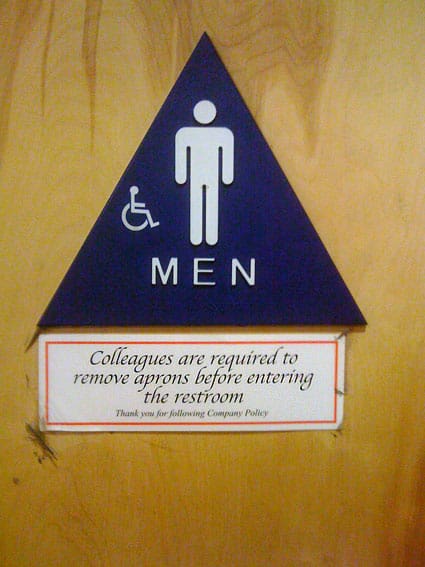
And below, explicit instructions to employees on how to transition between the front and back stage realms at an Alameda supermarket.

ChittahChattah Quickies

  • [from julienorvaisas] What’s with Steampunk? [More Intelligent Life] – [Subculture alert!] Inspired by the early science-fiction writings of Jules Verne and H.G. Wells, steampunk has a romantic, fantastical sensibility. It's not just a look, but an embrace of a nearly mythical era of mad science and weird contraptions at a time when most people rarely use their hands to make or discover anything. It is a subculture that uses virtual tools to honour the more crude and tangible kind. "Steampunk manages to be both conservative and progressive, backward-looking and forward-looking at the same time."
  • [from steve_portigal] What Futurists Actually Do [GOOD Blog] – When looking at the multi-variable, massively complex confluence of more than six billion free actors responding to (and continually creating) cultural, economic, and political forces, it is virtually impossible to plot a path to a definite and unambiguous future. And yet, we still use the singular—the future. Moreover, the future is not an end state. Tomorrow will someday be today, which will fade into yesterday. As our world moves through this unyielding passage of time, how people act in our world will determine just which of many possible futures we end up with. When we transform our notion of "the future" into visions of alternative futures, we transform our relationship to the very idea of change. We move from thinking we are heading toward an inevitable destination to seeing the world as a dependent, contingent, and therefore actionable, possibility space for us to design. Pluralizing "the future" makes us both more empowered and more responsible for our ultimate outcomes.
online pharmacy trazodone with best prices today in the USA

Series

About Steve