ChittahChattah Quickies
- IDSA National Conference 2009 – Day 2 Update – Core77 – Thanks for the good comments about my presentation!
It's a powerful idea and the movie's history from agit-prop to entertainment meshes nicely with some of the points I made about science fiction recently in interactions magazine, in We Are Living in a Sci-Fi World.
Under the Cybracero program American farm labor will be accomplished on American soil, but no Mexican workers will need to leave Mexico. Only the labor of Mexicans will cross the border, Mexican workers will no longer have to.
Using high speed internet connections, directly to Mexico, American farms and Mexican laborers will be directly connected. These workers will then be able to remotely control robotic farm workers, known as Cybraceros, from their village in Mexico.

(Updated to include slideshow with synchronized audio track)
We’re very excited today to be posting our findings from the Reading Ahead research project.
Lots more in the deck below, but here’s the executive summary
- Books are more than just pages with words and pictures; they are imbued with personal history, future aspirations, and signifiers of identity
- The unabridged reading experience includes crucial events that take place before and after the elemental moments of eyes-looking-at-words
- Digital reading privileges access to content while neglecting other essential aspects of this complete reading experience
- There are opportunities to enhance digital reading by replicating, referencing, and replacing social (and other) aspects of traditional book reading
We sat down yesterday in the office and recorded ourselves delivering these findings, very much the way we would deliver them to one of our clients.
Usually, we deliver findings like these to a client team in a half day session, and there’s lots of dialogue, but we tried to keep it brief here to help you get through it. (The presentation lasts an hour and twenty minutes.)
It’s been a great project, and we’ve really appreciated hearing from people along the way. We welcome further comments and questions, and look forward to continuing the dialogue around this work.
Audio
We’ve been hard at work synthesizing the Reading Ahead data. There’s a great deal of writing involved in communicating the results, and sometimes it makes sense to develop a visual model that represents a key idea.
Here are several partial models evolving through paper and whiteboard sketches, and finally into digital form.
We’ll be finishing synthesis soon, and publishing our findings on Slideshare, with an audio commentary.
Stay tuned…


We’ll explore the different cultural challenges that breakthrough products must overcome: emergent usage behaviors that are impossible to predict, a global customer base and cultural barriers inside the corporation that suffocate innovation. We’ll also share best practices for addressing each challenge.
Best practices for user research are not hard to come by, but experience is the ideal way to develop mastery. And with experience inevitably comes failure. Embarrassing, awkward, hilarious failure that gives the gift of self-improvement. We’ll share our own unvarnished examples and what they taught us.
When I buy a physical copy of a book, I feel psychologically more obliged to at least try to get through it. Online I experience a paradox of choice of sort. With hundreds of interesting books available there in front of me, I’m more inclined to excessively multitask, and end up checking out different books while I should still be reading the current one.
(Thanks @onwardparam and @chirag_mehta)
The researchers say the confusion arises because people from different cultural groups observe different parts of the face when interpreting expression.
(via Design-Emotion.com)

Tracy and her younger son thinking about possibilities for books and reading devices
Our fieldwork sessions often include a piece in which we ask participants to brainstorm and fantasize about the future.
In an earlier post, we talked about the simple models we were building for the Reading Ahead interviews.

Book and device models for participatory design activity
We wanted to put something in people’s hands to help them show us what the “book of the future” and “reading device of the future” could be and do. (This fieldwork approach borrows from participatory design.)
We’ve had clients come out in the field with us and say after an interview, “That person didn’t give us any ideas,” so it’s important to clarify that we don’t expect this kind of activity to directly produce marketable ideas. Rather, it gives people another mode for expressing themselves, and it’s great for helping them communicate things which may not always be easy to verbalize, like:

Chris uses the device model to help express his thoughts about navigation
Often for us, the very act of making the props for an activity suggests new ways of using them. In this case, while making a blank cover for the “future book” model, we realized that we could also make a blank inner page spread.

Holding the “book of the future” model
As it turned out, this meant that when we were done with the sessions, people had created very nice book models for us, with a cover and inner spread.


Erica’s “telescoping shopping bag” book with digital annotations, hyperlinks, and built-in dictionary
Part of the preparation for each interview session was to get the models ready with new blank paper. Here I am on the trunk of my car, prepping the models before an interview in San Francisco.

Now that the fieldwork is done, we have a great collection of models made by the people we interviewed.

Artifacts from participants’ “future book” ideation

The last section (copied below) of our Topline Summary synthesizes some of what we gleaned from this part of the fieldwork. These are just quick hits; we’ll develop any themes and recommendations that come out of these activities much further in the analysis and synthesis phase of the project.
Excerpt from Topline Summary: Participant ideation about the “book of the future” and “reading device of the future”
NOTE: The first thing a number of the participants said when asked about what the “book of the future” could be and do was that it’s pretty hard to improve on the book-it works very well the way it is. In addition to all the qualities already mentioned, books are
Instant on-off Durable
But people did have ideas. Here are some of them:
Put yourself in the story Leave the story for more information Choose from alternate endings, versions
Able to morph from bigger size for reading to smaller for transporting
Book form with replaceable content: a merging of book and device, with a cover, and page-turning but content is not fixed-it can be many different books Books that contain hyperlinks, electronic annotations, multimedia, etc.
Hide what you’re reading from others, hide annotations, hide your personal book list and lend your device to someone (with content for them)
A device that projects words that float above it, so that the reader doesn’t have to hold the device in their hands
Today about 15 minutes apart I posted, “Digging in to a day of reading transcripts for one project and laying out findings for another” on Facebook and, “Wondering how many things I can do simultaneously before my head explodes” on my Twitter account.
Seems like a contradiction: one describes a deep dive and the other a multitasking frenzy. Yet both are true–each post represents a different way of looking at time and the meaning of “now.”
With all of the channels we have for letting each other know what we’re up to, there is a huge range of options for what to say where and to whom. And each channel and tool suggests different approaches.
There’s no doubt that these modes of communication are and will affect our ways of writing, starting and maintaining relationships…even our way of conceptualizing time.
(via BoingBoing)
(Lone Gunman, I'm giving you folks credit for this and look forward to you reciprocating, thanks!)
Last year, Veoh, a video-sharing site operated from San Diego, decided to block its service from users in Africa, Asia, Latin America and Eastern Europe, citing the dim prospects of making money and the high cost of delivering video there.
“I believe in free, open communications,” Dmitry Shapiro, the company’s chief executive, said. “But these people are so hungry for this content. They sit and they watch and watch and watch. The problem is they are eating up bandwidth, and it’s very difficult to derive revenue from it.”
Five phases of the hype cycle
1. "Technology Trigger" —A breakthrough, product launch or other event that generates significant press and interest
2. "Peak of Inflated Expectations" — Frenzy of publicity typically generates over-enthusiasm and unrealistic expectations; There may be some successful applications of a technology, but there are typically more failures
3. "Trough of Disillusionment" — Fails to meet expectations and becomes unfashionable
4. "Slope of Enlightenment" —some businesses experiment to understand the benefits and practical application
5. "Plateau of Productivity" — benefits become widely demonstrated and accepted
A few weeks ago I saw this full-page newspaper ad for Verizon’s Hub:

I’ve blown up the smaller text at the bottom:
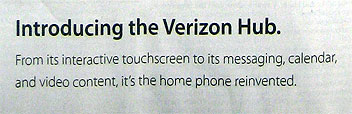
The phrase “the home phone reinvented” reminds us that explaining a new product in terms of what it is replacing, enhancing, or integrating with is often a very effective way to help ground something new. But the ad works mostly by establishing a physical context (the kitchen) and a use case (distributed family communication and meal planning). The actual functional specs are presented almost as an afterthought in the footer and greatly in service of the “reinvented” aspect.
I was excited by this ad because it does a reasonable job at something crucial that so few companies are actually doing: explaining clearly what their product is and who it is for.
I don’t know if this product is a good idea or a bad idea; it’d be fascinating to see how new users begin to use it and what sense they make it of it. But it seems that this product team Verizon is at least half a step ahead of many technology groups out there who collect a bundle of technology together but fail to create a compelling story about why this matters.
Last October I blogged about NBC’s use of “fusion marketing” with the show My Own Worst Enemy.
Are they at it again? A recent episode of the NBC show 30 Rock revolved around a mini-microwave, “The FunCooker“…

…and then a week later in some webvertising I saw an ad for this-

-the iWave cube, a tissue-box sized microwave.
I couldn’t help but wonder if there was another fusion marketing approach afoot.
Marketing is both ubiquitous and stealthy, and in this mashed-up and pervasive environment, any piece of communication in any medium could be a marketing effort. I find this simultaneously intriguing and disquieting.
Pervasive, cross-context marketing is producing some creative and thought-provoking experiences (the recent Skittles/Twitter (Skwitter?) campaign, for one). And it can be fun to spot marketing easter eggs–I felt a little thrill of potential discovery about the two microwaves.
At the same time, this lack of clarity about whether any particular piece of communication is company-sponsored or not adds another level of opacity to an already Filo-dough-like world of layered information. Will bionic critical thinking skills become the new common sense?
Related posts:
Interacting With Advertising
Collateral Damage
Crossover Hit