Posts tagged “fieldwork”

This Week @ Portigal

We all survived Friday the 13th last week and are ready to take on another week that certainly promises to end less ominously…

So, what’s happening this week at Portigal? Quite a bit…

  • We are up to our ears in interesting opportunities that require some creative thinking about participant engagement. Our research gears are turning!
  • Steve and Tamara will be giving a curtain-call presentation of findings from a recent study.
  • We continue to prepare for upcoming fieldwork (New York!! Los Angeles!!) and Julie is going to be busy making some tools to catalyze conversation.
  • Steve presses on with writing for his forthcoming book, synthesizing fabulous interviews with change agents who have driven the adoption of user research and pulling together the great suggestions people contributed to Tips to Improve Your Interviewing Skills (and a request for more!)
  • We are percolating some sweet ideas for primary research in 2012 for the Omni project and plan to share them soon. Stay tuned…
  • Steve continues to plug away on various tasks related to the upcoming Interaction 12 in Dublin.
  • We are all eagerly awaiting the arrival of Wednesday so we can get our geek on at Nerd Nite SF!
  • Steve is meeting with a big Silicon Valley player to explore how we can deliver design research training to their teams.
  • We continue to search for (and find!) cool opportunities for learning, teaching, and sharing. Julie and Tamara are currently in the throes of submitting proposals for Agile2012 and a few other gigs…
  • Tamara continues to dive deep into the eye-candy-land of visual thinking, doodling, mind mapping, graphic facilitation, etc. and welcomes suggestions for articles, websites, examples or groups of local SFists who like to get together with colored markers, blank paper, and ideas.

Merry Monday and Happy Week to you!

Steve to lead “Interviewing Users” workshop 9/28 in Seattle

As part of the Rosenfeld Media UX Workshops Fall 2011 Tour, I’ll be leading a full-day workshop – Interviewing Users: Spinning Data into Gold.

You can choose up to 3 workshops, including ones from Lou Rosenfeld and Steve Krug. Early registration (with a decent discount) ends September 9.

Bonus: the event will held at the amazing Seattle Central Library!

I hope to see you there!

ChittahChattah Quickies

  • [from steve_portigal] My Notes on Steve Portigal’s presentation – Design Fieldwork: Uncovering Innovation from the Outside In [The Pam] – [Pam pulls out the key points from my UIE WAMT presentation that most resonated with her.] The knowledge “You’re not your user” creates empathy, but going out to the field makes you listen and understand what your users are going through. Through fieldwork you can detect unmet business goals. Doing fieldwork can accomplish many research goals at the same time, not only about the users but also about your organizational goals.
  • [from steve_portigal] Web App Masters: Uncovering Innovation with Fieldwork [LukeW] – [Luke's summary notes from my 75-minute talk.] Be a methods-polygamist. Choose, mash-up, or create a methodology based on the problem you are trying to solve. Integrate with other methods. Create a library of methods and artifacts that you can call on and modify as needed. Different methodologies tell you different things. It’s not an either or.
  • [from julienorvaisas] Let’s Be Frank: Divisadero Public Discussion Board [The Bold Italic] – [Building on yesterday's quickie – here's a local example of the use of public space as a form for gathering thoughts of residents.] I think it's cool that people can participate after the event by writing their thoughts on the chalkboards. This neighborhood has evolved so much in the last few years, and I'm sure everyone who lives here has thoughts about the transformation, good and bad. I'm personally worried that the changes will leave out members of the old neighborhood, but I'm hopeful when I see the community come together on projects like these. However you feel about the change, I think it's a positive step when people are asked to voice their opinions in the process. So neighbors of Divisadero, don't be shy, what do you think the community needs?
buy female-cialis online female-cialis online no prescription

Backstage Pass

Our work brings us into intimate contact with people in their own environments, and we often get to see “back stage.” (Sociologist Erving Goffman used a model based on theater to talk about how people manage behavior in their everyday lives, referring to front stage and back stage realms and the differences in impression management that occur in each.)

There’s a moment that regularly occurs during fieldwork visits where the person we’re meeting with takes us into a hitherto shut room, opens a closet door to reveal something private, or simply goes to a new level of honesty and revelation in their discussion with us.

Places too have front stage and back stage elements, though these are often less closely guarded than those of individuals.

Here, front and back stage at a San Mateo ramen shop…

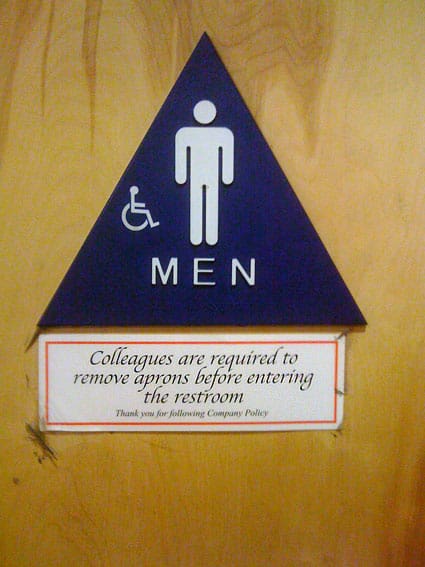
And below, explicit instructions to employees on how to transition between the front and back stage realms at an Alameda supermarket.

Persistence of Vision

buy lexapro online lexapro online no prescription

I was walking to dinner with a client in Chicago and saw this choice piece of graffiti. I immediately imagined using the image for an end slide in a presentation – “Problem Solved.” Very nice.

It wasn’t until after I had posted the shot on Facebook and seen it uploaded that I realized what it actually said. Which means that I saw the graffiti, composed the shot, took several alternate shots, and processed it in Photoshop, all the while seeing what my mind had interpolated rather than what was actually written there.

We’ve had numerous experiences of clients joining us in the field and saying – after we’ve interviewed someone who was either using or enthusiastic about their products – “She’s not our customer,” because the person didn’t fit their organization’s idea of who their customers are. We’ve also heard, “We already fixed that problem,” even after seeing clearly that the solution was unknown to the end user and the problem was still a problem.

It can be very hard to see something as it is if you come to it with a strongly ingrained idea of what you think

online pharmacy purchase augmentin online generic

it is.

But there is a reality – customers, environments, markets – whether you are seeing it or not. If you’re developing and selling products and services, you’re far better off working from an understanding of what’s actually there, rather than what you think is there.

Things to Do in Denver When You’re Dan

I was in Denver recently for a 10-day stint doing fieldwork. It was a long enough trip that, in addition to conducting interviews and spending time with our clients (who participated in more than half of the fieldwork sessions and some great after-work meals), I had a chance to do some exploring on my own. Here’s a short photojournal of some things that caught my eye…
map store
Cruising by the map store.


lit trees 2_denver
Getting out in nature.


caitlin
Asking our waitress about her tattoo.


indoor sky diving
Indoor sky diving!


drive-through-liquor-store
Drive-through liquor store.


train_denver
A lonely train.


grill-2_denver
Grills and gold teeth.


keep-your-door-locked
Enjoy your stay! Safety warnings on the TV in my room.


crossroads
I went down to the crossroads (but didn’t get down on my knees, because it was too damn cold!)

Reading Ahead: Managing recruiting

Reading ahead logo with space above

There’s always something new in every project. Often we encounter a bit of process that we may not know how to best manage it. So we’ll make our best plan and see what happens. We learn as we go and ultimately have a better way for dealing with it next time.

In a regular client project, we write a screener

online pharmacy cheap pharmacy

and work with a recruiting company who finds potential research participants, screens them, and schedules them. Every day they email us an updated spreadsheet (or as they call it “grid”) with responses to screener questions, scheduled times, locations, and contact info. It still ends up requiring a significant amount of project management effort on our end, because questions will arise, schedules will shift, people will cancel, client travel must be arranged, etc. etc.

For Reading Ahead, we did all of the recruiting ourselves. Although we’ve done this before, this may be the first time since the rise of social media: we put the word out on LinkedIn, Twitter, Facebook, email to friends, and here on All This ChittahChattah.

While Dan lead the effort, we both used our own networks, and so we got responses in a number of channels, sent to either or both of us, including:

  • @ replies on Twitter
  • direct messages on Twitter
  • Comments on Facebook posts
  • Messages on Facebook
  • Emails (directly to either of us, or forwarded from friends, and friends-of-friends

facebook
A private dialog on Facebook

facebook2
Comments on a Facebook status update. Note that Dan is able to jump in and make contact directly

twitter
Direct Messages in Twitter

Some people were potential participants, some were referrers to other potential participants, and some were both. And given the range of platforms we were using, with their associated restrictions (and unclear social protocols), we had to scramble to figure out who could and should communicate with who to follow up and get to the point where we could see if the people in question were right for the study. We didn’t expect this to happen, and eventually Dan’s inbox and/or his Word document were no longer efficient, and as some participants were scheduled or in negotiation to be scheduled, he ended up with this schedule cum worksheet:

schedule

Being split across the two of us and these different media, eventually we were interacting with people for whom we had to check our notes to trace back how we had connected to them, which was great for our sample, since it meant we weren’t seeing a group of people we already knew.

It was further complicated when we had finished our fieldwork and wanted to go back to everyone who offered help close the loop with them, thanking them for help. Technically, and protocol-wise, it took some work (who are the people we need to follow up with? Who follows up with them? What media do they use), basically going through each instance one-by one.

twitter2

We haven’t figured out what we’ll do next time; we won’t forget the challenges we’ve had but there’s just not time or need right now to plan for the future. If I had to guess, I’d imagine a Google Spreadsheet that includes where we got people from, who owns the contact, whether they are participant-candidate or referrer, etc.). Despite being very pessimistic about the demands of recruiting, we still underestimated the time and complexity required for this project.

Reading Ahead: Looking for the story

Reading ahead logo with space above

I started today by typing up all of the Post-it notes you saw in our recent blog post on Synthesis.

This activity created a 6-page Word document of bullet points.

The next part of the process is something I always find challenging: taking an incredibly detailed list of observations, particpant statements, hypotheses, and ideas; figuring out what the Big Ideas are (there’s a point in the process where many of them seem Big!), and putting those into a form that tells a cogent story.

First step: make a cup of tea.

Ok, then my next steps were:

  • Categorize all those bullet points
  • Synthesize those categories a bit further
  • Write down in as short a paragraph as possible what I would tell someone who asked me, “what did you find out?”
online pharmacy super-kamagra over the counter with best prices today in the USA

Then I went into PowerPoint, which is what we use when we present findings to our clients. I’ll continue bouncing back and forth between Word and PowerPoint; each piece of software supports a different way of thinking and writing.

I dropped my synthesized categories into a presentation file, sifted all of the bullet points from my Word doc into the new categories, and then started carving and shaping it all so that it started to follow the paragraph I had written. (I’m mixing cooking and sculpting metaphors here.)

I printed out the presentation draft, and laid it out so I could see the whole thing at once.

Portigal-Consulting_synth10

Steve came back from a meeting and I asked him to read over what I’d printed out. He started writing notes on my printouts, pulling out what he saw as the biggest of the Big Ideas.

Portigal-Consulting_synth11

We talked about what he’d written, which led to an energetic discussion in which we really started to breathe life into this. Tomorrow, I’ll start the day by iterating the presentation draft based on our conversation.

Reading Ahead: Analysis and Synthesis

Reading ahead logo with space above

Synthesizing field data into well-articulated, data-driven patterns, themes, and opportunities is a big part of our work, but it’s an aspect that generally has less visibility than the fieldwork.

An essential early step in the synthesis process involves going back over the fieldwork sessions. An hour or two-hour interview creates an incredible amount of information. By going back into a record of the interview, we make sure not to leave anything significant behind.

We go through and make notes on interview transcripts (done by an outside service), watch videos of the sessions, and look over photographs, sketches, maps, and participatory design pieces.

Portigal-Consulting_synth3w
Annotated interview transcript

We made a bulletin board of the people we met, so they’re ever-present while we’re working.

Portigal-Consulting_synth1

Yesterday we came together to share the points we’d each pulled out. We present each interview, like a case study, to the team. Sometimes it’s just us, and sometimes our clients join us for part of this process.

Portigal-Consulting_synth2w

While one of us presented, the other captured the essence onto Post-its. We had a lot of discussion and debate while we did this, pulling together multiple viewpoints.

Portigal-Consulting_synth5w

When we were done presenting the interviews, the board looked like this:

Portigal-Consulting_synth4w

Our next step is to take these notes and start grouping them. We’ll look at different ways the information can be organized, and from there, will start refining our work and writing it up clearly and succinctly into a report.

Reading Ahead: Photo Diaries

Reading ahead logo with space above

In addition to our in-person fieldwork, we often ask research participants to do some kind of task on their own. In past projects, these assignments have included a range of activities, from workbooks and journals with specific daily prompts, to fairly open-ended photo diaries.

For Reading Ahead, we asked people to do a short photo diary, and send us five or so digital pictures (before the interview session) that would help us get a sense of how reading fits into their lives.

Diaries like this accomplish several things. They give us access to a person’s world beyond what we might be able to get in just a face-to-face meeting. We’re able to see what they do in more locations, at more different times, and in more situations.

We probably won’t be there to see someone actually reading in bed before they go to sleep at night, but they might well ask a family member to take a picture of it for their photo diary, as Tracy did for this project.

Portigal-Consulting_diary1

Diaries also help us build rapport more quickly with the people we’re meeting, by giving us a common set of stories to begin the conversation with. There’s often a bit of back and forth dialogue between us and the participants during the assignment as well, which helps us establish a relationship.

Having some shared knowledge and possibly interaction prior to the interview means that when we are face-to-face, we can jump right in with that person at a deeper level, which can free up time in the interview session for exploring more areas of the research topic.

When you look at the pictures people sent us for this project, you’ll see that they’ve responded in a variety of ways. Some focused on objects, some took pictures of other people, and some photographed themselves or had other people photograph them. It’s useful to see the different ways people interpret the topic area, and the connections they draw. It helps us understand how each person sees the world, and can point us to additional lines of inquiry.

Below are the photo diaries for Reading Ahead.

Erica

Peter

Tracy

Julie

Series

About Steve