Mapping for change

ferrymapdetail

The Ferry Plaza Farmer’s Market is an amazing experience for San Francisco locals and visitors alike. In front of the Ferry Building they have an information booth that features a large photograph of the building on a metallic surface, with magnets representing the different booths. Obviously, as businesses come and go, or don’t show up on weekend, or are moved, it’s easy to update the map. And the use of the building itself as a backdrop reduces the abstraction typically found in a floor plan.

ChittahChattah Quickies

  • Excellent Rob Walker "Consumed" on Lululemon Athletica and the idea of a "lifestyle brand" – Anybody who is honest about consumer behavior knows that often what we buy is not simply some thing but some idea that is embodied by that thing. “Conceptual consumption” is the name given to this practice in a recent paper with that title by Dan Ariely, a professor of behavioral economics at Duke University (and author of the book “Predictably Irrational”), and Michael Norton, an assistant professor of marketing at the Harvard Business School, in The Annual Review of Psychology. Their notion has various subsets, one of which is the consumption of goals.

Designed for smuggling

(originally posted at Core77)

From a recent Fresh Air is a profile of the Tobacco Underground, an investigation by The Center for Public Integrity about how money from cigarette smuggling is sometimes used to fund terrorism. Of note is Jin Ling, a smuggled-only brand “virtually unknown to the authorities three years ago, [it] has grown so rapidly that law enforcement officials say it now rivals Marlboro as the top smuggled brand being seized in the European Union.” Of course, underground brands are unlikely to pay attention to intellectual property rights, hence the familiar packaging design, with the Camel camel replaced by a goat.

Calling out, around the world?

(originally published at Core77)

suica
Subway ad for Suica, transit fare payment by mobile phone, Tokyo, 2008

Why Japan’s Smartphones Haven’t Gone Global is a toe-dip into the case study of factors that have limited export of Japan’s cutting-edge mobile phone innovations.

Yet Japan’s lack of global clout is all the more surprising because its cellphones set the pace in almost every industry innovation: e-mail capabilities in 1999, camera phones in 2000, third-generation networks in 2001, full music downloads in 2002, electronic payments in 2004 and digital TV in 2005.

Despite their advanced hardware, handsets here often have primitive, clunky interfaces. Because each handset model is designed with a customized user interface, development is time-consuming and expensive, said Tetsuzo Matsumoto, senior executive vice president at Softbank Mobile, a leading carrier. “Japan’s phones are all ‘handmade’ from scratch,” he said. “That’s reaching the limit.”

ChittahChattah Quickies

  • Exercises in Style – 99 visual retellings of the same story – Matt Madden's visual version, where the same one-page story is told in graphic novel form 99 different ways.
  • Exercises in Style – 99 retellings of the same story – Exercises in Style, written by Raymond Queneau is a collection of 99 retellings of the same story, each in a different style. In each, the narrator gets on the "S" bus (now no. 84), witnesses an altercation between a man (a zazou) with a long neck and funny hat and another passenger, and then sees the same person two hours later at the Gare St-Lazare getting advice on adding a button to his overcoat.
  • Wally Wood’s 22 Panels That Always Work – "Wood created this piece not for others, but as a reminder to himself to not become bogged down in unproductive eddies" – like Oblique Strategies or McLuhan's Distant Early Warning Cards, this is another go-to set of tools for a creative problem (in this case, how for comic illustrators to present information in different ways)
    (via waxy)
online pharmacy buy metformin no prescription online pharmacy

ChittahChattah Quickies

  • Home Burials Offer an Intimate Alternative – Advocates say the number of home funerals, where everything from caring for the dead to the visiting hours to the building of the coffin is done at home, has soared in the last five years, putting the funerals “where home births were 30 years ago,” according to Chuck Lakin, a home funeral proponent and coffin builder in Waterville, Me.

    The cost savings can be substantial, all the more important in an economic downturn. The average American funeral costs about $6,000 for the services of a funeral home, in addition to the costs of cremation or burial. A home funeral can be as inexpensive as the cost of pine for a coffin (for a backyard burial) or a few hundred dollars for cremation or several hundred dollars for cemetery costs.

Garbage and Municipal Branding

fashioncenter
The Fashion Center garbage bags, Fashion District, New York City, 2004

leuvengarbage
Stadhuis garbage bags, Leuven, Belgium, 2009

While there is likely a practical driver to these branded garbage bags (controlling the distribution of the special bags ensures that only authorized parties can make use of garbage pickup services), it’s surprising to see them labeled with symbols of pride. Sure, every surface is a branding opportunity and every communication is a change to stay on message, but is this a good thing or a bad thing here? And does it differ between residents and visitors?

ChittahChattah Quickies

  • ColaLife is a campaign to get Coca-Cola to open up its distribution channels in developing countries to carry much needed 'social products' – …such as oral rehydration salts and high-dose vitamin A tablets (that might retro fit into existing shipping hardware)
    It was launched by Simon Berry, who had an idea while working on the British Aid programme in 1988 "Maybe by dedicating one compartment in every 10 crates as ‘the life saving’ compartment?" Having made no progress with the idea for 20 years, Simon decided to try once more but this time using the convening power of the internet. Since floating the idea on his blog in May 2008, he has managed to create a huge community around the campaign, through a Facebook group and appearances on Radio 4’s iPM programme. He is now in discussions with Coca-Cola and is looking to engage with an international NGO to move the project forward.

    ColaLife is an independent and purely voluntary movement backed by thousands of supporters on its Facebook Group. ColaLife is not an organisation.

What is advertising really selling us?

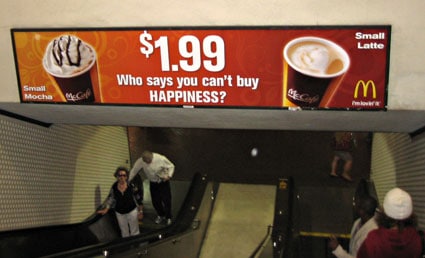
The Boing Boing post about ludicrous advertising claims echoed an earlier post here (Products with (fake) benefits) and brought to mind this photograph I took recently in downtown San Francisco, entering a BART station.

happiness
Who says you can’t buy happiness?

At least Twix, Red Bull and SoyJoy have an element of ironic bemusement in their claims, but McDonald’s is playing it pretty straight: buy this and you will be happy. Does this sort of pronouncement raise an eyebrow anymore? Do we actively or passively subscribe to that premise?

Series

About Steve