Posts tagged “music”

ChittahChattah Quickies

  • [from steve_portigal] The Art of Design Research (and Why It Matters) [design mind] – [Lovely piece by Jon Freach on what design research brings to design and innovation.] And sometimes design teams don't have the patience to see the value in dragging out a study in an effort to make it scientifically or statistically significant. We're just not wired that way; we prefer to make and experiment and then analyze later. So what is research good for? 1. Learning about people's behavior; 2. Understanding and analyzing culture; 3. Defining context; 4. Setting focus…Design research is not "a science" and is not necessarily "scientific." It gives designers and clients a much more nuanced understanding of the people for whom they design while providing knowledge that addresses some of the most fundamental questions we face throughout the process. What is the correct product or service to design? What characteristics should it have, and is it working as intended? "The research" won't necessarily provide cold hard answers. But it will generate some good and feasible ideas.
  • [from steve_portigal] CBS Radio Tells Its D.J.’s to Name Titles and Artists [NYTimes.com] – [Tying together the fortunes of radio and record sales?] Last week the head of a major radio company felt compelled to instruct its programmers to identify more of the songs played on the air, by title and artist name…at some indeterminate point in history ­ the mid-1980s ­ song identification began to vanish from the air as programmers struggled to squeeze out anything considered “clutter.” “You were always conscious about the amount of talk you would put on,” he said. “But the truth is that people tune in and tune out, and it was probably underestimated at the time how much people really wanted that information.” For record companies, having a song’s title and artist’s name mentioned on the air ­ especially if new and unfamiliar ­ is crucial marketing…“At one point in our culture there were well-schooled retailers who could help people figure out what that song was, because they wanted to buy it,” said Greg Thompson, VP at EMI Music. “In this day and age that doesn’t exist.”
online pharmacy lariam for sale no prescription pharmacy

ChittahChattah Quickies

  • [from steve_portigal] New record label hands decision-making over to fans [Springwise] – [This is exactly what Devo did in 2010 with their Devo 2.0 initiative which we blogged about extensively. Love how rapidly an experiment/social commentary becomes a "straight" idea in someone else's hands] Crowdbands is offering users the chance to become record label executives from their homes. Established by Tom Sarig and Peter Sorgenfrei, the Crowdbands label has already signed LA-based band The Donnas. By signing up as a Crowdband member for USD 25 a year, users are entitled to vote on major decisions in The Donnas’ career, from which songs are included on their albums, which artists they should collaborate with, where and where they tour, and even ideas for album cover art. In exchange, not only do members get to see their decisions implemented, they also receive the band’s releases before the general public.

ChittahChattah Quickies

  • [from steve_portigal] Crewspace – a social network for roadies – [The Internet provides a regular reminder of surprising or niche communities, connecting people that might otherwise remain disconnected, and revealing that these seemingly fringe groups can have significantly large membership. But how does a specialized social networking site differentiate from Facebook or LinkedIn? Do users inhabit both? How will all of us manage the different facets of our lives? How does a site like Crewspace adapt to its users in its user experience? Plus, how can I get backstage tonight?] Crewspace is the private social network for professional road crew (roadies) in the music industry worldwide. Membership is by invite only, so no time-wasters! Anyone who tours can become a member of crewspace (crew space) – tour & road mgrs, production mgrs, audio engineers, sound engineers, LD's, light techs, electricians, backline techs, road crew, catering, carpentry, riggers, security, transport, roadcrew, merch, wardrobe, make-up, crew, roadies.

ChittahChattah Quickies

  • [from steve_portigal] LCARS Standards Development Board – [Library Computer Access/Retrieval System is the name of the operating system used by ship systems on Star Trek. As fan sites and other bits of consumer-developed tech emulate the look and feel of interfaces from Star Trek, this site is an effort to create a set of UI standards around colors, fonts, animation, sounds, and other interactive elements.]
  • [from steve_portigal] How Kanye makes his musical sausage [Kottke] – [If you've been enjoying our recent examples of inspiring or provocative thoughts on creativity from performing artists, here's another one] Interesting piece on how Kanye West's latest album, My Beautiful Dark Twisted Fantasy, got made. Lots of good creative process bits

ChittahChattah Quickies

  • [from julienorvaisas] Music and speech share a code for communicating sadness in the minor third [Scientific American] – [We unconsciously employ culturally-imbued musical cues and tonal differentials with each other to convey emotion, sadness being one. This seems so obvious once it's stated, and so important to our methodologies, as we search for emotional response and connection.] The tangible relationship between music and emotion is no surprise to anyone, but a study in the June issue of Emotion suggests the minor third isn't a facet of musical communication alone—it's how we convey sadness in speech, too. When it comes to sorrow, music and human speech might speak the same language. Since the minor third is defined as a specific measurable distance between pitches (a ratio of frequencies), Curtis was able to identify when the actors' speech relied on the minor third. What she found is that the actors consistently used the minor third to express sadness.

ChittahChattah Quickies

  • [from steve_portigal] End Of An Era: Sony Stops Manufacturing Cassette Walkmans [Crunchgear] – [I share the author's surprise that this product was still being manufactured! The CD Walkman – its successor – has long been quaintly outdated, so cassettes? Perhaps there was a retro market, or perhaps other countries discarded formats differently than we have here] Sony announced it will stop manufacturing and selling these devices in Japan – after 30 years. Sony says the final lot was shipped to retailers in April this year, and once the last units are sold, there will be no cassette Walkmans from big S anymore. The first Walkman was produced in 1979. The TPS-L2, the world’s first portable (mass-produced) stereo, went on sale in Japan on July 1 that year and was later exported to the US, Europe and other places. Sony says that they managed to sell over 400 million Walkmans worldwide until March 2010, and exactly 200,020,000 of those were cassette-based models.
  • [from steve_portigal] PlumWillow Is Making the Customer Part of Its Culture [NYTimes.com] – [Employment criteria: do you represent our target customer? Hiring for insight as an internship strategy] They’re part of a team of 15- and 16-year-old interns who are being tapped for their own special brand of expertise and insight: a bird’s-eye view into the life and mind of high school teenagers, exactly the audience that PlumWillow is seeking. “They definitely aren’t shy about telling us what they like and don’t like,” says Lindsay Anvik, director of marketing at PlumWillow, who helps oversee the internship program at its offices in Manhattan. The interns are also emblematic of how Web-based businesses are doing more than merely shaping their products and services around customer preferences. The companies are corralling those customers in the workplace and making them part of the design and marketing process, according to Susan Etlinger, a consultant at the Altimeter Group, which researches Web technologies and advises companies on how to use them.

ChittahChattah Quickies

  • [from Dan_Soltzberg] The clever furniture designs of OOOMS [Core77] – Some wonderfully playful furniture by Dutch firm OOMS. The "Low-Res Chair" at the bottom of the page is sheer genius.
  • [from julienorvaisas] The art of slow reading [www.guardian.co.uk] – [Will unplugging from technology really help us read more attentively, as the article suggests?] First we had slow food, then slow travel. Now, those campaigns are joined by a slow-reading movement – a disparate bunch of academics and intellectuals who want us to take our time while reading, and re-reading. They ask us to switch off our computers every so often and rediscover both the joy of personal engagement with physical texts, and the ability to process them fully.
  • [from steve_portigal] Pandora, MOG, Apple, and online music’s future [The New Yorker] – [Sasha Frere-Jones writes about the digital listening experience with clarity and insight] No one knows what the future of the music business will look like, but the near future of listening to music looks a lot like 1960. People will listen, for free, to music that comes out of a stationary box that sits indoors. They’ll listen to music that comes from an object that fits in the hand, and they’ll listen to music in the car. That box was once a radio or a stereo; now it’s a computer… Sometimes we will be the d.j.s, and sometimes the machines will be, and we may be surprised by which we prefer.

ChittahChattah Quickies

  • Gathering insights by having people hand write their stories [DMI News & Views] – Asking people to tell us stories has repeatedly proven to be a rich and productive avenue for important insights. We ask people to tell us a story about a relevant event or experience. For instance, tell me about the last time you baked something from scratch. Or tell me about the last time you purchased a car. We try not to set too many rules or give too much guidance. We let them determine where the story will begin. This, after all, is what we are looking for. We ask for the story to be in writing—and ideally the story will be handwritten, if the logistics permit. We ask for the story to be as descriptive as possible—and we ask that the story be illustrated with pictures (hand drawn stick people or cuttings from magazines or from the Internet).
  • 100 Records: Project turns on fictional jackets [SFgate.com] – Exhibiting as "100 Records", Sonny Smith, a San Francisco musician, artist and writer, commissioned nearly 100 artists from around the world to create the artwork for 100 45 rpm record jackets that represent more than 60 fictional bands and singers.

Cutting Thru Clutter at SXSW

As David Armano writes about SXSW “Hundreds of vendors, brands and companies vie for your attention.” This was certainly one of my big surprises from the recent SXSW event (my first time attending). From the huge attendee bag o’ crap with every kind of sticker, sample beverage, light-up pen, button, pamphlet, coupon, invite, brochure, and screen cleaner imaginable, to the half-dressed-skinny-girls inviting us to try a WiFi cafe, I was struck how by showing up in Austin I was essentially a captive audience to be marketed to. There was free food-and-drink (the Ice Cream Man on 6th street hands ice cream to passerby, with a Nokia napkin; the Sobe people were giving out psych-ward-meds-sized portions), free electricity (via Belkin and Chevy), and on and on.


Pepsi had large area with several zones, including tents for…I guess…video conferencing. I saw people hanging out at the bar drinking small portions of Pepsi, but not many making use of this service.
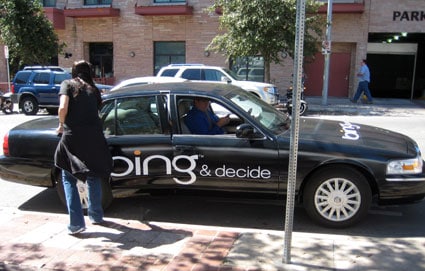

Bing had a fleet of Town Cars, as well as hostess-y types that would offer you a free ride.


This bus was promoting the new book from Tony Hsieh (of Zappos). I just saw it driving around, or worse, idling. I never saw anyone get on, or off. Was it an eco-nightmare billboard? Or some sort of service? I think it’s kind of creepy!


Sidewalk advertising, of course. Let’s hope they cleaned it up after, or that the city was prepared to fine them. I haven’t checked out this URL, but feel free to and let us know in the comments. Or, really, why bother?


There are three concurrent/adjacent festivals: Interactive, Film, and Music. Each of them serves up an insane range of options, well beyond what we normally encounter in our choice-flooded lives. The net effect (and my theme here) is that content creators are expected to shout louder (or more interestingly) to create awareness for their product. Here are ads for all sorts of things, including a cryptic phrase about a hurting vagina (which turned out to be from a movie).


Those posters don’t go up by themselves. It takes work.


As Austin reached beyond-critical-mass, 6th Street, the live music area, was closed to traffic. People were passing out more pamphlets and flyers promoting their events. And here’s where many of them ended up.


Just because.


Drawing attention to yourself to promote an event.


iPad guy was the triggering noticing event that led to this post. On my second-to-last night I saw this guy walk by, with a cardboard iPad around his neck (yes, kids, this was before the iPad was actually available). I yelled out “Hey, iPad guy!” and he stopped and let me take his picture. We introduced ourselves, and I asked him why he was wearing an iPad around his neck (see, that ethnography experience comes in handy!!!). His answer? So people will talk to him, like I did (turns out he works for a Search Engine Optimization firm, so…). While SXSW is a hyper-condensed environment, it represents some early-adopter aspects of typical daily life, and so I was struck to see the continuum between the promotion of Pepsi, Sobe, Bing, an indie film, an indie band, and an individual.

I’ve had my experience with guerrilla methods of promoting myself (from wearing a giant sombrero when campaigning for student government, with the slogan “the little guy in the big hat” to wearing a very loud SpiderMan tie when interviewing for jobs at a CHI conference long ago…only to be upstaged by the guy with a resume-dispensing-box with an embedded recording of him giving his elevator pitch) but the past seemed quainter, where the extreme needs (getting elected, getting a job) permitted extreme norms. But at SXSW it seems like everything is a promotion for something and I feel just a little bad seeing us take our lessons on how to connect with each other from big brands. Is this an exception or an emergent norm?

My favorite content from SXSW:

Check out more of my SXSW pictures here.

Slides and audio from Integrating User Insight, my presentation with Aviva Rosenstein, are here.

You may also like License to Shill, a FreshMeat column from 2004.

Series

About Steve