ChittahChattah Quickies
August 19th, 2009
- Summer Reading Programs Gain Momentum for Students About to Enter College – Nationwide, hundreds of colleges and universities, large and small, public and private, assign first-year students a book to read over the summer, hoping to create a sense of community and engage students intellectually.
While there are no reliable statistics on summer reading programs, a recent survey of more than 100 programs by a student researcher at Gustavus Adolphus College in St. Peter, Minn., found that most had started in the last four years, although a few go back decades.
The range of books colleges use is enormous, covering fiction and nonfiction. Classics are largely absent, with most of the works chosen falling closer to Oprah than academic.
Still, a certain canon of summer reading is emerging: books that are readable, short, engaging, cheap. Often, it helps if the book is a best seller dealing with some aspect of diversity, some multicultural encounter — and if the author will come to speak on campus.
- Canada Reads — CBC Radio – Canada Reads celebrates five Canadian books for three months online, on the air and at public events. It all leads up to a week-long show hosted by Jian Ghomeshi. In this annual title fight, five celebrity panelists defend their favourite work of Canadian fiction. One by one, books are voted off the list, until one panelist triumphs with the book for Canada to read this year.
- Beyond the Book – Beyond the Book: Mass Reading Events and Contemporary Cultures of Reading in the UK, USA and Canada is a 3-year interdisciplinary research project.
Our main objectives are to determine why and how people come together to share reading through a comparative study of selected mass reading events.
The mass reading event is a new, proliferating literary phenomenon. Events typically focus on a work of literary fiction and employ the mass media as a means of promoting participation in the themed activities and discussions that take place around the selected book. Beyond the Book uses research methodologies drawn from both the humanities and social sciences to investigate whether mass reading events attract new readers and marginalized communities. We also wish to determine whether this contemporary version of shared reading fosters new reading practices and even whether it is capable of initiating social change.
"ONE BOOK" READING PROMOTION PROJECTS (Center for the Book: Library of Congress) – "One Book" projects (community-wide reading programs), initiated by the Washington Center for the Book in 1998, are being introduced across the U.S.A. and around the world. Here's lengthy list of authors, communities, and dates.- The Big Read – The Big Read is an initiative of the National Endowment for the Arts designed to restore reading to the center of American culture. The NEA presents The Big Read in partnership with the Institute of Museum and Library Services and in cooperation with Arts Midwest. The Big Read brings together partners across the country to encourage reading for pleasure and enlightenment.
The Big Read gives communities the opportunity to come together to read, discuss, and celebrate one of 30 selections from American and world literature. This initiative supports innovative reading programs in selected communities, providing engaging educational resources for discussing outstanding literature and conducting expansive outreach and publicity campaigns, and a Web site offering comprehensive information about the authors and their works.
- Literary Reading in Dramatic Decline, According to National Endowment for the Arts Survey – (July 8, 2004) Literary reading is in dramatic decline with fewer than half of American adults now reading literature, according to a National Endowment for the Arts survey released today. Reading at Risk: A Survey of Literary Reading in America reports drops in all groups studied, with the steepest rate of decline – 28 percent – occurring in the youngest age groups. The study also documents an overall decline of 10 percentage points in literary readers from 1982 to 2002, representing a loss of 20 million potential readers. The rate of decline is increasing and, according to the survey, has nearly tripled in the last decade.
- 15 Books That Have Stuck With You (yet another of those Facebook etc. "memes" that are more like chain letters than memes) – Pick 15 books that will always stick with you. Don't take more than 15 minutes. Tag 15 friends including me because I'm interested in seeing what books my friends choose.
- My pictures from Belgium 2009 (345 of 'em!) – Here's the whole set on Flickr. I'll continue to blog highlights from the trip.
- Google book project far from settled – As the deadline draws near for authors and publishers to opt out of a proposed legal settlement allowing Google Inc. to forge ahead with plans to scan millions of books, more opponents of the landmark deal are stepping forward, and the local literary world is growing more perplexed.
"Smart people, major players that are sophisticated in the ways of publishing, are still at loggerheads," said Ted Weinstein, a San Francisco literary agent. He said they're not just arguing whether the deal is good or bad, "but still expressing disagreement about what exactly it will do. That's a problem."
Tags:
arts, belgique, belgium, books, bruges, brugge, brussels, Canada, club, college, community, connection, copyright, culture, decline, discussion, education, endowment, engagement, Europe, facebook, google, group, impact, interaction, interviewing, leuven, literacy, literature, louvain, mass, media, memories, national, nea, noticing, observation, onebook, ownership, photography, photos, publishing, quantitative, read, reading, reading ahead, research, scanning, sharing, social, study, support, survey, travel
ChittahChattah Quickies
March 4th, 2009
- Paul Graham writes on "Why TV Lost" – Lots of interesting points in Graham's essay, but I found these two, about the underlying media component of many startups, and the temporal aspect of TV-watching especially thought-provoking: "Now would be a good time to start any company that competes with TV networks. That's what a lot of Internet startups are, though they may not have had this as an explicit goal. People only have so many leisure hours a day, and TV is premised on such long sessions (unlike Google, which prides itself on sending users on their way quickly) that anything that takes up their time is competing with it."
- Where does Twitter go from here? – My post on Core77 about how Twitter can think about evolving its overall user experience as it straddles lead users and mass awareness
- Logic+Emotion: Skittles Smackdown, A Sociological Viewpoint – Nice words from David Armano, pulling out something I wrote yesterday about the Skittles/Twitter PR experiement
Tags:
armano, behavior, core77, culture, design, evolution, google, Graham, interaction, interface, media, norms, observation, startup, tv, twitter, ue, user experience, users, watching
ChittahChattah Quickies
February 14th, 2009
- LinkedIn has a mascot? – From 2007, here's the LinkedIn Wizard.
- Rob Walker on the origins of Twitter's Fail Whale (the indicator that the service is down). – "As with many Web-popularity stories, there’s a lot of flukiness to Fail Whale’s rise." Groan! Can anyone explain LinkedIn's completely off-brand Wizard?
- How Google Decides to Pull the Plug (with a perspective on product development and innovation) – For many ideas, Google’s first and most important audience is its employees, and it typically tries products internally before releasing them. Google and other technology companies refer to this as “eating your own dog food.” Through such “dog-fooding,” Google learned that the early version of its calendar program was fine for parents tracking children’s soccer games, but not robust enough to meet a corporate user’s need to book rooms, reserve equipment and delegate scheduling.
Equally important is listening to users. Most products have an official blog to explain changes, and customers are encouraged to share their thoughts.
Google’s willingness to take risks offers a lesson to other companies about the nature of innovation, said Jeff Jarvis, author of “What Would Google Do?” “Perfection closes off the process,” Mr. Jarvis said. “It makes you deaf. Google purposefully puts out imperfect and unfinished products and says: ‘Help us finish them. What do you think of them?’ ”
- 15 Companies That Might Not Survive 2009 – Including Rite-Aid, Chrysler, Dollar-Thrifty, Sbarro, Six Flags, Krispy Kreme and Blockbuster
- Blackwater Changes Its Name to Xe, chooses to spend more time with its family – Blackwater Worldwide is abandoning the brand name that has been tarnished by its work in Iraq, settling on Xe (pronounced zee) as the new name for its family of two dozen businesses. Blackwater Lodge and Training Center, the subsidiary that conducts much of the company’s overseas operations and domestic training, has been renamed U.S. Training Center Inc., Blackwater’s president, Gary Jackson, said in a memo to employees that the new name reflected the company’s shift away from providing private security. He has said the company is going to focus on training.
Tags:
blackwater, consumed, fail whale, google, innovation, linkedIn, naming, NYT, product development, rob walker, wizard
Spammers as culture watchers
November 26th, 2008
Just got this bit of sp@m with the subject line: Make Money with Google Bailout Plan

I love how they evoke the government bailouts as something now available to you, potential customer mark, and tie it to Google, a recent blue-chippy money brand. Of course, the image is something they can keep reusing and change the subject line as the cultural story around the economy keeps evolving.
One could track the zeitgeist by following the thrust of our sp@m.
The Google cliche
April 18th, 2008
It used to be that you could take notice at the outset of a poor essay or speech when it began with the dictionary definition for the central topic. The Simpsons referenced this at least once
Homer: “What is a wedding? Websters defines it as a process of removing weeds from ones garden.”
But now lazy bloggers and NPR journalists are pretending to channel the zeitgeist by using the number of Google hits for their term as a proxy for cultural relevance. When the numbers are over 1,000,000, how meaningful is this? It’s simply a cheap cliche.
Full disclosure: I’ve probably done both of these and will probably do them both again. In the interest of always trying to tell better stories, I will attempt not to, however.
Neologism du jour: Google pr0nrank
November 1st, 2007
I may not be the first to air this idea, but I’ll give it a shot anyway. Google pr0nrank refers to the number of Google Image Search pages it takes to reach a NSFW/dirty/titillating image for a given search term.
winston churchill is 48; an image of a bodily organ near a face appears on the 48th page of results.
aficionado is 1. The first row of results contain suggestive bikini ladies.
In neither case, of course, was I expecting to find such images.
I would have (seriously) rated the grade of toilet paper
February 16th, 2007
In My Microsoft Google Yahoo Stories we get some comparisons of internship experiences at 3 big tech companies. I don’t recommend the article necessarily, only to provide context for this awesome chart.

I love how the deconstruction of the experiences (related in detailed narratives in the article) into these specific categories give a blunt and amusing summary of, well, the person relating it. What categories we create to represent something qualitative tells a lot about us and how we make sense of those experiences.
Quickies from UXWeek
August 15th, 2006

Despite all the training, the swanky Palomar Hotel, site of UX Week, isn’t able to get basic things like room reservations (ObSeinfeld: “See, you know how to take the reservation, you just don’t know how to *hold* the reservation”) sorted out. I wasn’t the only one it seems that arrived (hot and dusty from a long long voyage) to find some polite confusion at the front desk. And today (after friendly but pungent maintenance men visited my room during the well-communicated fire alarm test) a polite person knocked on my door to see if my room was indeed occupied.
Anyway, more content stuff to come (great keynote by Michael Bierut). Surreal moment of zen last night when the very “guy” bartenders at the billiards bar where Google hosted a (recruiting) party poured out pitchers of shots (of what they referred to as a concoction and had us all toast – like patrons of wet-t-shirt-nite – to GOOOOOOOOOOGLE!!!!!!!!!! It was a viral-video/co-creation opportunity waiting to happen.
Living in Beta
July 31st, 2006
I have no idea of Google Maps is in Beta or not, but man, is it broken. In Firefox and in IE, I can not print a map. It’ll generate a nice print preview with all the directions and so on, but the all-important IMAGE is absent. Argh.
Do you ever find yourself screwing around with some semi-working website (especially one you trust and expect to work, like Google) for a ridiculously long time, only to have to completely throw up your hands and go onto another method? It’s nice that it’s free and all, but what a waste of time! This used to work only recently. Very annoying!
What the hell is wrong with Froogle?
March 14th, 2006
We’ve got some quality control problems with Froogle. Maybe this is nothing new. I searched for “bluetooth mouse” and clicked on one listing to see the two results in detail. Here they are listed. The name of the product and the merchant, together.
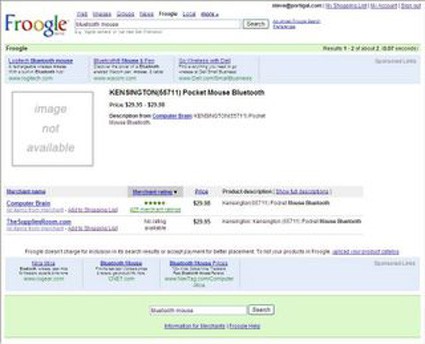
I tried the first one and the product page they link to is actually for a screen protector, not a mouse.

I tried the second one and it prompted me for login and password, and then of course denied me access.

Don’t be evil, sure. But don’t be lame, either.
