Posts tagged “culture”

Brand Equity?

I had to replace one of the toilets in my house recently. On the advice of a friend who’s a builder, I went to Home Depot seeking an American Standard brand toilet.

Replacing a toilet is surprisingly easy. It’s really quite something that the toilet is such a simple device, considering its significance in enabling modern life to be as pleasant as it is.

I had bought all the pieces I needed separately, and by the time I finished my installation, had forgotten that I’d bought a seat that was also made by American Standard.

I experienced a little warm flash of joy when I raised the seat of my new toilet for the first time and saw that the logo on the bottom of the seat matched the logo on the toilet itself.

toilet-seat-branding.jpg

online pharmacy https://www.healthfirstchc.net/wp-content/uploads/imodium.html no prescription pharmacy

That I would feel spontaneous pleasure at having the brands of components on my toilet match–is it not testament to the primacy of place that branding and labeling have in our culture?

That this positive feeling was caused by something I never could have told you I cared the least bit about–something that seems so silly to me that I’m chuckling inside as I write this–really shows the power of the larger culture to influence emotional responses.

It also illustrates the necessity of being in real places with real people doing real things, if one wants to witness these types of dynamics.

The coda on this little story is an ironic one:

toilet-tank-labling.jpg

Does it matter to me that my American Standard toilet was made in Mexico? Not really. I’m just happy that the logos all match.

Get our latest article: The Journey Is The Reward

riverpayment.jpg
My third interactions column, The Journey Is The Reward, has just been published. I offer some thoughts about the experience of the outsider, especially when we travel to other countries, and how that outsider experience can be so generative in understanding other frames of reference and cultural models.

Get a PDF of the article here. As the interactions website only has a teaser, we’d like to offer a copy of the article. Send an email to steve AT portigal DOT com and (if you haven’t given us this info before) tell us your name, organization, and title. We’ll send you a PDF.

Other articles

From Here to There: Design Research Symposium

Recently I was invited to ASU in Tempe, AZ, to participate in a Design Research Symposium called From Here To There, a reference (I think) to moving from questions to answers (or, perhaps, more questions).

I was pleased to be part of such a great lineup of speakers:

  • Dennis Doordan, Editor, Design Issues
  • Laura DeWitt, Research Director, laga Innovation Group
  • Dan Formosa, Smart Design Worldwide
  • Matthew Jordan, Director of Research and Interaction Design, Insight Product Development
  • David Alan Kopec – “DAK”, Associate Professor of Design, Newschool of Architecture and Design
  • Steve Portigal, Principal, Portigal Consulting
  • Meg Portillo, Chair of the Department of Interior Design, University of Florida
  • Altay Sendil, Design Researcher, IDEO
  • Jason Severs, Principal Designer, frog design
  • Susan Winchip, Professor of Interior and Environmental Design, Illinois State University
  • Matt Zabel, Human Factors and Design Research Manager, Brooks Stevens

We heard from people in academia and people in consulting practices, and we learned about culture, education, methodology, a day-in-the-life of a professional design researcher, quantitative approaches, and a lot more.

I gave a plenary address that built on Practicing Noticing Stuff and Telling Stories. The bulk of the talk was different examples of cultural norms and/or design requirements revealed through observations and photographs. Some of those pictures have appeared on this All This ChittahChattah. In a great bit of small-worldness, one of the students in attendance was the very person who had explained (in a previous blog post here) just what was going on in one of my Hong Kong pictures.

saturday_steveportigal10.jpg
Steve talks about poo

saturday_steveportigal1.jpg
About

I also ran an in-depth workshop on interviewing techniques. In our training work, we’re often using this same material in professional settings where our clients have a little or a lot of experience in using interviewing and observation as a method for gathering insights so it made for a point of contrast to have the discussion with people who are in student mode and who have had very few applied experiences with design research. I’m appreciative of these opportunities to teach a range of people with different skills levels and backgrounds as I think it keeps the material sharp and our approach always fresh.

A smattering of other conference images:
wall.jpg
Questions, answers, and dialog

severs.jpg
The Incredible Jason Severs

dak.jpg
DAK

It was a great event, a good group, well organized, and good interactions. There’s a rumor that the talks may be podcast eventually. I’ll update this post if that happens.

Pop Culture Osmosis, Tokyo (part 2)

(also see part 1)

What sort of stuff is “popular” in another country? How do we, as visitors, experience, catalog or contextualize pop culture?

Tokyo’s Shibuya district is the throbbing heart of Japanese youth culture, overflowing with pedestrians (and vehicles), with dense ground-to-sky advertisements for music and electronics and clothing.

Upon arrival, we see a truck driving by advertising an upcoming album release by Ayumi Hamasaki.
dsc_0194.jpg

In fact, we see this truck – or others like it – constantly. We’ve never heard of Ayumi, but clearly someone wants this album release to be a big deal.

dsc_0561.jpg

One evening, we notice large crowds outside Yoyogi National Stadium. Turns out it’s an Ayumi Hamasaki concert.
dsc_0032.jpg
(Notice the suitcase, featuring her logo.)

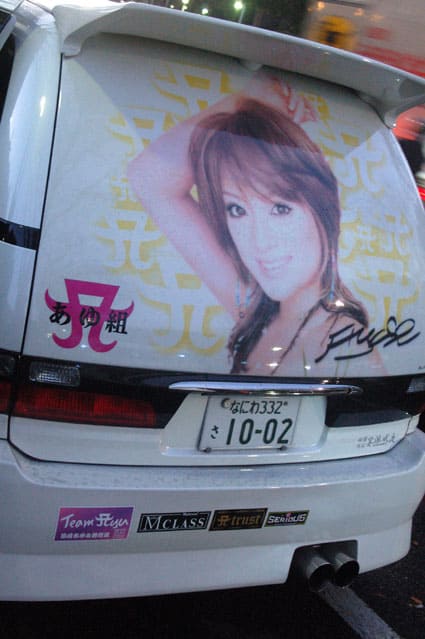
Parked alongside the stadium are a number of Ayumi Hamasaki tribute vehicles
dsc_0034.jpg
dsc_0038.jpg

Passing by the next night, New Year’s Eve, there is an even more extensive display of tribute vans.
dsc_0184.jpg

Assuming (and I do) that these vans were made by fans, and not record company plants, then at this point it becomes impossible to deny the obvious: she is huge. The larger-than-life marketing messages are appropriate given the enormous popularity. The foreigner’s reaction of “Well, we’ve never heard of her” is only a temporary refuge in the face of the demonstrable devotion.

Consider this: in a major city in the world there’s an performer where fans decorate their vehicles with her face on the outside and displays on the inside and tailgate together with their custom vans before concerts. And you’ve never heard or heard of her. (Disclaimer: doesn’t apply to you if you’ve heard of her).

And: spend a few days in this major city and you will learn about this performer over and over and over again and wonder how you could have possibly not heard of her before.

Body Self-Image

Photos from my various travels depicting global cultural variations of the fundamental person icon.

bali.jpg
bali2.jpg
Bali, Indonesia. They’re some pretty small people, so why does that first person seem so hulking and Cro-Magnon-y?

taipei2.jpg
taipei1.jpg
Taipei, Taiwan. Note the hip chapeau the stroller is sporting, and the protective headgear (?) worn by the worker.

london.jpg
London, UK. This fellow toils as above, but without the benefit of a helmet. Less chance of sunburn, maybe?

tokyo.jpg
Tokyo, Japan. The Japanese cute aesthetic shows up in the large head and even larger cigarette.

bangkok.jpg
Bangkok, Thailand. Who takes care of children?

providence.jpg
Providence, RI, USA. Not just walking, but actively moving forward, dancing, and exuding joie de vivre.

And Karrie Jacobs has a nice example here.

The FreshMeat archives

(__)                     
(oo) Fresh                  
 \/  Meat

From 2001 to 2005, FreshMeat was a semi-regular email column about the relationships between business, culture, technology, products, consumers, and so on. As this blog found its voice, it gradually replaced FreshMeat as our outlet for the same sort of commentary.

This is a jump page for archived FreshMeat issues.

4/29/05 – Push to Talk
1/04/05 – Total Recall
7/26/04 – License to Shill
4/05/04 – The More The Merrier
12/23/03 – Pun Americana
6/30/03 – Livin’ La Vida Luxa
5/21/03 – The Houses of the Wholly
2/18/03 – She Blinded Me With Silence
11/07/02 – American Girl, Mama Let Me Be
8/05/02 – Free Agent Irritation
4/06/02 – Get Down Off the Shelf
1/16/02 – The Name of the Game is the Name
12/07/01 – Why The Cleaning Lady Won’t Do Windows
11/21/01 – A Load On Their Mind
11/09/01 – Beaming Up Scotty
10/30/01 – Got Zeitgeist?
10/04/01 – Everyone Remembers Their First Time
9/28/01 – If I Had A Hammer…Would Everything Look Like A Nail?
9/18/01 – Take Pictures, Last Longer!
9/04/01 – Cleaning Up On Aisle 5
8/27/01 – Reading FreshMeat Declared Safe!
8/17/01 – We Love to See You Smile?
8/09/01 – Every Product Tells a Story (Don’t It?)

online pharmacy order glucophage without prescription with best prices today in the USA

8/01/01 – Blue Hawaii, or Viva Las Vegas

Note: TurnSignals (PDF) – originally sent out by fax – was an antecedent to FreshMeat.

Vergangenheitsbewältigung: coming to terms with the past

Wired writes about the attempts to reintegrate 600 million scraps of paper from surveillance notes and dossiers torn up by the East German secret police as the wall fell. Some of the article deals with the enormity of the challenge and how technology is playing a role, but the best part deals with the powerful personal and cultural meaning of this part of German history represents to the people it affected so strongly.

G?ºnter Bormann, the BStU’s senior legal expert, says there’s an overwhelming public demand for the catharsis people find in their files. “When we started in 1992, I thought we’d need five years and then close the office,” Bormann says. Instead, the Records Office was flooded with half a million requests in the first year alone. Even in cases where files hadn’t been destroyed, waiting times stretched to three years. In the past 15 years, 1.7 million people have asked to see what the Stasi knew about them.

Requests dipped in the late 1990s but…The Lives of Others, about a Stasi agent who monitors a dissident playwright, seems to have prompted a surge of new applications; 2007 marked a five-year high. “Every month, 6,000 to 8,000 people decide to read their files for the first time,” Bormann says. [T]he Stasi Records Office spends $175 million a year and employs 2,000 people.
…
The files hold the tantalizing possibility of an explanation for the strangeness that pervaded preunification Germany. Even back then, Poppe wondered if the Stasi had information that would explain it all. “I always used to wish that some Stasi agent would defect and call me up to say, Here, I brought your file with me,'” Poppe says.
…
She was able to match codenames like Carlos, Heinz, and Rita to friends, coworkers, and even colleagues in the peace movement. She even tracked down the Stasi officer who managed her case, and after she set up a sort of ambush for him at a bar – he thought he was there for a job interview – they continued to get together. Over the course of half a dozen meetings, they talked about what she found in her files, why the Stasi was watching her, what they thought she was doing. For months, it turned out, an agent was assigned to steal her baby stroller and covertly let the air out of her bicycle tires when she went grocery shopping with her two toddlers. “If I had told anyone at the time that the Stasi was giving me flat tires, they would have laughed at me,” she says. “It was a way to discredit people, make them seem crazy. I doubted my own sanity sometimes.” Eventually, the officer broke off contact, but continued to telephone Poppe – often drunk, often late at night, sometimes complaining about his failing marriage. He eventually committed suicide.

Poppe is looking forward to finding out what was in that last, reconstructed 5 percent. “The files were really important to see,” she says, taking a drag on her cigarette and leaning forward across the coffee table. “They explained everything that happened – the letters we never got, the friends who pulled away from us. We understood where the Stasi influenced our lives, where they arranged for something to happen, and where it was simply our fault.”

Industries have culture; culture drives usage

This piece in the Financial Times about how anthropology is important to understand the behaviors of bankers is well-timed and relevant (if indirectly related) to the story of Société Générale’s Jerome Kerviel, the rogue trader.

For one thing that anthropology imparts is a healthy respect for the importance of micro-level incentives and political structures. And right now these issues are becoming critically important for Wall Street and the City, as the credit crunch deepens by the day.
…
But what is crystal clear is that if you want to understand which banks will emerge as winners from the current mess, it is no longer enough to look at their computer systems and balance sheets. Now, more than ever, investors need to understand a bank’s culture too – and the degree to which it is tribal.

We just wrapped up our second study of traders and it’s really gratifying to see this column. Traders, as a profession, have a lot of strong character traits (humor, macho/aggression, social) and much of their work is competitive and manipulative. The tools they use are pretty straight transaction machines, though, that don’t reflect the complex layers of intention that are driving everything the trader does. The only product that seems to echo or reinforce trading culture is the Bloomberg terminal which, in addition to all the data-oriented tracking and graphic capabilities, also offers an IM/email/Facebook-like platform to a closed, consistent, and co-located (The City in London, Wall Street in New York, and other neighborhoods in major financial markets) community.

There’s enormous potential for the other software tools used by these traders to similarly match their offering to the dynamic culture of their users. It’ll require these vendors to take a fresh look at how their products can really bring exceptional value to the people who make their living with them. Failure to understand and design for these folks will undoubtedly lead to more stories like the current scandal.

socgen3.jpg
SocGen (as it’s known by people in the industry) in London (actual fieldwork photo!)

img_0540.jpg
A new Krispy Kreme located in the heart of London’s The City (the financial district) gives away free boxes of donuts, causing a run

FT story via antropologi.info

The bear that saluted me

bearshot.jpg
I thought this advertising bear in Shinjuku was cool, and so stopped to take a picture. The bear saw me and posed with the typical Asian two-fingered V-gesture. After I took the photo, I did my best gaijin attempt at a bow. The bear returned the bow, and then saluted me.

Without a common language (indeed without a common species) we had an interesting opportunity to share our knowledge of each other’s culture in gestures. And although I rarely salute my friends and family, I understood its intent as a gesture-of-Western-origin.

Japan is quite impenetrable to the outsider, and it’s easy to subsist on a parallel layer, free from the possibility or opportunity for everyday interactions. In our two weeks that moat was crossed less than a dozen times (i.e., the couple in a cafe who smiled and waved at me when I peered in the window and inadvertently triggered the sliding door, letting in some very cold air; the couple who saw us eating Taiyaki (cooked sweet batter filled with bean paste in the sahpe of a fish) and explained what it was, what is was called, and compared camera models) and each time was rewarding in its own small way.

But making this connection with a bear, in the land of kawaii, was briefly and intensely magical.

Pi-club, Japanese activity calendars

calendarslarge.jpg

We found these interesting calendars

buy amitriptyline online amitriptyline no prescription

(Google translate link) in Japan. They contain different daily activities tied to the room that you’d use them in, including kitchen, bedroom, bathroom (i.e., the room you bathe in), and toilet. I liked that the toilet calendar features a happy individual, presumably using the calendar, sitting on the throne. The calendars offer a small peek into Japanese home life.

online pharmacy purchase isotroin online with best prices today in the USA

06-b.jpg

Series

About Steve