Q107 Culpa

Last year I applauded Q107 for owning up to their deceptive presentation of a Rolling Stones bootleg as a simulcast of a club show in Toronto. I was probably too easy on them in hindsight, but whatever. Some other folks pursued the misleading handling of it by The Mighty Q with the government regulatory body, and got some satisfaction. The ruling is quite lengthy (but includes a lot of detail from the broadcast) and says, in part

As a preliminary matter, the Panel wishes to note that “promotions” are not limited to such advertising as occurs prior to a broadcast, aired in order to entice listening (or viewing) of an upcoming program; they may also include trailers, bumpers and other types of promotional material that are aired during a broadcast. Such promotions serve to identify a program that is already underway for those listeners/viewers who may be surfing or just tuning in, on the one hand, or to encourage already engaged audience members to remain tuned to that broadcast. It follows that the bumpers aired by Q107 going into and out of the commercial breaks during the Rolling Stones concert, as well as other language used by the host, all fall under the heading of “promotions”, as anticipated in Clause 12 of the Code. The question for the Panel is, then, whether those promotions were misleading.

On that point, the Panel considers that an ordinary reasonable listener could reach only one conclusion. The show promised to them was to be the live Rolling Stones Concert from that night. Nothing less. While the station said, in its reply to the complainants, “We certainly did not intend to deceive any of our listeners”, it hardly took their sensibilities into account. From the get-go, it said, “As promised, live Stones in Toronto comin’ up -“. And how coincidental was it, from a listener’s perspective, that the broadcast of the “old” concert began at precisely the same time as the live concert? And that the background sounds at the start of the concert were those of a crowd cheering and instruments warming up? To compound the likelihood that the audience would believe it was that night’s live concert, the radio host said:

Uh, the club gig, live, tonight, right now in Toronto at the Phoenix Concert Theatre. As promised all day, the Stones live in Toronto. Enjoy everybody, on Q107. [Emphasis added.]

According to the complainants (but unverified by the CBSC), similar comments about the upcoming “live” Rolling Stones performance were made on air for at least 36 hours leading up to the broadcast. Also, the bumpers during the broadcast stated “This is the Rolling Stones live in Toronto” and “This is the world’s greatest rock ‘n’ roll band live.” The repeated juxtaposition of the word “live” and references to the Phoenix show occurring in the identical time period as the broadcast concert clearly left the impression to any listener that the broadcast was indeed that of the live 2005 Rolling Stones show. This impression was compounded by the sounds of a crowd cheering and other typical concert noises which served as background audio when Scholes was speaking. Further remarks such as “Phoenix Concert Theatre, 410 Sherbourne, the club gig for the Stones before they embark on their tour. It’s, uh, happening right now. More live Stones comin’ up, hang on” would have led any reasonable listener to assume that they were in fact listening to the concert then taking place at the Phoenix.

The only consequences are that Q107 has to broadcast this decision a number of specific times. But still, it’s pretty cool.

Further, on our Asia trip

It’s interesting to try and capture and document and share as rich an experience as our two week trip through Asia. I took hundreds of pictures and have been posting the best ones here

online pharmacy xenical for sale no prescription

, here, and here, trying to tell a small story with as many of them as I can. It’s sort of a scattered way to narrate what we saw, but it’s also manageable from my end; little pieces, the visual does most of the heavy lifting, and it’s mostly chronological. As I write this I’m a little more than halfway (I believe) through the pictures, so that database on flickr, if you will, should continue to accrete.

But of course, there are lots of experiences that don’t get documented in the photos, other observations, feelings, or conclusions. My recent Core77 article takes one slice at that, but let me try and add some more.

One of the best things about the whole trip was the local connections we had in each city we visited. We didn’t manage to link up with anyone in Bangkok (and we were there for less than 48 hours, I think), but we had a fantastic time with people in Hong Kong, Bangalore, and Mumbai. First of all, these were all professional connections. But these were friends, if not at the beginning then certainly by the end. “Work” was a way to have made these connections (most of which had existed over the Internet pretty much for a couple or years or so), but it didn’t feel like “work” to spend time with them.

I realized that I’m personally pretty lame when people come to visit from other countries; this may simply reflect the culture I live in, I don’t know. People took time off work to come hang out with us, to show us around, to take us places we wouldn’t know to find, to show us how they lived, what their homes were like, what their lives were like. They really opened up to us and shared stories that made us feel connected. We got relevant suggestions for books, stores, souvenirs that were not simply standard tourist advice, but came from people who “got” us and what excited us about their city. One person brought us an extra cell phone that we borrowed for a few days, encouraging us to make international calls since they were free on their plan. And it didn’t seem like it was work on their part; I felt like the time spent together was very mutual.

What a world we live in, in 2006. I can get on a plane and go somewhere on the planet, and I’ve got a connection with someone there. I’ve experienced this Internet-enabled phenom many times before but somehow this seemed the most dramatic.

Separate from the intentions of these friends, the hosting played out differently in Hong Kong and in India. We felt very comfortable on our in Hong Kong, the transit system is amazingly well-designed, there is a lot of English available, and we only had one difficult travel experience. I actually was the most relaxed I had been in months. So the good times and the help we received was a bonus. But India was different – the friend who hosted us and helped us feel relaxed and comfortable played a major rescue-type role for us.

We didn’t like being in India. We never felt comfortable on our own.

It’s probably not too strong to say that we hated our time in India. In fact, we changed our flight and came home a day early, deliriously happy. It’s actually been hard to think about and talk about India, giving me a bit of chest-tightening PTSD every time.

All this would have been different if we could have spent all our time with our wonderful hosts. Those times felt great. And I fear hurting their feelings by sharing our negative experience when we were not with them.

And maybe our negative feelings reflects on us, I don’t know. Lots of people who visited before told us that India was an “experience” but not necessarily a positive one. Others I’ve met since speak positively about it – people who spent more time rather than less time – there’s an adjustment process we didn’t get to go through. I guess all of what I write below would be dramatically different if we spent 3 weeks or 3 months in India rather than about a week.

I feel like we have travelled a reasonable amount – I guess that’s just me normalizing our experience. We haven’t been to Kuala Lumpur, but we’ve been to a fair number of places over the years. We are curious and like exploring and just seeing what’s up.

So anyway, what about India was problematic for us?

There are a number of things that often get cited as problems with India: traffic, crowds, pollution, poverty. Those aren’t necessarily fun things, but I don’t think that was it. I’ve seen traffic, and pollution, and crowds (and certainly have not seen such poverty). They can make a new place like India overwhelming, tiring, dramatically different from home. But they wouldn’t ruin a trip.

The fact was that we just could never be comfortable (except in our hotel rooms, or with people who we had arranged to be with – our friends, or the conference). It just seemed that every interaction, big or small, was fraught with uncertainty and so much extra work. You can’t do anything – get from A to B – get some food – go see a tourist attraction – without a large number of small interactions that are unusual, that are “off script” (at least the script we carry in our Western heads), and that require some amount of negotiation that we had no preparation for.

Much of it had to do with feeling like you were going to get scammed around every corner. And the amounts of money were trivial, but it led to a feeling of being out of control, not being able to relax and enjoy something because your guard had to be up.

Example: we go to a temple (the Bull Temple). We had a driver that day, so he stops, and lets us out. We walk past the people selling stuff and ignore them. We approach the temple entrance (it’s like a room filled with a big statue with one end opened), and there is a chair and someone telling you that you have to take your shoes off. So we do that, and leave them outside the temple. As we walk in, someone joins with us and begins talking with us. a young kid. I don’t care what he’s telling us, I’d just like to look at it, but suddenly we are in a “scene.” In hindsight (and perhaps reading this) you can probably identify coping strategies to deter this, but we couldn’t at that time. It took too much “work” (or think of it as energy, if you prefer). We could not enjoy looking at this big black statue of a bull, we couldn’t look at each other and discuss it, we were forced by our need to stick to social norms to sort of politely acknowledge the information. Can’t hang up on telemarketers? Don’t go to India. At the end of the bull the boy says “I guide you now you give me money?” and then the woman with the chair for taking your shoes off and on also demands money.

It wasn’t clear up front that this would require money; you don’t know when or how you are entering into a transaction, you are a bg white target, and you don’t know the rules. That pretty much sucks.

And this goes on everywhere that tourists go. It goes on outside the front of the hotel where you ask them to get you a taxi or a driver, or whatever. You can’t figure out who is playing what role; they all have uniforms or not uniforms, and you don’t know what is going to happen next, so it requires vigilance. You go to the airport and people descend on your taxi and start unpacking your bags and carrying them away. We had to learn from that and prepare for the next time and stop them from doing that if it were to happen again. No one intervenes on your behalf. The taxi drivers don’t care. They don’t close the window when beggars run up in traffic and stick their heads in the cab and start asking for stuff.

It made walking down the street an incredibly daunting experience – not because anything so bad happened to us, but the fear – and it was indeed fear – of an unpredictable unmanageable encounter that could be just around the corner.

We saw a fair number of beggars – small children that would make a pathetic hand to mouth gesture with little piping voices as they clutched at sleeves. They staked out corners and when you waited for traffic to come they would descend. There was nothing to make them stop. It wasn’t frightening, but it was annoying and intense, and it was frightening how I began to see them as pests rather than people; how I began to dehumanize them and wanted to swat them like flies for their minor but persistent annoyance. We didn’t give money, I think for fear of being assaulted, and with that whole “oh, you’ll just be encouraging them” fear lurking. It was often very sad, especially as we walked back to our hotel with leftovers from a restaurant one night. Do we help someone if it means the difference between suffering and less-suffering, only for a brief period of time? I’m sure the moral answer is yes, but we were in self-preservation mode through our foreignness, our discomfort, our naivete.

There was a marked lack of a counterpoint to the odd interactions – the lack of pleasant interactions with strangers. In most places you go, you probably can have someone smile at you, or at least give friendly but not servile service. Again, on our own, we didn’t have that in India hardly at all. The facial expresses we were greeted with looked – to our Western eyes – like a hostile stare. I don’t presume to intuit the feelings behind how we were looked at (though there was a lot of persistent staring that is not appropriate in our culture), but it’s hard not to take away the feeling that you’re trained in – that you are being viewed with dislike. Mostly by men – there are a staggeringly disproportionate number of men on the streets and a woman may find that difficult and uncomfortable – again, even if nothing happens.

We had a nice elevator chat with fellow travellers (from the UK, I think) at our hotel. We were greeted by young children lining up at the famous (yet amazingly crappy) Prince of Wales Museum who seemed excited to see white people and waved and called “hi” – first the girls in one line and then the boys. The “hi” and wave passed down the line as we walked by and it was incredibly charming. And amazingly rare. I think another little child smiled at us as we ate a meal.

(By the way, it was really really crappy – faded dioramas that were covered in dust, lots of dead animals, sad bent railings, with a few lovely new architected wings at the end of the trail)

And the lack of general welcomingness takes its toll. And so it’s easy to look at the lack of development, the poverty, noise, debris, chaos, and filth and be critical, but I kept reminding myself just what was bothering me.

I know there have been tremendous economic shifts that have impacted North America and India in terms of jobs and so on, but I really can’t see how that is working. I wonder if there’s just huge class distinctions so I don’t see the white collar as a tourist. But you look at this place and you think “there’s no way.” There are so many people and so much poverty and illiteracy that you can’t think of the total population as a market, or as a workforce or whatever. Mumbai is one of the world’s largest cities, and it has amazingly low – for example – numbers of people who have been online, ever. It’s not London. It’s got some of what London has, but it’s a lot of different things on top each other. As I’ve written, you’ve got IT parks and poverty right next to each other. You can look at the IT park and say, wow, things are changing. And they are, but you can’t forget the weight of the stuff that is missing. I will say that there was a remarkable lack of denial about all of this – you can’t pick up a newspaper or magazine without reading about these problems (and many more).

As an aside – reading the newspaper was fun. The politics are so dramatic and so complex, it was fun trying to figure it out, as well as see the latest scandals and gossip around the Bollywood stars (scandal being a relative term; it’s a very conservative culture).

Back to my screed: it’s hard to find a chain store. It’s hard to find an advertising message that isn’t incredibly naive, like it’s advertising to children. Reminders of the purity, safety, and quality of products – implying that if you have to think about that, maybe, well just maybe, that isn’t what’s being delivered at other times.

This is just one experience; I know business people from the West travel regularly to Bangalore and other cities to work with their colleagues. I don’t know how that works; I just feel so skeptical. It’s a hard place to go to.

My India pictures reveal stunning images: hovels; a lovely Donald Duck trash bin on a shopping street that is probably the dirtiest thing you’ve ever seen; an international airport that looks more decrepit and chaotic than you can imagine.

I’m not an economist or an international development expert and I wasn’t conducting business in India (though we attended a conference and visited Microsoft Research, so we saw a bit), but for much of the time I had to gape and wonder how this thing we read about is happening.

One last thought – watching what you eat was crazy tough. I learned to shower facing away from the water to minimize what I swallowed. Could you drink fresh juice? What about X? Or Y? There were so many different complex food choices that came up. I opted for caution over exploration, and I still got a little bit sick. Sadly, I also got sick of Indian food (not ill, but rather my desire abated). On our last night we found a restaurant with an amazing looking buffet of every kind of food, including Indian. I had to pass, with great regret, knowing that a week hence I would give anything to be a guest at that banquet. I just could not deal with the thought of the flavors and spices and sauces. Which I truly love.

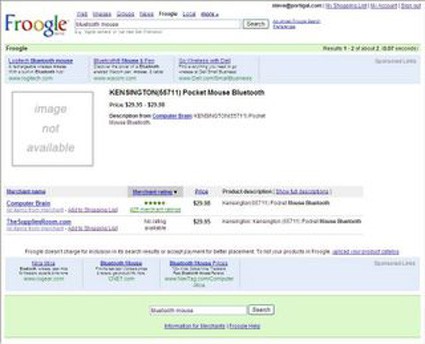
What the hell is wrong with Froogle?

We’ve got some quality control problems with Froogle. Maybe this is nothing new. I searched for “bluetooth mouse” and clicked on one listing to see the two results in detail. Here they are listed. The name of the product and the merchant, together.

bluetooth-mouse-froogle-3.jpg

I tried the first one and the product page they link to is actually for a screen protector, not a mouse.
kensington-55711-cling2-sc.jpg

I tried the second one and it prompted me for login and password, and then of course denied me access.
yahoo-401-authorization.jpg

Don’t be evil, sure. But don’t be lame, either.

Dirk sez Yahoo! = Wal-Mart


In Yahoo! = Wal-Mart, Dirk takes Yahoo! to task for all the crappy things they do; or more for their failure to do the great things that they could do with all their assets. And draws a comparison to Wal-Mart in the process.

I actually had to check a few times on the actual thesis of the post, because, of course, != is computer code for “not equals” so Yahoo!= suggests that Yahoo is NOT Wal-Mart. But in fact, Dirk is saying that they are.

I think his screed against Yahoo! is pretty well-founded, but I think (especially in a conversation about brand meaning), the Wal-Mart comparison is a bit distracting. Wal-Mart’s brand includes a number of powerful attributes that aren’t part of the argument – the stuff that engenders hatred towards Wal-Mart (squeezing out local businesses, screwing over employees) doesn’t apply to Yahoo. It’s hard to look at the two company’s brands without acknowledging this other aspect of their public face (despite Wal-Mart’s large efforts to divert from that). Google may own “Don’t Be Evil” (although no one believes them at all anymore and their hubris in claiming and then ignoring that may lead to some sort of downfall, if only a brand/meaning downfall), Yahoo! has not really ever stepped into that, but Wal-Mart (regardless of your feeling about the politics, and acknowledging that they have many many customers, some of whom undoubtedly love them unswervingly) definitely treads into (perception-wise) “Be Evil, You’ll Get Money” territory.

Wal-Mart also is a model for other companies in (some aspects of) how to do business. Their technological innovations in tracking inventory and shipping stuff around and adjusting prices dynamically is studied and perhaps copied (or lusted after) by other companies. What infrastructure or operational innovation of Yahoo’s is copied?

One commonality I do see is the great discomfort I felt upon entering both. A Wal-Mart store in Mountain View a few years ago was just…uncomfortable, and Yahoo’s main reception area a couple of years ago was twitch-inducing. The Yahoo! story is a bit funnier, I guess…the main reception area in their Silicon Valley HQ is a heavily branded environment. Lots of photos of previous marketing initiatives where, as far as I can tell, big stuff was covered with the Yahoo logo. Buses. Trains. Etc. A Yahoo store. Examples of co-branded Yahoo products in display cases.

Ahhhh, Yahoo is a marketing company, not a technology company. And meanwhile the lobby is filled with people awaiting their meetings, dressed up, tight smiles on their faces as the person with the checkbook comes down to great them chummily. Pheromones of fear and greed were flooding over me as I waited someplace safe. I stood near the reception desk and overhead a conversation “….I’m sorry. Mr. Potato Head is not available on Tuesday at that time. Not available until after 3.” Eventually I realized that they were talking about the name of a conference room!

Of course, once my friend showed up and we went into a normal building and the cafeteria and so on, my comfort increased to a normal level. But whoah, that reception area.

The sharpest knives in the drawer

Zippy profile of Oxo in the LATimes.

“We do a lot of shopping, we do a lot of talking to consumers and chefs,” Sohn said. “We do consumer testing, we do a lot of surveys, we talk to people we know, people our sales reps know, all over the country.”

Oxonians also apparently do a lot of yelling. Sohn said product meetings among the staff can be brutal, in a culture where criticism is not just encouraged but venerated.
…
Surprisingly, what Oxo does not do is design. The staff is made up of product managers and engineers, all focusing on the idea end. They then work with nine industrial design firms, including two in Japan, to translate pie-cutter-in-the-sky notions into eminently usable gadgets.

“The ideas of what to make and what features to offer come from here,” Lee said, then designers at companies such as Smart Design in New York and Bally in Pittsburgh do the rest.

Letter From Asia – Drive-by observations from Steve Portigal


Core77 has just posted my latest article, a travelogue- Letter From Asia.

Hong Kong is a visually stimulating city–where bright neon signs stretch horizontally out from the buildings across the road and electric boxes are covered with graffiti advertising household services. Storefronts open to the street, and service windows for snacks of every kind proliferate.

The standard line about Hong Kong is that it’s a shopper’s paradise. But Hong Kong shopping seemed to be more about the shallower pleasures of acquisition versus the immersive indulgence of massive choice . Take Tokyo as a point of contrast: Tokyo’s Akihabara (or Electronics Town) is a place to find all things electronic. If you want USB cables, you choose from myriad lengths, each in a large variety of colors and translucencies. If you are a Rolling Stones fan, in the Harajuku neighborhood you will find a tiny store with an exhaustive collection of trinkets, books, and assorted Stones ephemera.

But in Hong Kong, shopping is more about bounty; quantity over variety. For example, Mong Kok is a neighborhood with several shopping areas, including Sai Yeung Choi Street, where you’ll see a crowded street with small stores selling the very latest digital cameras, mobile phones, and MP3 players. Next door will be a similar store selling a similar selection of gizmos, and three doors down will be another branch of the first store…and across the street will be yet another branch of that same store. A few chains occupy many of the stores, seemingly with little specialization. The point seems to be that there’s lots of this stuff here, so why not grab some? It seemed to work–people were actively buying.

There’s more about Hong Kong, as well as Bangkok, and India.

NYT with two nice pieces on culture and entertainment

Two really excellent and thoughtful reviews in the NYT today. The new TV show Black. White. and a performance by Hasidic rapper Matisyahu. Both articles are insightful and funny and deal with entertainment and culture and race. Read the excerpts below for most (but not all) of the good stuff.

Black. White. is a show where two families (one black, one white) are made up and go out into the world as white and black, respectively. And there the hilarity er um I mean cultural insights ensue.

If reality television can be said to be about anything at all, it seems to be about impersonation and the odd and increasingly tenacious hold it has on the American psyche. The crooked-nosed are made over and play the genetically good-looking. Heiresses get out of their $200,000 sports cars and enact the habits of the agriculturally inclined. A vegan mother from Boulder trades houses with an evangelical wife in Mobile, is encouraged to care about scripture and breakfast sausage, and essentially tries to pass.

Reality television, as we know it, in fact, could exist only in a culture infatuated with passing – a world where white suburban boys dress to look more like Nelly and Punjabi girls from Queens wear blue contact lenses to link them closer in appearance to someone who might trace her lineage four generations in Laguna
….
The problem with “Black.White.” is the extent to which it inadvertently supports the foundations of Bruno’s reasoning, searching for examples of racial discrimination, as it does, almost entirely within the world of the consumer marketplace. The participants are too often sent out to stores to take the measure of race relations in America. “Black. White.” would have felt far more substantive had it sent Brian and Bruno, in their racial guises, out on a mission to procure high-end medical care or mortgages, say, rather than trousers and shoes.

When Rose and her mother, as black women, go out with an African-American friend, all pretending to look for jobs, they do so not in the offices of a small insurance company but in clothing stores in a swanky shopping district on the West Side of Los Angeles. The women are told that managers are absent or applications not in stock. (Leaving aside the possibility, however remote, that the responses were honest ones, it might have been faintly interesting then had the producers sent Carmen and Rose, as themselves, out to look for jobs in hair extension salons in Compton.) At any rate, the suggestion you’re left with – one similar to a point made some years ago in a controversial essay by Patricia Williams, an African-American law professor – is that the worst injustice a black person can suffer is to be denied the best treatment at department stores or the chance to sell expensive jeans in Santa Monica.

I thought Hasids doing “black” music were a joke (Rapping Rabbis) as old as Night Court (and we’re talking fifth season of Night Court lame), but there’s a big NYC/Brooklyn Jewish hipster thing going on and reggae singer Matisyahu is increasingly hot (and presumably not as hip at the same time). But no one ever talks about the rapper Curly Oxide (profiled a while back on This American Life).

The record is dull, and the concert was often worse.

Still, once you hear Matisyahu’s music, you may wonder why someone didn’t think of this sooner. The plaintive, minor-key melodies of reggae aren’t so far removed from the melodies Matisyahu would have heard, and sung, when he attended the Carlebach Shul, on the Upper West Side. And the imagery of Rastafarianism borrows heavily from Jewish tradition: Matisyahu is by no means the first reggae star to sing of Mount Zion, although he might be the first one who has had a chance to go there.

Matisyahu’s black hat also helps obscure something that might otherwise be more obvious: his race. He is a student of the Chabad-Lubavitch philosophy, but he is also a white reggae singer with an all-white band, playing (on Monday night, anyway) to an almost all-white crowd. Yet he has mainly avoided thorny questions about cultural appropriation. He looks like an anomaly, but if you think of him as a white pop star drawing from a black musical tradition, then he may seem like a more familiar figure.
…
Perhaps Matisyahu’s fans aren’t familiar with a little-known group of performers who still make great reggae records: Jamaicans. Maybe they are waiting for a shopping list of the best recent reggae CD’s from Jamaica. So here’s a start: Richie Spice, “Spice in Your Life” (Fifth Element); Luciano, “Lessons of Life” (Shanachie); Sizzla, “Da Real Thing” (VP).

Matisyahu has built a following by bypassing reggae fanatics (many of his fans come from the jam-band world). That explains why he outsells and outdraws his Jamaican counterparts. And it may also explain why some listeners find his music so exciting. Certainly no one seemed disappointed after Monday’s concert. And as the crowd filed out, a wry young black woman working the door could be overheard singing to herself. It was a line from an older reggae song: “Could You Be Loved,” by Bob Marley. “Don’t let them fool you,” she sang.

Series

About Steve