Tell me about yourself

myups.jpg

I’m an occasional user of MyUPS (although their failure to offer a daily email or RSS update to track a package is ludicrous) and when visiting the site this week I had to agree to their news Terms of Service and update my contact information. This sort of web form typically covers basic logistical information that someone who does business with you will need: address, billing information, etc.

But this time I was required to answer a question that was obviously tied to some market segmentation work they’ve done: which of these statements best describes you? with the following choices:

  • I don’t ship daily, but when I do, I want it to be quick and informative.
  • I use ups.com daily and know several shortcuts to save time.
  • I use ups.com to troubleshoot and to report on shipping activity.
  • I focus on the big picture and monitor shipping operations performance.
  • I prefer to use the web only when necessary. My job is easier without it.

First of all, it’s utterly inappropriate to require me to answer this question when I’m dealing with straightforward contact information that is necessary for UPS to have in order to provide the services I pay them for. Making them optional would be nice, but really this doesn’t go here at all. It’s hamfisted.

Second of all, it’s ludicrous to ask someone to find themselves in a badly written list such as this. What if I use ups.com daily but don’t know any shortcuts? Compound conditions are very hard for people to answer cleanly.

One has to wonder about the meeting where they decided this would be a good idea.

ChittahChattah Quickies

  • Kelly Erickson brings in Van Halen and our AIGA GAIN piece, and just about everything else into an enthusiastic rant “So, are you a bulldozer, getting through the day with your head down, plowing through your piles of work? Or a Zen professor, observing, wondering, and looking for connections? Have you trained yourself to slow down and notice?”
  • “It reminded me of my days as a student of graphic design and the noticing exercises we practiced. I still employ the same noticing tactics today but I had forgotten how important this fundamental principal is to marketing and visual communications.”
online pharmacy order clomid without prescription with best prices today in the USA

Wild and Free

ghost7_firefly_osaka.jpg
Me on bass, Firefly Club, Osaka, Japan, 2001

I had the TV on in the background the other night while I was doing some work around the house–I’ll admit it to you–I was watching E Hollywood True Stories, “Joe Francis Gone Wild.” (Francis is the guy who created Girls Gone Wild (NSFW))

Anyway…about halfway through the show, I heard a really familiar sound fading up in the background. I turned up the volume on the show, and, sure enough, it was a piece of a song from a CD I recorded a few years ago.

ghost7.jpg
ghost7, New Directions in Static, 2004

As the wow feeling of hearing something I had made broadcast this widely subsided, I started thinking about other aspects of the situation: shouldn’t someone have contacted me, shouldn’t I be getting paid for this?

And here’s where the irony, or at least the thought-provoking conundrum, begins.

I know how hard it is to earn a living playing music (or even just to cover your expenses). Yet I have, ahem, “friends,” who download all kinds of “free” musical content. And when I lived in Japan, I had other, ahem, “friends,” who rented lots of CDs from Tsutaya (the Japanese Blockbuster Video) and copied them onto MiniDisc to build their music collections, thus depriving the artists of their cut of a CD sale. (For a great breakdown of the traditional music industry business model, and a startling look at the reality of making a living as a musician, check out Moses Avalon’s website and book, Confessions of a Record Producer).

My initial self-righteousness about getting paid for the use of my music highlighted a clear differentiation I’ve been making between creative “product” that comes out of the “entertainment industry” and what’s made by people like me, whose primary livelihood is something other than their music, art, etc.

Now that any content placed in the public arena is almost instantaneously redistributable, whither goes the business model/s for creative production? Are songs-as-products becoming obsolete, to be replaced by songs-as-loss-leaders, a la the Starbucks/iTunes “song-of-the-week” card?

How, in this freewheeling new world, will it continue to be possible to shift enough units to pay for the production of something like a U2 album or a feature-length film?

dokken-george-lynch-will-play-for-food.jpg
CD Cover, George Lynch (ex-Dokken), 2000

New analysis covered over at O’Reilly on Radiohead’s 2007 “pay-what-you-like” experiment for selling their album, In Rainbows, would seem to support the loss leader model, with the attention generated by the online trading of the album seemingly as valuable as any actual money earned through paid downloading.

I’d add as well that firing up the tour bus remains an essential part of the prospect. Aside from tribute bands, no one’s found a way yet to pirate the live performance. (Although perhaps the scenario in Kiss’ 1978 movie, where the band is attacked by a lookalike robot band, suggests one possible model.)

phantom_of_the_park.jpg
VHS box, Kiss Meets The Phantom of the Park, 1978

But back to more grounded futuristic pondering. Is Karl Marx’ dream of making means of production accessible to ordinary people coming to fruition via peer-to-peer content sharing and the free flow of certain types of “raw materials?”

As the “redistributability” of content facilitated by the internet crossbreeds with technology and approaches like just-in-time production, 3D printing, and mass customization, will other types of product production also be wrested from commercial producers?

And will someone from E True Hollywood Stories please contact me about that royalty check?

Upgrading blog software

Let’s hope things stay intact.

Update: They didn’t. Sorry for the boringness and geekiness. 9 hours later and it was a nightmare. I upgraded to WordPress 2.6, and lost categories, tags, emailing posts and comments, but worst of all the blog page (https://portigal.com/blog) wouldn’t load all the recent posts but would redirect to a specific old post with “blog” in the title. Permalink problem?

No love fixing it, so then I did a manual rollback and learned about PhpMyAdmin and pasting in 44M of text in as queries to restore the contents of the blog. I actually learned a lot about doing it and maybe feel more confident trying this again; I have a bunch of not-that-exciting content (such as spam comments that are in the spam queue) that I’ll restore over the next few days, but wow.

Anyway if anything is not working, please let me know.

ChittahChattah Quickies

ChittahChattah Quickies

Note that the service that automates this is flaky right now so I’m going to do it by hand til they get themselves sorted. Or until I can implement a workaround. Sigh!

  • When pedestrians cross, by design, in all directions including diagonally. Associated with Shibuya Crossing (I presume by Westerners who have witnessed the dramatic mass of humanity) but originated in North America and making a comeback in urban planning.
  • SpinVox (a voice-to-text tech firm) reports that 73% did not like the way their voices sounded. “It seems Britain is being gripped by an epidemic of accent envy and accent self loathing. After decades where dialect diversity has been celebrated, the majority of Britons now aspire to received pronunciation – and to share the sound of their voice not only with The Queen but with celebrities like Liz Hurley and Hugh Grant.”

Framed framework/conceptual art

Upon entering the Visitor’s Centre at the Battersea Power Station we encountered an enormous graphic, printed on canvas, and mounted on the wall like a work of art.

Here’s a thumbnail (click to see it on Flickr – account required)
battersea-power-station-con.jpg or view it full size here.

Here’s a detail:
framework.jpg

It looks as if the team working on the redevelopment conducted (or simulated the output of) an in-depth brainstorm session and had someone illustrate the resulting mental map/conceptual framework/jargony-jargon-jargon. But this is a bit of insider cricket, so why is it presented like artwork and the first thing that greets a visitor? An odd, if intriguing, way of using an artifact like this.

Previously on Battersea Power Station

Also: see more of my London and Sheffield pictures here.

Travelling at Home

I spent some time last week walking around the area near our office in Pacifica. It’s amazing how often, when you break your usual routine, you find something fascinating and unfamiliar right around the corner. In this case, a whole pier fishing subculture, with its own set of tools, infrastructure, workarounds . . .

(Cell phone pix, so forgive the lack of detail)

fishing-pier-2.jpg
Fishing, Pacifica Pier

fishing-cart.jpg
Fisherman with homemade cart and pinups

online pharmacy xenical for sale with best prices today in the USA

fishing-pole.jpg
Fishing pole held in crack (price tag $11.96)

online pharmacy buy hydroxychloroquine no prescription pharmacy

fishing-scale.jpg
Catch and release measuring scale on lamppost

The space between yes and no as a local indicator

While in the UK recently I took advantage of an extremely rare opportunity to tour the long-closed Battersea Power Station. It’s an iconic part of the London landscape, known to many for appearing on the cover of Pink Floyd’s Animals.

The tour was basically a community open house, to try and drum up support/input for the redevelopment plans. Visitors were asked to complete a survey…

battersea.jpg

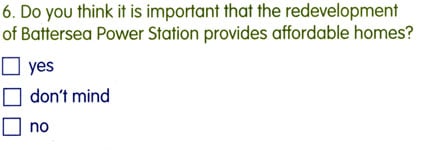
…and this question caught my eye:

dontmind.jpg

I really got a kick out of the localized UK English choices for the responses.

Also: see my pictures from the Battersea Power Station here and more of my London and Sheffield pictures here.

Previous posts on surveys:

Series

About Steve