Posts tagged “music”

ChittahChattah Quickies

  • Denny's is trying to restake its claim as a nocturnal hot spot for young adults. – The restaurant chain has been trying to set a different scene for night owls. Between the hours of 10 p.m. and 5 a.m. it pipes in rock and country music and it is scheduling after-concert parties for up-and-coming bands. It has added late-night menu items fashioned by well-known musicians including Rascal Flatts and Good Charlotte. On Tuesday, singer Jewel is slated to concoct a new Denny's menu item at a New York test kitchen.

    Denny's last year created the "Allnighter" program, which includes adopting emerging musicians and offering a "rockstar" menu for night patrons. It gives adoptees $1,000 in Denny's gift cards so they can eat while touring. Then, Denny's uses Twitter and MySpace to inform its target market of 18- to 24-year-olds when and where the adopted bands' after-parties will be held and when new menu items are added.

    The program itself hasn't been as big of a hit, though. The chain of more than 1,500 restaurants said late-night traffic has increased just 5%.

ChittahChattah Quickies

  • NEA Highlights from 2008 Survey of Public Participation In The "Arts" – There are persistent patterns of decline in participation for most art forms such as classical music, jazz, opera, ballet, musical theater, dramatic plays, art museums and craft/visual arts festivals [Seems a rather limited/traditional definition of "art" – no popular music? no stand up comedy?]. Fewer adults are creating and performing art. Weaving and sewing remain popular as crafts, but the percentage of adults who do those activities has declined by 12 points. Only the share of adults doing photography has increased – from 12 percent in 1992 to 15 percent in 2008. Aging audiences are a long-term trend. Performing arts attendees are increasingly older than the average U.S. adult (45). The aging of the baby boom generation does not appear to account for the overall increase in age. Educated Americans are participating less than before, and educated audiences are the most likely to attend or participate in the arts

Understanding the fan community

Ben Ratliff writes an interesting piece about Grateful Dead fandom (not the tie-dye, need-a-miracle twirling, but the tape trading/DAT-head/live show collecting aspect). The article offers a couple of provocative perspectives:

1. The hierarchy of fan expertise
At the basic level, people know about published material, beyond that fans differentiate between the different eras, then choosing between specific performances (known by date and venue), then songs within a specific performance, and ultimately thoughts about the provenance of a specific recording (which source, which remaster, etc.).
This level of engagement (it’s easy to call it obsession if it’s not your bag, of course) is not limited to Deadheads, of course. Being a long-time Rolling Stones enthusiast, I’ve experienced some of that progression myself (and certainly observed debates among many of my fellow travelers along pleasurably obscure details). Indeed, going from the first level (I know what’s on record) to the second (discovering the treasure trove of unreleased material that other fans are sharing) is an On Beyond Zebra experience, like that dream where you find that you’ve had another room in your house all this time.

2. Long-tail meets plenitude meets paradox-of-choice
I remember my earliest days on the Internet where the most active non-technical communities were for fans of either Star Trek or the Grateful Dead. The Internet offered a dramatically increased ability to connect with other collectors and trade cassette tapes by snail mail. But Ratliff describes the massive increase in availability over the past few years as broadband, iTunes, and other online digital sources provide ridiculously easy access to the nearly 2,200 available shows. As more shows become available to more people, the landmark shows that everyone used as a common reference point for “best” have less of a footprint.

My analogous experience differs from Ratliff’s (although liking the Stones is not exactly like liking the Dead): I don’t need to choose Taylor vs. Wood (two lead guitarists with markedly different sounds and associated with markedly different eras). Since I can now listen to a version of Satisfaction where the Rolling Stones essentially covered Otis Redding’s then-popular cover version, or a 9-minute version of Brown Sugar with horns, or a live version of a relatively-obscure album track that really bring the song home, I now have a broader and richer fan-listening experience. Listening and listening again and hearing new things over the years is sufficient; deciding the best isn’t ultimately that useful once you’re in a position to even make a reasonable distinction.

Deadheads and Stones fans are connected communities with passion and purchasing power and Ratliff’s article is worth reading for some insight on – at the extreme end – how those communities evolve and transact.

ChittahChattah Quickies

  • MediaMaster is shutting down – We did some really interesting user research to help define the overall value proposition, concept, and user experience. Exciting to see what they were able to do but obviously disappointing to see where it ended up a few years later. "Don’t wait for large corporate partners to make your business viable, it needs to be so on its own. Design it well from the start, it helps when you don’t have to re-engineer the interface, it’s the most complex part! (That was not a problem we had)"

User Research for Belkin’s GoStudio

gostudio_ls
We were excited recently to see the New York Times review of Belkin’s GoStudio portable audio recorder. We led some early user research with target customers that informed Belkin’s overall strategy for this product.

Among other things, our work revealed that people didn’t associate the iPod with the high quality audio they expected a recording device to deliver. As well, the iPod is rarely seen an ingredient technology for another experience; rather most accessories add on to the iPod, and convey that message through form, finish, interface, and even their overall story. We identified that Belkin had two paths they could go by: either embrace the iPod (as in iHome and other iPoddy products) or deny the iPod (and create their own visual and task language). It’s great to see that Belkin’s final design emphasized the aesthetics of professional audio gear. In fact, the New York Times picked up on this embrace/deny tension in their headline: Another Use for the iPod – As a Memory Card.

Wild and Free

ghost7_firefly_osaka.jpg
Me on bass, Firefly Club, Osaka, Japan, 2001

I had the TV on in the background the other night while I was doing some work around the house–I’ll admit it to you–I was watching E Hollywood True Stories, “Joe Francis Gone Wild.” (Francis is the guy who created Girls Gone Wild (NSFW))

Anyway…about halfway through the show, I heard a really familiar sound fading up in the background. I turned up the volume on the show, and, sure enough, it was a piece of a song from a CD I recorded a few years ago.

ghost7.jpg
ghost7, New Directions in Static, 2004

As the wow feeling of hearing something I had made broadcast this widely subsided, I started thinking about other aspects of the situation: shouldn’t someone have contacted me, shouldn’t I be getting paid for this?

And here’s where the irony, or at least the thought-provoking conundrum, begins.

I know how hard it is to earn a living playing music (or even just to cover your expenses). Yet I have, ahem, “friends,” who download all kinds of “free” musical content. And when I lived in Japan, I had other, ahem, “friends,” who rented lots of CDs from Tsutaya (the Japanese Blockbuster Video) and copied them onto MiniDisc to build their music collections, thus depriving the artists of their cut of a CD sale. (For a great breakdown of the traditional music industry business model, and a startling look at the reality of making a living as a musician, check out Moses Avalon’s website and book, Confessions of a Record Producer).

My initial self-righteousness about getting paid for the use of my music highlighted a clear differentiation I’ve been making between creative “product” that comes out of the “entertainment industry” and what’s made by people like me, whose primary livelihood is something other than their music, art, etc.

Now that any content placed in the public arena is almost instantaneously redistributable, whither goes the business model/s for creative production? Are songs-as-products becoming obsolete, to be replaced by songs-as-loss-leaders, a la the Starbucks/iTunes “song-of-the-week” card?

How, in this freewheeling new world, will it continue to be possible to shift enough units to pay for the production of something like a U2 album or a feature-length film?

dokken-george-lynch-will-play-for-food.jpg
CD Cover, George Lynch (ex-Dokken), 2000

New analysis covered over at O’Reilly on Radiohead’s 2007 “pay-what-you-like” experiment for selling their album, In Rainbows, would seem to support the loss leader model, with the attention generated by the online trading of the album seemingly as valuable as any actual money earned through paid downloading.

I’d add as well that firing up the tour bus remains an essential part of the prospect. Aside from tribute bands, no one’s found a way yet to pirate the live performance. (Although perhaps the scenario in Kiss’ 1978 movie, where the band is attacked by a lookalike robot band, suggests one possible model.)

phantom_of_the_park.jpg
VHS box, Kiss Meets The Phantom of the Park, 1978

But back to more grounded futuristic pondering. Is Karl Marx’ dream of making means of production accessible to ordinary people coming to fruition via peer-to-peer content sharing and the free flow of certain types of “raw materials?”

As the “redistributability” of content facilitated by the internet crossbreeds with technology and approaches like just-in-time production, 3D printing, and mass customization, will other types of product production also be wrested from commercial producers?

And will someone from E True Hollywood Stories please contact me about that royalty check?

2002 Flashback

Some years back, in Boston, I helped out on a shoot for Public Enemy‘s Revolverlution video. It was a lot of fun, and pretty amazing to hang out with such seminal artists. I was going through some old pictures today and came across some fun images from the shoot.

9cdmiss3_sm.jpg
A portrait of Chuck D, the idea man

dtsff_sm.jpg
My wife, Theresa, and me (with permed straight hair!) hanging out during lunch break with Flava Flav

peme1_sm.jpg
And one of the hardest rocking shows I’ve ever seen, at the Middle East nightclub in Cambridge, Massachusetts

Excellent times! Public Enemy has been consistently innovative, not only in their music, but in their willingness to experiment with new approaches to producing and distributing their work.

Rock and roll is a vicious game

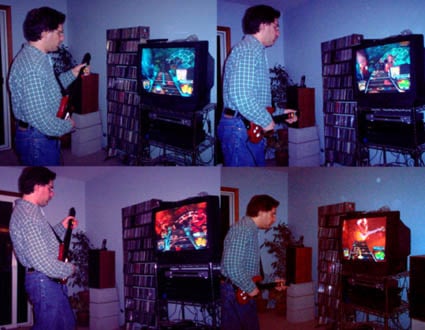
guitarherocollage.jpg
“Is that for your kids?” asked the Sears dude as he handed me the box. “Uh, my kids?, heh heh, it’s for me!” I managed as I headed out of the online-order-pickup station. [Yeah, Sears.com actually has something in their store if their website says they do; unlike Circuit City that shows an item available when you look on their website but when you visit their store it’s not on the shelves and if you can find a human who’s willing to help you, all you’ll hear is that they don’t have it. You lost a customer, Circuit City!]

Just last week I saw leaked footage (since pulled down) of an upcoming video game called Rock Band where a group of people perform a song (using guitar controllers, a drum accessory, and a microphone) and it just gave me chills. I realized I needed to get Guitar Hero, the existing predecessor.

I grew up playing video games. As a kid, we’d find any bowling alley or arcade and spend hours pumping in quarters. I used to hang out a dry cleaners (!) after school, playing whatever game they had. I got an ATM card and moved my bank account just so I could go next door to get $5 at a time in this afterschool activity. So why was I not doing it still? I had a PSX for a while; it was amusing, but it never really fit.

But this – the idea of a game that was about performing…I’d been hearing about it for a long time; stumbling across the video and subsequent conversation with friends was the motivational tipping point for me.

Wow.

The game is fun. It’s really really fun. This is an innovation around the notion of what a video game can be. Musical and performing games have been appearing for many years, such as PaRappa the Rapper, and Dance Dance Revolution, or the various precursors of Guitar Hero that one could find in a Tokyo arcade 5 years ago.

The idea of the game isn’t new, but is definitely novel. You hold a guitar, with five different buttons where frets would be. Instead of strings, there is a strumming bar. On screen, notes come towards you on a fretboard. When the note gets to the bottom, press the corresponding button on the fretboard and strum, zapping the note. Each level is a different song and the notes that play (or don’t, if you miss) as you zap ’em make up the guitar parts of the song. You are essentially playing the song, with enough realism that you get a real charge out of it.

Some nice touches make it really work. There is a great tutorial that explains how to play and how to use the controller. No need to page through the tiny print in a book and figure out what the heck is going on; they’ve designed an explicit learning interface.

As well, there are various levels, to enable you to have some success. We played on Easy, and it was tough at first, then become somewhat less tough with practice. And more fun, the better we got. We dabbled with the Medium setting and it was more fun to play. This blew me away. Instead of simply increasing the challenge (more monsters, smarter monsters, faster moving monsters), the game gives back more. The more intricate the pattern of notes you are sent, the closer you are to “playing” the song. It’s more fun and more engaging.

There’s a nice mode where you can go through any of the songs at a variety of slower speeds and practice the guitar parts. The songs are broken down into intro/chorus 1/verse 1/bridge/solo etc. so you can really focus on what you are trying to learn.

This is the best game I’ve ever seen and it’s a really nice implementation of some fresh thinking about what video games can enable.

We were amused to see the game featured in the New York Times today (although they referred incorrect to Stevie Ray Vaughan’s “Texas Flood” as “Texas Blood.” Nice).
15guit1901.jpg

Finally, the SF Chron featured this image, full-size, on their real estate supplement.
re_gen_y15_034_rad.jpg

Kids? Sheesh. This is the perfect game for my generation, young Sears dude.

A firehose in your ear

sxsw2007.jpg
You can (with a single download) get 739 mp3s by 739 artists from the SXSW festival. That’s a lot of music. As someone points out
on MetaFilter that’s over 37 hours of music. Someone else bemoans the organizational task that will create (I’m about to do that task myself).

I downloaded about half as many songs last year, and I really enjoyed them, but it’s an intimidating-if-wonderful gift.

Our digital technologies and the massive capabilities they afford us still continue to exceed or at least push the edges of our capacity as consumers. Indeed, the word consume may hold a clue. Do we consume music? Eat it up, digest it, and excrete/delete when we are done, or are we collectors, accumulating more and more? I imagine many of us are in straddle positions, not being ready to delete an MP3, or many MP3s, because we already possess them.

Update: am slowly working through listening to the songs…some real quality control issues with their distribution. One track with a skip in it, and about two dozen that are seriously truncated.

Series

About Steve