This Week @ Portigal

This week we continue to swim through an ocean of data from two concurrent projects.

  • Tamara and Julie are still poring over transcripts from New York and LA. We are looking forward to hosting our clients for another co-analysis session this week..
  • We are making sense of the transcripts and spreadsheets of data from our second project. Next up- outlining the key findings and drafting the presentation!
  • Steve is down in Austin for SXSW Interactive and a little vacation time. We look forward to getting the rundown when he returns.
  • What we’re consuming: Global Home, dim sum, homemade fortune cookies

ChittahChattah Quickies

‘Brogrammers’ challenge coders’ nerdy image [SF Chronicle] – It’s a bit of a silly story that turns a catchphrase into a cultural trend, but of course there’s something happening to drive the growth of the catchphrase. Sad that flipping the nerd stereotype reveals a sexist one.

Tech’s latest boom has generated a new, more testosterone-fueled breed of coder. Sure, the job still requires enormous brainpower, yet today’s engineers are drawn from diverse backgrounds, and many eschew the laboratory intellectualism that prevailed when semiconductors ruled Silicon Valley. At some startups the pendulum has swung so far in the other direction that it’s given rise to a new title: brogrammer. A portmanteau of the frat-house moniker “bro” and “programmer,” the term has become the subject of a Facebook group joined by more than 21,000 people; the name of a series of hacker get-togethers in Austin, Texas; the punch line for online ads; and the topic of a humorous discussion on question-and-answer site Quora titled “How does a programmer become a brogrammer?” (One pointer: Drink Red Bull, beer and “brotein” shakes.) “There’s a rising group of developers who are much more sociable and like to go out and have fun, and I think brogramming speaks to that audience,” said Gagan Biyani, co-founder and president of Udemy, a San Francisco startup that offers coding lessons on the Web.

Mr. Peanut’s Alter Ego Leads Kraft Into Planters Butter [Bloomberg] – Surprising not to see any mention of Kraft Peanut Butter, the Canadian product that pretty much defines peanut butter in that market.

Mr. Peanut has a stunt double. Sporting a goatee, aviator sunglasses and overconfidence, “Doug” performs death-defying feats that always end the same way: with him getting crushed and turned into peanut butter. Doug’s daredevil act is part of Kraft’s move into the crowded U.S. peanut butter market. In what may be the most overdue brand extension in history, Kraft is using the 100- year-old Planters brand to spark growth in its mature grocery business. Kraft is targeting adults, who consume two-thirds of the $1.8 billion of peanut butter sold in the U.S. each year, Kraft was looking for an adult mascot and settled on Doug, voiced in Web ads by Kevin Dillon in an homage to the hapless Johnny Drama character he played on HBO’s “Entourage” series. “Peanut butter was a natural extension,” Schmelter said. The new spread and Peanut Butter Doug, as he is formally known, are signs Kraft is getting more aggressive with the grocery business, said Alexia Howard, an analyst for Sanford C. Bernstein & Co. in New York.

Internet Archive’s Repository Collects Thousands of Books [NYT] – Digital technology allows rapid content creation, and creates interesting archiving challenges. First all the digital data was worth preserving. Then digital was a method to archive the physical world. Now we’re going all-in and trying to archive the physical world itself. Seems like a setup for a Steven Wright joke (didn’t he describe his full-scale map of the US and the problems he had folding it?).

“We want to collect one copy of every book,” said Brewster Kahle, who has spent $3 million to buy and operate this repository situated just north of San Francisco. “You can never tell what is going to paint the portrait of a culture.” As society embraces all forms of digital entertainment, this latter-day Noah is looking the other way. A Silicon Valley entrepreneur who made his fortune selling a data-mining company to Amazon.com in 1999, Mr. Kahle founded and runs the Internet Archive, a nonprofit organization devoted to preserving Web pages – 150 billion so far – and making texts more widely available. But even though he started his archiving in the digital realm, he now wants to save physical texts, too. “We must keep the past even as we’re inventing a new future,” he said. “If the Library of Alexandria had made a copy of every book and sent it to India or China, we’d have the other works of Aristotle, the other plays of Euripides. One copy in one institution is not good enough.” Mr. Kahle had the idea for the physical archive while working on the Internet Archive, which has digitized two million books. With a deep dedication to traditional printing – one of his sons is named Caslon, after the 18th-century type designer – he abhorred the notion of throwing out a book once it had been scanned. The volume that yielded the digital copy was special. And perhaps essential. What if, for example, digitization improves and we need to copy the books again?

Myq Kaplan Gives Birth to a Stand-Up Joke [NYT] – The prototype/test-with-users/iterate process of designing a joke.

The first week is arguably the most creative in the life of a joke. For Mr. Kaplan it’s all about generating ideas. What could explain this jacket convention? Maybe, he speculated, jackets were once very cheap and, as he would later say onstage, “men wore seven coats out, hoping it wasn’t an eight-puddle day.” He also decided that the modern equivalent was leaving the toilet seat down. All these ideas were transformed into jokes as the bit expanded. Setups shrank. Punch lines multiplied. The jacket over the puddle soon became one of several examples of chivalry that began with his pantomiming opening a door after asking the audience: “Does it detract from chivalry if, when opening a car door for a lady, I say, ‘Chivaaalry!'” He dragged out the last word in the self-satisfied voice of a magician introducing his assistant. A coarse joke about chivalry during sex replaced the homeless-man line. By early January Mr. Kaplan’s rhythm became more assured and moseying, lingering on pauses, finding extra laughs between punch lines. His typical stage pose – leaning back, his free hand placed gently on his stomach as if he were pregnant – became looser, adding touches of showmanship. It didn’t matter where he performed (clubs, restaurants, even a hostel), chivalry always worked. The focus now was on getting the right laughs. It was important, he thought, to get a big one right at the start with his car-door opening, and in paring it down, he turned a question (“Does it detract from chivalry…”) into a statement. Later, he brought back the question. Laughter marginally improved.

Lucy Kimbell: Expanding the visible and sayable

This interview has been edited, condensed, etc.

Lucy Kimbell works as a designer, educator and researcher. She is head of social design at the Young Foundation in London and associate fellow at Said Business School, University of Oxford. As an undergraduate she studied engineering design and appropriate technology and made feminist performance/theatre. What she does these days does not look that different. Find her on twitter: @lixindex

Tell us about your work!

Lucy Kimbell: Over the past decade I have worked in a range of contexts, from academia to art to design. I have been able to move fairly fluidly between what might seem quite distinct fields, at a time when innovation and creativity are supposedly what’s needed to address global, community and organisational challenges but when artists, designers and others are not necessarily good at explaining how or why what they do might be relevant or productive, and the effects of their work are as varied as anything else.

In January I started a role as head of social design at the Young Foundation, a 60-person organisation working in the UK and internationally to trigger and support social innovation and venturing. Basically my role – which is new for the organisation – is to explore how practices within design and the arts can help support creating social (in the sense of civil society) ventures and projects. My brief is to build up the Young Foundation’s capability, rather than building a design team. There are lots of other examples of this shift both at government level (like Mindlab in Denmark or TACSI in Australia), and other activities initiated by consultancies and by universities and corporates. I’m hoping to be able to combine some of the ideas I’ve been exploring teaching design to MBAs at Oxford University for the past six years, research I’ve done in design thinking and designing for service in particular, and my own art/design making practice. The latter has dwindled although my Physical Bar Charts have been shown a few times in the past year including at TEDGlobal in Edinburgh and a show at Palazzo Strozzi in Florence. Right now I’m setting up a critical reflective conversation about all this stuff, with a series of talks and seminars co-organised with Guy Julier (University of Brighton/Victoria and Albert Museum) and the people at Policy Connect.

tOp: How do you define “technology?”

LK: I don’t think of technology as something that exists outside of people and what we do, who we are, and how we live and work. It’s not a thing, it’s not other, but rather is part of being human. We’re not human without the things we currently call technologies, whether these are Google, or management fads, or pencils. I think of the things often called technologies as stable arrangements or configurations that are a result of the ways humans and material/digital artefacts come together, at specific times and places. But they are not just results; they also shape how things are and how they could be. So our relationship with technologies are changing – who we are as human beings and the cultural practices within which we come to be those people change with this.

tOp: What do stories about technology reveal about our culture and our relationship with technology?

LK: This question makes me wonder who is telling these stories, who is engaging with them, and where they are circulating. The stories I see on TV in the form of adverts are more or less the same as they have been for several decades: This new device/network/thing will help you become a different, better person! more lovely! more effective! will make you become a more connected family! help drive sales! And so on. More or less the same but perhaps with higher levels of anxiety? Then there are the narratives that are often outside of corporate culture, of resistance, and alternatives, and questioning of assumptions. One of the interesting things about the Occupy movements in Western/Northern cities last year was resistance to advancing a totalising alternative – a narrative of what the right answer is. I suppose what I see is narratives about technology being mobilised for quite distinct purposes and there are probably examples of everything.

tOp: What are the factors that influence how (or what) technology is being developed?

LK: Every now and then I hear about a bubble-world I am not familiar with which is focussed on technology for example in healthcare innovation. And as an outsider I am struck by how existing practices in a particular sector constitute differently what the technology question is – what they hope a thing they call technology might be able to do for that sector. These vested interests and ways of thinking about what “technology” can do, whether they are professional or corporate or in the realm of public policy, have a big role in shaping what technology research programmes take shape.

tOp: How do you think technology is changing everyday lives for mainstream consumers?

LK: I wouldn’t say that technology is changing their lives, but rather that new configurations or arrangements of people and things come into being and stabilise and so what is possible, or expected, or what is at any point in time the regular way of doing things, changes. And material and digital techniques, tools and artefacts are part of this but so are the way people use them, adapt to them, break them or improvise in relation to them. So I would say that what it is to consume or rather be constituted as a consumer in relation to possible practices of consuming changes. My consuming as an affluent London resident living within a straight family involved in a global elite of educators and design innovators is different to other consuming I was involved in when I was younger, single, not a parent, less affluent and so on. Technological artefacts are part of that but are not the (only/main) drivers.

tOp: Your working definitions for “technology” and “consumption” seem close to each other. How do they relate?

LK: To be a consumer in an affluent society now involves lots of what in ordinary language we call technology. To be a teacher or student, to be a parent, to be someone who works in a supermarket, to be a bus driver, to be to be a person who goes out in the evening, to be a person who has a garden in a city, to be a person operating in the art world, all of these involve technologically-mediated practices.

tOp: What kind of impacts is technology having on your own life?

LK: My partner and I are finishing a major house refurbishment where we live in London. We sourced many of the buliding materials as well as furniture and fittings via eBay and Freecyle. Not just shelving and beds but also windows, doors, flooring, insulation, radiators, toilets, showers, ovens, tiles and so on. Rather than saying technology had an impact on how we did the refurb, I would say we developed some new ways of living and building, as we increased our skills and knowledge about how to source, price, bid for, exchange, pick up, transport, store, make use of and dispose of all the stuff that is involved in constructing a house. Digital networked technologies have made this possible through giving us access to platforms where people want to give away or sell their unwanted items, and allowing us to search for and research what we need, and get things transported if they are far away, and get input from the architect when we needed it. The carbon and materials costs are not very visible in these transactions but they should be.

Compared to other projects of this size, we may not have saved money (we saved on buying materials but then the contractors had to do lots of non-standard activities to fit or use them) or time (it’s taken two years). But there’s a satisfaction in knowing that the ash floor was picked up from the street where someone had thrown it out, and the gas hob, insulation, sliding windows, toilets and many other things would most likely be in landfill. We’ve paid for them not to be there, through our labour and through paying for adapting our building process to what’s available and when it’s available – a middle-class luxury, in one sense, but also a kind of living out of our values. So the technologies we used made all this possible in ways that we (and probably their designers and manufacturers) would not have foreseen.

tOp: As a society, do you think we are losing or gaining anything with these changes?

LK: I have the hope that the practices and devices that come into view through these changes support wider access to resources, enable participation in decision-making of people who have been excluded or marginalised, increase transparency and accountability, and reduce the effects of climate change. But I don’t think the technologies/practices that we now have that we are learning to live and work with do not necessarily do any of these things per se, even if their designers or funders or champions want it to be so. You can see the influence of the ethnomethodologists and ANT researchers on me here – it all depends on the local, the specific, the what is – I’m avoiding making generalisations, sorry. What remains an always open and public question is the what could be. Art and design practices have very powerful ways to constitute and involve people in collective imaginaries and in particular disrupt the current ones by doing what the French philosopher Jacques Ranci?®re calls expanding what is visible and sayable in the distribution of the sensible (le partage du sensible).

tOp: Is your own work meant to provoke those imaginings? Who do you regard as influential in expanding the visible and sayable?

LK: I asked someone else a version of this question recently and after a long pause, the answer was…hmmm… Bourdieu, Wittgenstein… To be a bit more 2012 I have a whole long list of makers and writers and researchers and educators who provoke me to imagine (although I also like Bourdieu). Within design, this includes the people in the School of Design Strategies at Parsons in NY, Ezio Manzini in Milano, Thomas Binder in Copenhagen, Pelle Ehn in Malmo, Jon Kolko at Austin Center for Design, Nathan Shedroff at CCA, small consultancies like the fashionable young men at Berg London, or the people constituting new digital publics at Futuregov. Within the arts, practitioners like Nina Pope and Karen Guthrie of Somewhere, Heath Bunting or Natalie Jeremijenko. Within the social sciences people like Noortje Marres and Nina Wakeford at Goldsmiths and Cat Macaulay at Dundee. The people behind the Kenyan comic cultural enterprise Shujaaz. Some people I met yesterday who run a hostel for homeless people in Soho. The three Roca brothers who run El Cellar de Can Roca in Gerona, Cataluyna. The producers and writers and actors of TV shows like True Blood and The Wire. The people of the city of Homs in Syria. I seem in recent years to be located (to locate myself) in a way which asks me to be quite careful about how I do any disrupting which is the price of my institutional reconfiguring. It’s too early to say what that’s doing to my imaginaries.
This Week @ Portigal

This week is all about data, and making sense of it

  • We’re poring over transcripts from New York and LA. We’ve killed a lot of trees with our printouts; everyone is heads down reading through interviews and making notes. Our clients are coming over for a no-doubt lively session of storytelling, analysis, debate, sticky-note madness, and pattern matching.
  • We’ve put a stake in the ground over last week’s multi-method mayhem; sharing a topline summary with those clients (now safely back at home overseas) and staging the next round of transcripts and analysis.
  • I’m off to Austin later this week for SXSW Interactive and then hanging around for some vacation time at the film festival, with some live music, tacos, and BBQ thrown in for good measure.
  • What we’re consuming: Laser Quest, The Ice Cream Bar.
  • online pharmacy order singulair no prescription with best prices today in the USA

Interviewing past the platitudes

From this past Sunday’s New York Times, a review of Craig Taylor’s “Londoners”:

Taylor devoted five years to collecting the material for “Londoners.” He gathered stories from all 32 boroughs, conducting formal interviews with more than 200 people, running through 300 tape-recorder batteries and taking down enough notes to generate transcripts of more than 950,000 words. Fewer than half the people he talked to made the final cut. Some interviews took months to set up and lasted just a few minutes. Others went on for hours.

The reviewer, a journalist herself, makes an excellent point about the challenges in interviewing:

Anyone who conducts interviews for a living knows how hard it can sometimes be to get subjects to move past cant and cliché, to leave the platitudes and drive on to the good stuff. (How many articles feature people expressing “shock and sadness” at their neighbors’ personal tragedies or noting that a murder victim “kept to himself”?)

buy https://aspenpharma.com.au/wp-content/uploads/2009/04/prednisone.html online https://aspenpharma.com.au/wp-content/uploads/2009/04/prednisone.html no prescription pharmacy

Collecting soundbites is easy; the trope of the soundbite is so well-entrenched that most anyone will perform one in the right circumstances. Sometimes those soundbites feel – to the interviewer – like nuggets. It’s up to us to understand the difference between performance that we’re eliciting and a comment or observation that leads us towards insight.

Note: For more “Londoners” Taylor himself has an essay elsewhere in Sunday’s paper.

ChittahChattah Quickies

P&G gets innovative [Cincinnati.com] – The process behind Tide Pods includes lots and lots of research such as “talking” to 6,000 consumers. It appears this research was all done in simulated environments. I am bemused by the willing self-deception that if you put a couch in a lab, it makes the research contextual. I’d like to see P&G watching people do laundry in their real, non-idealized, messy, distracted, semi-functioning environment. Because then maybe you’d get takeaways richer than “Most laundry-doers are looking for a way to get it done faster.”

Inside the Beckett Ridge “home,” P&G researchers interviewed regular people as they sat in the comfortable couches of a mock family room or at the counter of a mock kitchen. They did the wash in a fully functioning laundry room. Through it all, they were videotaped and audiotaped, so P&G can capture how the wash gets done in a real-world setting…Back at Beckett Ridge, researchers worked on the packaging and the store display. Inside the “grocery store” with its six aisles, two checkout lanes and a self-scan lane, cameras are everywhere, recording how shoppers shop. The video feed can be streamed to any P&G Intranet site so questions and comments can be called in.

Never Too Early Movie Predictions – Sure, if we care at all, we’re still digesting the most recent Academy Awards. But forgot about 2012, this site has predictions through 2017. Sheesh, I haven’t seen any of these movies! Another moment where the corners of the Internet remind you that everyday life is filled with some genuine science fiction moments.

2015 Oscar Best Picture predictions
1. Noah
2. Citizen Hughes: The Power, The Money And The Madness
3. Churchill And Roosevelt
4. Avatar 2
5. The $700 Billion Man
6. The Color Of Lightening
7. Serena
8. Americana

Young Women Often Trendsetters in Vocal Patterns [NYT] – I had missed the original “vocal fry” hubbub a few months back, but I also enjoy how this article reframes young-female speech into a positive, leading-edge anthropological act.

Girls and women in their teens and 20s deserve credit for pioneering vocal trends and popular slang, adding that young women use these embellishments in much more sophisticated ways than people tend to realize. “A lot of these really flamboyant things you hear are cute, and girls are supposed to be cute,” said Penny Eckert, a professor of linguistics at Stanford. “But they’re not just using them because they’re girls. They’re using them to achieve some kind of interactional and stylistic end.” The latest linguistic curiosity to emerge from the petri dish of girl culture gained recognition in December, when researchers from Long Island University published a paper in The Journal of Voice. Working with what they acknowledged was a very small sample – recorded speech from 34 women ages 18 to 25 – the professors said they had found evidence of a new trend among female college students: a guttural fluttering of the vocal cords they called “vocal fry.” A classic example of vocal fry, best described as a raspy or croaking sound injected (usually) at the end of a sentence, can be heard when Mae West says, “Why don’t you come up sometime and see me,” or when Maya Rudolph mimics Maya Angelou on SNL.

online pharmacy buy desyrel no prescription with best prices today in the USA

Plastic Surgeons See iPhones Increase Demand for Cosmetic Procedures [Austin-Weston Center for Cosmetic Surgery] – It’s hard not to be cynical about this “press release” in which plastic surgeons tie the need for their services to a particularly hot tech brand. If you do this (the wrong way, at least) in China, you can get into trouble!

“Patients come in with their iPhones and show me how they look on [Apple’s video calling application] FaceTime,” says Dr. Sigal. “The angle at which the phone is held, with the caller looking downward into the camera, really captures any heaviness, fullness and sagging of the face and neck. People say ‘I never knew I looked like that! I need to do something!’ I’ve started calling it the ‘FaceTime Facelift’ effect. And we’ve developed procedures to specifically address it.” (via Kottke)

draw me in – Jeff Johnson’s quest to become a comic book extra. The best summary of the project – yet another example of the collapsing gulf between producer and consumer comes from this Wired article (quoted below).

Popping up in nearly 30 comic books, he has become the industry’s Waldo-a lurking stowaway who has managed to hijack the unlikeliest panels. “It’s the ultimate bragging right to go into a comic store and pick up a book you’re in,” says Johnson, a 30-year-old Kmart electronics clerk from Leavenworth, Kansas. His infamous glasses-and-goatee mug has been zombiefied (The Walking Dead), digitized (Tron: Betrayal), and placed alongside Sinestro (Green Lantern Corps), thanks to his ceaseless lobbying and the cooperation of artists. The idea sprang from a 2006 FHM contest in which entrants sent pictures of themselves in homemade costumes of villains; the winner (if you want to call it that) was drawn into Ultimate X-Men. Johnson didn’t want to dress up, so instead he handed out DrawMeIn flyers at Comic-Con, after which penciler Ryan Ottley worked him into Invincible.

This Week @ Portigal

This is an intense, single-focus week for us

  • We are hosting a dozen or so clients from overseas. They’ve shipped over their working (we hope) science-fiction-like prototype which we’ll be showing to a huge number of people, using a method (for the first time) called Central Location Testing (aka CLT). Over a few days, we’ll also be visiting some of those same people in their homes to talk further about how this product might be used. Probably our most intensive data-gathering three days ever.
  • What we’re consuming: Lucky Peach issue 3, MacGyver, Gary Shteyngart.

From Dublin, presentation videos of the IxD12 Student Design Challenge

We’ve got video of the four finalists giving their presentations. You can see their slide decks here.


Grand Prize: Priscilla Mok

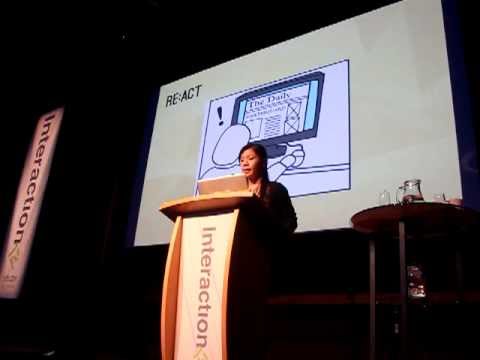
@Interaction12(Dublin)- Priscilla Mok presents her idea on 'Future of News'


1st Runner Up: Diksha Grover

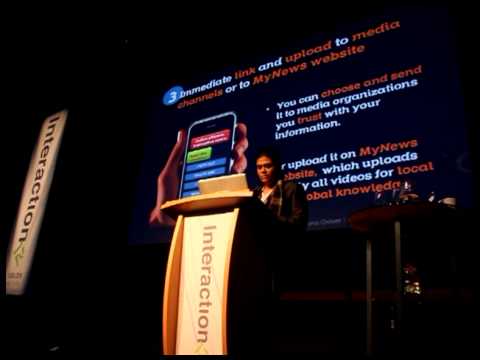
Interaction12(Dublin)- Diksha Grover presents her idea on 'Future of news'


2nd Runner-Up: Siri Johansson

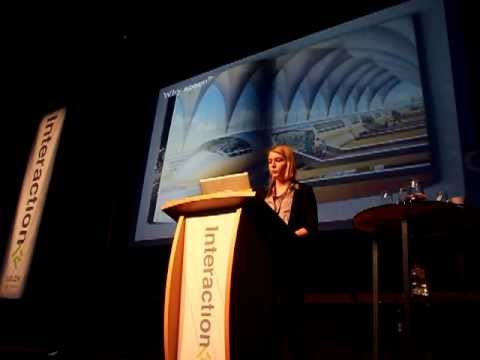
@Interaction12(Dublin)- Siri Johansson presents her idea on 'Future of News'


Honourable Mention: Jaime Krakowiak

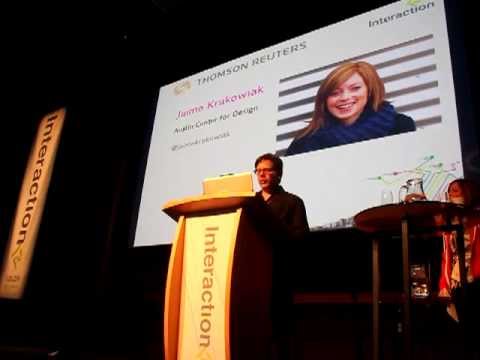
@Interaction12(Dublin)- Jaime Krokowiak presents her idea on 'Future of News'

Out and About: Julie in NYC

There’s no better place than New York for the casual wandering photog. And no better way to unwind between interviews than wandering casually. Tamara shared her observations from last week’s trip; here are a few of mine.


An ambitious seeker-of-companionship slipped this onto the subway; an attempt at old-school social networking, ironic in its particular placement. It’s author provides a few interesting and wholesome-sounding options (library, the zoo, coffee date) to entice people to respond to this rather salacious-seeming invitation. Who calls, I wonder? And don’t they know that with Google Voice they can link those two numbers?


Surprisingly lifelike and expressive, for mini-robots cobbled out of plastic scraps.

A few of my pictures wound up revealing accidental compositional synchronicity. That’s one of the joys of taking photos – along with being obvious documentations of what I ran across, I often discover something new when I get them back and reflect on them:


When I took this, I only saw the blue face. And yes, this is the correct orientation of the photo!


The colors in this juxtapostion of the utilitarian and the ephermeral echo each other.


I like taking pictures of poles for the way they can surprisingly and dramatically bisect a scene. And because people put stickers on them. The little face sticker here is obviously a product of the same person/people who slapped up a little sticker I snapped on the other side of the country, at Venice Beach, just two weeks prior – the LA one reads, “Enjoy You” rather than, “Gain You.” Interstate sticker-art pattern! Theories?


Red, yellow and blue syncopate in a Brooklyn subway entrance, in a way that put me in the mind of Mondrian’s Broadway Boogie Woogie. Jazzy patterns abound, waiting for us to notice them.

Out and About: Tamara in NYC

Last week Julie and I got to take a bite outta the Big Apple and take in the sights, sounds and sensations of the city streets. Here are a few highlights and memorable moments from the adventure…

Fired folks aren’t the only ones profiting from their appearance on The Celebrity Apprentice. I am not convinced that a restaurant appearing on this show implies endorsement of a quality culinary experience and while the stock photo certainly has the flavor of Reality TV, it doesn’t say “appetizing” to me.

These guys were camped out in front of a Foot Locker store in anticipation of the arrival of the new Nike Foamposite Galaxy a week later. I imagine this is very common, but I honestly can’t think of anything in life that would compel me to camp on a city street for one week.

I initially appreciated the tenor of this little letter to Residents until I got to the end. From, Porter. felt so impersonal! Unless of course, that is his name…

Poetry in motion! Thumbs up to the NYC Department of Transportation for adding a little beauty to the urban landscape.

Series

About Steve