Livestrong magnet

You don’t have to wear the bracelet now, you can get a magnetic picture of a bracelet. It’s not about the act of wearing, it’s just about the image of the bracelet? Where does the meaning reside?
You don’t have to wear the bracelet now, you can get a magnetic picture of a bracelet. It’s not about the act of wearing, it’s just about the image of the bracelet? Where does the meaning reside?

Faced with growth that they aren’t prepared to handle, the company that makes Moleskine notebooks is planning on selling itself. An atypical (idealistic? honorable?) response in these days of leveraging brand equity, extensions, cross-marketing, product placement, and the like.
Via Kottke.

Thanks (one suspects) to the South Park Character Generator, it seems that Air Arabia has been using familiar looking characters on their website. Unexpected things can happen when DIY design tools are put out there. Via MeFi
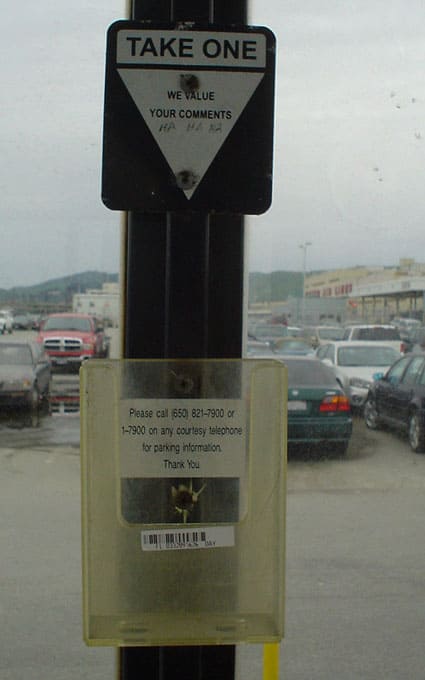
These feedback forms in the SFO Long Term Parking bus shelter are always empty. Someone has written Ha Ha Ha as a sarcastic bit of feedback, presumably about the implied hypocrisy of an unmaintained feedback mechanism.
There’s a phone number (that would ideally be covered by feedback forms) that you can call from a telephone (if you’re carrying one) or a courtesy phone (once you get into the airport itself, a 10 minute drive away), for parking information. Parking information? You’ve already parked, if you’re seeing this. The sticker is out of sync with the feedback form holding function.

I was in Houston a few weeks ago and saw this Buddha-like Ronald inflatable. Perhaps Ronald is our new prophet.
37Signals responds to my earlier posting (about their mocking of customer feedback on their blog). I’m resposting it here.
I’m the author of the post at Signal vs. Noise.
We didn’t ridicule/mock our customers with this post nor did we intend to. We used our customers own words. We quoted directly. If you feel that quoting someone directly is equivalent to mocking them…well, we disagree.
This is disingenuous. As one example (and there are millions), go watch The Daily Show – it makes extensive use of direct quotes, but the mocking is quite evident. What is said before and after, and what pieces are chosen are highly editorial decisions that convey a point of view. Don’t you know this?
Fwiw, we don’t think the requests were stupid and we do value customer feedback. We showed theses comments so people can see the different realities that exist for individual customers vs. companies vs. the customer base as a whole.
Why share this info at all? The truth is these sorts of conversations are happening all the time in companies all over. Is it better that they be hidden from the public or is it better to have an open, honest dialogue about them?
Why the forced choice question? There are more than two options. For example, the option you guys chose. That wasn’t an “open, honest dialogue” by any means. Why not invite those individuals to participate, let alone consent, if you want such a dialogue?


Spotted on BoingBoing is this special toilet paper just for kids. It’s printed with a puppy paw path that spans five sheets (and then begins again). It’s portion control for toilet paper, presumably there is a need to have kids learn how much to use? I’m a bit confused as to the actual need, and how this solves it. Wouldn’t the amount needed depend on what is being wiped? And who is being wiped?
I’d guess you’d want to teach kids to wipe until they are done – to pay attention to the bodily and other cues (visual?) to ensure that the hygiene need has been handled. Making it such an inflexible system doesn’t teach anyone anything!
And if you use a different amount than five sheets, ever, then the system breaks until you sync up back to sheet zero with the happy puppy. A training system that is intolerant of (highly likely) user error is not a good training system.
You must always use five and only five sheets. Regardless of what’s going on with your po-po! Cottonelle has forgotten that they work for us, not the other way around.
And their site includes this lovely FAQ (which is such as misnomer, since these are not likely to be frequently-asked-questions, but rather info they wish to convey) that suggests some product problems besides the obvious usability failures.
Why is my toilet paper printed on the inside? How do I fix this?
The good news is that this is an easy fix. The toilet paper isn’t actually printed on the inside. What’s happened is that the two plies have become separated, and the inside ply is wrapped around the outside of your roll (you’ll probably also notice that the perforations on the two plies don’t line up). To fix, first make sure your toilet paper is positioned so that it unrolls from the spindle with the sheets coming over the top. Next, steady the roll so it does not move in the spindle. Take the top ply (make sure you are only handling one ply) and unwrap it behind the roll. The print should now appear on the outside, as intended, and the bottom ply should now be longer that the top ply. Tear off the excess bottom plies (approximately 3) and you are ready to go.
and When I tear the toilet paper, the perforations on the two plies do not line up? How do I fix this? which offers the identical answer.
Now we’re taking on toilet paper maintenance tasks? Who the hell wants to fix their toilet paper? This is way too much work and this company hasn’t a clue about addressing real people’s needs.
Mashup or Mashed Potatoes? A report from the Stanford Graduate School of Business looks at haute cuisine for insights about breaking category boundaries to create innovation. Their observations:
And from the report itself
In many cases, says Rao, categories sit on ideological fault lines. In the Italian wine industry, for example, a battle is ensuing between entrepreneurs who are turning winemaking into a chemistry business and those who want to retain the old, slower way of production that reflects an entire traditional way of life. “What managers need to realize is that a lot of times they’re operating in cultural space,” says Rao. “If they don’t come up with new ways of doing things that take this into account, their businesses can sometimes be hit hard.”
I have completed the mammoth task of editing and posting all my Asia pictures to flickr, with the completion today of the set from India (Mumbai and Bangalore). Previously: Bangkok and Hong Kong
. All told, about 650 pictures.
Whew.
I’ve written two long pieces (and many smaller pieces on this blog) about our trip. An article for Core77 here and a more personal assessment here.
The process of taking time and reviewing the pictures with increasing distance from the event is pretty interesting, giving me a chance to reflect and revisit, to see things that I certainly didn’t see at the time I opened the shutter, and through the interactions on flickr, to gain insight and clarifications about things I observed but did not understand, especially with the pictures from India, where a pretty good dialogue has emerged (seen in the comments posted on the various pictures in that set Oops, not any more). The document of the experience is scattered, the interactions are scattered, but as the publisher of this content, I’m personally at the hub of all of it, so I’m taking full advantage. But clearly technology (even the ability to take several hundred pictures on a two week trip) is enabling some powerful behaviors; we know this, of course, but stepping back and noticing it is always pretty cool.


From House & Garden comes this awesomely negative review of Karim Rashid’s new book
.
Considering the chutzpah of the basic conceit, I expected Rashid to pepper the volume with absurd pronouncements. To my great disappointment, the most shocking thing about the book is the banality of the designer’s advice: “If you’re short, don’t worry about it.” “Clip and trim your nose hairs.” “Make friends online.” “Know yourself.” Try to imagine Dr. Phil grooving on some pharmaceuticals at the Milan Furniture Fair and you start to get the picture. Predictably, the book is rife with evidence of Rashid’s narcissism, but even those passages don’t relieve the painful tedium.