On Every Street

p1000565.jpg
Old and run-down business goes away, omnipresent Dunkin Donuts comes in. One shouldn’t infer timing, nor cause-and-effect, of course. But perhaps signs of the times?

Meanwhile, a recent post on Bostonist maps out the density of DD in nearby Boston.

I figured I’d be eating some donuts on that trip, but I did not. I was quite excited to see a Tim Horton’s (a rare sighting in the US, especially away from a Canadian border) and ran in to get a butter tart (a dessert fave). Yum!

ChittahChattah Quickies

ChittahChattah Quickies

Green? Ennh, problem solved. Almost? Um, not quite.

Greenwashing

is the unjustified appropriation of environmental virtue by a company, an industry, a government or even a non-government organisation to sell a product, a policy or to try and rehabilitate their standing with the public and decision makers after being embroiled in controversy.

Frankly, after some talks (more of the same stuff we’ve been hearing for a while) at the recent IDSA Shift conference I feel like designers and other eco-do-gooders are as guilty of greenwashing as the supposed evil corporate fat cats. We face a barrage of examples that are dramatically missing the real details. If you want to make the case that we need to solve the world’s problems, that’s one thing. If you want to make the case that design and designers are solving these problems, that’s another.

The barriers to innovation and change are political, financial, cultural, not a lack of smarts, gumption, or whizbang know-how.

Lifestraw should be familiar to many.
illustration01.gif
But as our friend Dina Mehta pointed out in a conversation last year in Bombay, the real problem is how to get people in rural areas to understand that water contains invisible poisons that they must avoid. Based on her work with and awareness of India’s rural population, she saw this as the bigger challenge.

But Lifestraw (and others like it) are presented as a fait accompli.

How many times have you seen some innovative design for a homeless shelter? Low ecological footprint, low cost, easy put up and take down, etc. Wonderful. Well, why do we still have homeless folks sleeping on the street? Oh, because what municipality is going to allow a built encampment? Let alone spend money and give land away for homeless people to live in. That’s a huge political challenge. I’m not suggesting the real problem is homelessness, but the real problem is how to get your solution adopted. But no one wants to talk about that.

Similarly, designers create something but emphasize that it’s biodegradable, as if that solves everything. But it doesn’t. Things that degrade leave material behind. If plastic bags biodegrade, you[‘ll have something left behind. We like our pretty graphics with ugly stinky machinery turning into happy flowers in gentle meadows, but that’s not really what happens. Biodegrade is an oversimplification that ignores some real consequences. The problem isn’t solved and presenting a solution implying that it is solved is the form of greenwashing that I’m getting fed up with.

You could make a similar point with claims (like those made by presenters at RISD) that “corn is renewable.” Ask Michael Pollan about the problems with corn.

The fact is that there’s a moral, ethical, technical, environmental, and social calculus beyond our ability to manage. How does one decide where to look at a problem and a potential solution. We can’t agree on paper vs. plastic or to-go cup vs. ceramic. This is Tenner-level complexity.

Eco-eager designers do their efforts a disservice but oversimplifying or denying this complexity. By misleading through omission, they echo the institutions they claim to be fighting against.

Huzzah! Free money!

icann_02_07.gif

The Internet Corporation for Assigned Names and Numbers (ICANN) recently agreed to reduce their Registrar Transaction Fee from $.25 to $.22. What does this mean for you?

Good news. You have been credited $.03/yr for each domain name you registered or renewed dating back to July 1, 2006* — $.03 has been placed into your Go Daddy account with this customer number: xxxx.

Your in-store credit will be applied to your purchases at GoDaddy.com until it’s gone or for up to 12 months, whichever comes sooner.

It’d be cool if I could donate this with one click, presumably there’s enough of these refunds going about that as useless as they are to the individual (unless you register a great deal of domain names) they would add up to something of some worth.

Tell me how you.. vs. show me how you…

We’re doing a bunch of fieldwork these days looking at how people are using their software and hardware to accomplish some tasks. It’s interesting to see the difference in the flow between the part where we ask people to describe what they do and how they do it, and the part where we ask them to show us how they do it.

The discussion part is hard. It’s a bit abstract to explain a detailed behavior in absence of any props or artifacts. People work to give clear explanations and it takes a lot of follow-up to get the details.

Most of the same people light up when they are asked to show us (although some simply decide to show us without prompting).

But I find myself liking the “tell me how” part of the interviews better; the comfort level is lower, but the struggle to articulate is very insightful. Looking at how people describe things from memory isn’t wholly accurate in capturing their perceptions or usage, but it pulls out some neat contrasts.

And ideally, we’re trying to get stories, not factoids. The discussion (not the demo) is much better for stories. The participant takes over in the demo, and it becomes a semi-hurried list of “this works like this, and this other thing works like that.”

Of course, we’re doing both, and we need to be doing both, and some of the insights will come of the tension or differences between the two.

I think we’ll switch the order on today’s interviews, and maybe try starting with the demo, and then doing a discussion afterwards. I sometimes feel the demo requires time, and rapport, and trust, before we can safely ask for it (especially if the equipment in question rests within an inner sanctum), and so this is a bit of a leap for me.

Of course, there are few “right” answers in evolving one’s technique, it’s about building up a larger palette of approaches and making intelligent choices about when to switch around. I’m not at all unhappy about how the interviews have gone so far; they’ve been fun and fascinating, but I’m thinking hard about how to keep doing better.

Twittering

twitter.png
In From Many Tweets, One Loud Voice on the Internet, the NYT explains Twitter.

“Twitterers” send and receive short messages, called “tweets,” on Twitter’s Web site, with instant messaging software, or with mobile phones. Unlike most text messages, tweets – usually in answer to Twitter’s prompt, “What are you doing?” – are routed among networks of friends. Strangers, called “followers,” can also choose to receive the tweets of people they find interesting.

Tweets are published on a “public timeline” on Twitter’s home page.

I finally started using it and I’m not sure I like it. I have an instant message window that every once in a while pops up a small statement from someone I’ve decided to follow. Someone I know, or know of. It’s the same people I’m linked to on flickr, dopplr, and many others.

I think the phenomenon of loosely-keeping-in-touch is fascinating. Last year, in one week I went to one party and someone started a conversation about a recent trip, skipping the “so where have you been lately” because they subscribe to my flickr pics, while at a dinner with friends, something that had been included in a blog posting (something more biographical about me, I had bought something, or had some experience, etc.) moved the discussion forward, without me having to introduce the story. When you see people you know, people who you don’t directly interact with very regularly, they already are vaguely “in touch” because of stuff that you publish.

If you don’t “publish” you can still “consume” of course, and keep up with people who may not know much about you.

I think it’s a really powerful idea, it’s an impactful side effect of some simple technologies like putting up your pictures on a website. It starts to evolve well-formed social interactions like party chat.

Twitter takes that behavior and blows it up. The side effect is now the main effect (and no doubt tons of new side effects are created).

And I don’t like using Twitter. It makes me feel lonely and isolated. I don’t know what most people are talking about, I sometimes feel bad I’m not included in their conferences, travels, adventures, dining. Maybe I’ve chosen the wrong people to follow, maybe it’s not the same people to Twitter with that I would LinkIn with. I don’t have a posse, a regular gang. I have social relationships with colleagues, but we’re not in each other’s lives in any sort of deep way.

I don’t dismiss or blame Twitter; I may find the experience evolves over time, or I may simply bail. It’s always interesting to introduce new layers of interface onto my social interactions and see what the impact is.

I’d love to hear from others how they are using Twitter and of course how I might start using Twitter.

Update: My twitters, lame as they are, are here.

ChittahChattah Quickies

  • “The Design” with a capital “D is only minimally about that white and silver object with the rounded corners, the circular controller and the hard disk inside. Rather, my analysis says that there was not a single part of the Apple organization that was not involved in the iPod success, and that each excelled in its own sphere of “design” and that is what made “The Design” so outstanding.< /div>

Radisson doesn’t quite get basic tech

Like the phone.

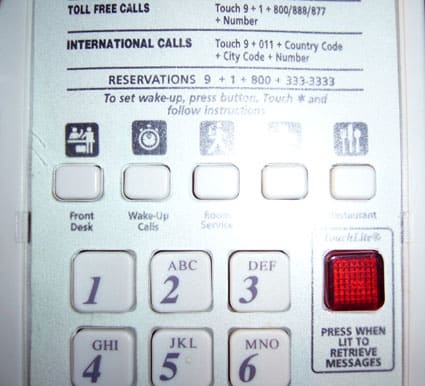
Last weekend I needed to set a wake-up call, and either introversion or bitter experience leads me to trust an automated service more than a human being, but even so, I always look on the phone for instructions on how to arrange for one.

p1000523.jpg
Right. Press the button and you’ll either end up in the automated system or you’ll be speaking to someone who can handle it. I press the button, but nothing. Press again, nothing. I try the other buttons and they all simply click. The phone has special function buttons but they are unprogrammed.

Okay, all is not lost. The room has another phone in it.
p1000525.jpg

But this phone has a different interface. Here we’re told to touch 77 (why is touch the verb, anyway?). Doing so brings me to the voice mail interface, which does not have any wake-up options.

Two phones, two different interfaces, both screwed up. I called 0 (or touched 0, if you prefer) and spoke to someone (shudder!) and it was handled.

It’s just a weird failure of attention-to-detail.

Series

About Steve