If you rent from Budget, do you get what you pay for?

Last week I rented a car from Budget. Since I was renting a car just to get from Providence to Logan, I was psyched that Budget had a pickup service. Saved me figuring out how to get from my hotel to wherever their office was. The web info said to call ’em 24 hours beforehand.

When I called they explained that they aren’t staffed for pickup at their location (despite the web saying otherwise), and I should take a cab and bring in the receipt and they’d give me the money. Well, that’s not the point. Now I need to get to them, rather than having them come to me. They offer a service, but they don’t need to actually fulfill their promise?

When I arrived at the rental location, the woman at the counter was in-depth in a very personal family conversation. She took my ID and began pecking at the computer keyboard, stopping when she needed to focus on the advice she was giving. I can’t express how much I hate when people who are working service businesses carry on their personal crap while I’m trying to transact. It forces you to stand there and either look at them as if you are in a normal interaction of that type (which feels rude) or to shift and look away as if you are interrupting them. It always takes longer since of course they aren’t paying attention to what they are doing, and having someone push a piece of paper and pen at you, without even saying (or maybe just sotto voce) what it is they want from you (“….sign and initial…”) is awkward as hell. For the customer. This should absolutely be a firing offense.

When I returned the car, the wearable-computer dude was only printing out slips that sent us into the office to complete our return. So much for the Fastlane service. Was anyone trying to resolve a technical problem, let alone tell us what the problem was? Nope.

With the car, the trunk release didn’t work, but none of the check-in folks asked me if the car was okay (a standard question at Hertz).

I figured I would let Budget know about my less-than-satisfactory experience at some point, and hey, what I do see in my email today a chance to fill out a survey (and everyone knows how much I love surveys) about my recent rental experience.

I rated various parts of the experience, based on what I was asked, and they got low marks. There was some question that seemed to be a follow-up, asking for the different causes (list pre-selected by them) for my low rating.

Obviously, there was no chance to share information about the poor service, especially the specific crap that I had the most problems with.

But I did get this lovely screen:
1d5c13df1.jpg

Business, personal, or leisure. Oh, and personal is non-leisure. What does that mean? Taking your dog to the vet is personal but not leisure?

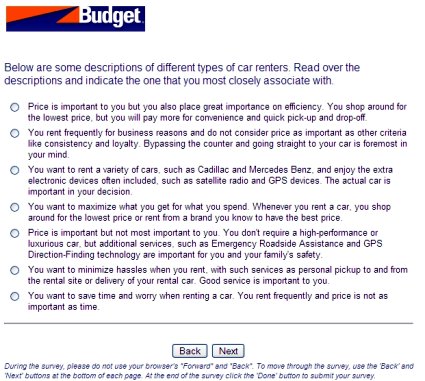
And then a lovely segmentation question.
1d5de04c1.jpg

Actually, I’m a semi-retired chiropodist with buck teeth who collects snakeskin clothing and rents vehicles for the vague high from the new car smell. Do you have one of those I can check off?

1d5eec751.jpg

Of course. We’re done when you say we’re done? You didn’t come close to asking me any of the questions I’d like to answer. Nicely played!

What would you do if they gave you the job?

A few months ago I received a press inquiry from James Pethokoukis of US News & World Report. He wrote:

Mr. Portigal,

I am currently writing a story on innovation for US News & World Report, and I trying to cast a wide net for ideas and insights. Let me ask you this: If you were appointed America’s Innovation Czar (no idea what such a gig would pay), what three things — include more if you wish — would you recommend that government do to foster innovation or make our economy and/or government more innovative? I am trying to get beyond “push kids to study science more” or “cut capital gains taxes.” Any insights would be most appreciated!

It’s kind of a crazy question, but what the heck. I sent in a long answer, but I guess it never made it into the piece. Anyway, I’ll share it with you all here…

If I was given this prestigious new position, I would do a few things. I would demystify the sense of innovation by encouraging problem solving in small areas. For example, the San Francisco Chronicle (as do many other newspapers) runs a regular section called Chronicle Watch. In it they present reader-reported problems typically in public space. A misleading sign, a broken curb, construction materials left behind, a trip hazard, rotting stairways, littered highways, and so on. They also publicize the agency and individual responsible. When fixes are made, they publish their results, or when fixes are delayed, they update the status. The fixes themselves are not innovations. Repairing a curb, fixing a handrail, posting a sign – these are solutions we’ve long since known how to create. The problem is why these situations recur and are so challenging to address. The Chronicle is an attempt, at least, at an innovation in process. Cutting through bureaucracy where possible, although sometimes their failures highlight the difficulty of doing that. My point here is that there is a great deal of small improvement to be done; sanding off the rough edges of the things we touch every day. It won’t create a new Internet or iPod to do this, but solving these small problems (that are hard to solve) will improve the underlying fabric of everyday life. Buckminster Fuller spoke of the “trimtab” – the small change that has a big effect; perhaps finding ways to address this sort of thing would qualify.

I would introduce empathy processes into government, especially departments that interact with the public or with businesses. Everyone – EVERYONE – will go through the process that their “clients” go through, on a regular basis (say, once per year). DMV clerks who stand in line (as the obvious example) will have an opportunity to see what the “other half” experiences.

The neat trick with empathy is that it leads to understanding, and then leads to problem solving. Seeing what the tax filing process is like from the perspective of someone else begins to suggest how it might be improved. There are lots of examples of this in business, many that go even further such as the elder-suits that car designers wear to restrict their mobility, sight, and so on. Since they can already drive a car, there’s little empathy (or problem solving) created until they more accurately simulate the conditions of their “users.”

A goal would be for the government to develop a set of best practices for user-centered-design – where design is making anything that gets used or experienced by someone else, apply those as broadly as possible throughout government, and then help businesses adopt more of these into their own practices. The thrust being to get people out of their own environments and their own mindsets, into the moccasins of those who are they are trying to serve. Creating empathy, understanding, and problem solving.

That would remake life in our culture, and if that isn’t an innovation, I don’t know what is!

A seat at the table

backwardsx.jpg
You may have already seen this proposed seat layout around the blogosphere. It appears today in USATODAY

PAIG and its design partner, Acumen, used experts from 12 major international carriers as a focus group in developing the seats. None of those 12 – which Bettell said he can’t identify because of non-disclosure agreements – has placed an order yet.

This raises an issue well articulated by Graham Marshall at the IDSA SHIFT event this past weekend…that in many business situations, the people being designed for aren’t just the end user, but include partners, and customers (where customers refers to the company who buys the product, such as Target, UPS, or United Airlines). Of course, as Graham made clear, it’s crucial to develop with and for all those groups. Here we’ve got a story about a company that ran (yuk) focus groups with the airlines only. Sure, those people have asses and backs, so they could try the seats out (assuming the focus group went full-out and had model seats that could be experienced) but they are not the ultimate user of the seats. It seems that doesn’t really matter at this stage of the process! You’ll sit in ’em and you’ll like ’em!

ChittahChattah Quickies

Opposite day?

Today I received a newsletter from some furniture design company. As far as I know, I’ve never heard of them nor asked to receive their newsletter. Isn’t that um spam?

I used the link in the newsletter to unsub:
1814acce1.jpg

Press the button and I get this:
1814ad8d1.jpg
which I don’t read carefully, presuming that in fact it is removing me from their list, until moments later I get this email:

Subject: You’re on my list!

Hi

Thanks so much for joining our list, your subscription was a success. If you have any questions about our emails or have any feedback of your own, please don’t hesitate to reply to this email. We’d love to hear from you.

Also, We’ll be including a removal link in every email we send you, so you can leave our list any time that suits you

Ohhhhhhh. The unsubscribe link takes you to an unsubscribe page which then asks you to confirm your SUBSCRIPTION. Nice inescapable loop, folks.

Survey Revenge?

I’ve written so much about surveys as of late and was so amused to receive one in the mail from the research arm of my HMO, Kaiser Permanente. The focus of the survey is Genes, Environment, and Health.

It’s a very sophisticated effort, with a two-page FAQ (some parts are interesting/amusing: Does this research involve cloning, or stem cells, or genetic engineering? and What do you mean by “genes” and “environment”?). See Page 1 and Page 2 for the full FAQ.

Here’s the last page, showing questions 30 through 37.
surveyscansmall.jpg
(click to enlarge)

This is a serious survey, it’s obviously been assembled by specialists in medical quantitative research, and has no doubt gone through human subjects approval/ethics guidelines, etc. I’d say this is an example of survey best practice. However, I’m not going to participate; the user experience for me is not pleasant; there’s very little upside (being asked to provide a saliva sample later on? Whoopee!) and although it’s funny out of context to look at question 36 (getting and keeping an erection (or hard-on) that is rigid enough…), it’s a not so interesting (or turn-off) to fill out a survey about that sort of thing.

I really want to say that the whole survey seems long, and hard. But that would bring the level of discourse way way way down on this blog and I pride myself on setting high standards here.

ChittahChattah Quickies

  • Very confusing structure/interface; seems to include IT@Intel; Technology@Intel; Views@Intel. Views includes a post by Genevieve Bell about some of the amazing work her team is doing with purchasers of second homes.
  • Ask any interaction designer about the power and influence of the default option in a choice situation. Or anyone that has done e-commerce and seen the “send you our newsletter” option already checked. We know this.
online pharmacy purchase ciprodex without prescription with best prices today in the USA

Series

About Steve