This Week @ Portigal

After a weekend of working in the yard I’m stiff and creaky on Monday, each keystroke of this update requiring a supreme effort (well, maybe I exaggerate just a bit).

Harry Dean Stanton and Silence

interviewing-users

Interviewing Users is now available. Get your copy here!


hds
At SXSW this year we saw Harry Dean Stanton: Partly Fiction, a moody and elliptical portrait of the actor. Despite the filmmaker being a long-time friend of his, Stanton is evasive and mercurial, seeming more earnest when performing music for the camera than in answering questions about his parents or his relationships with women. On more than one occasion, the subject doesn’t respond and just stares off or at the camera or the interviewer. And the interviewer stays quiet for a surprisingly long time.

There was a Q&A after the screening, so I asked the filmmaker about what she thought about the power of silence (for in addition using silence in the interview, they also chose to leave those silences in the final film). She told us “I just wanted to see what would happen, and to see the boundaries of being uncomfortable.”

I found this fascinating; in Interviewing Users I describe a scene from Werner Herzog’s Grizzly Man where the director uses silence to gives space for an astonishing and revelatory moment to occur. In this case, “nothing” happened. Of course, as the director reminded me, the “nothing” that happened with Harry Dean Stanton was still something; it revealed a lot about the subject and changed our own experience in hearing his story.

It’s further illustration of the power of silence, even when it doesn’t pay off in the obvious manner and bring something out, it’s still bringing something else out!

Empathy begets empathy

interviewing-users

Interviewing Users is now available. Get your copy here!


In Chapter 1, I argue that in addition to gaining valuable information through interviewing, the process also builds empathy which in turn increases our overall capacity for empathy.

Marc Maron (describing his journey with the WTF podcast), in this Rolling Stone interview, says the same thing in his own way.

But once I started talking to people, I evolved a capacity I never had before, which was to be an empathetic listener. I still step on people a lot, and I interrupt them with my own bullshit. But I was a better person. I was humbled.

Also0 see yesterday’s Maron example here.

Marc Maron on listening

interviewing-users

Interviewing Users is now available. Get your copy here!

About a year ago, Marc Maron (comedian, host of the WTF podcast, and an example in Interviewing Users) was on Chris Hardwick’s Nerdist Podcast. They got into a discussion of interviewing, touching on listening-builds-empathy, the pressure on the interviewer to keep talking and choosing to interrupt.

MM: It’s one-on-one, we’re in a garage, it’s cozy, and I’m pretty much a too-much-information kinda guy and I’ve learned how to listen. I don’t know when that happened. I’m happy it happened but -when I was a kid I grew up with a bipolar father so there’s some part of me that’s wired to emotionally connect with very charismatic volatile people and throughout most of my childhood I would always be attracted to crazy homeless people that walked around where I used to work at this restaurant. I always wanted to hear their stories. I always liked people that were funny and large personalities because I’d been sort of diminished by my father’s brutality in terms of his emotions. And I just find for a long time there I was bitter, and I was “Aw fuck, everyone was out to get to me” and defensive and I’d gotten very cynical and now because of the podcast I’m very empathetic. When I listen, there are times when I’m about to cry, or where I’m so engaged in the story that I’m just happy when -wow I’m into this.

I think that is just my own curiosity, the way I’m wired but I’m very happy that’s happened. I like to listen to people.

CH: It’s something that I certainly I wish I did more sometimes, I’m always like-NO DEAD SPACE, NO DEAD SPACE – always gotta keep talking

MM: I think that’s natural, I do that..Some people criticize for me on my podcast that I occasionally interrupt too much, it’s because they’re not used to listening to interviews the ways I do. A lot of times I interrupt because I get nervous if people are doing some – if someone is a public personality, they’ve got their story, you know, and I can sorta tell when like I’m not the first one to have heard this story, sometimes – it’s happened with Anthrony Bourdain specifically because I wanted to connect with him, but he speaks in public a lot and I listened to part of his interview on Joe Rogan, one because I wanted to see what kind of person he was in conversation and I knew there was a couple of points that he clearly hit regularly so when I heard him start those I was “Yeah, but what about-” I tried to get around them only because I wanted to see if I could get-I ended up getting something different, it was good, it was good. But I’m sorta aware of that stuff. You?

CH: I try to be aware of it, but I also try to keep the conversation going and a lot of times if I’m talking with someone and this is why I don’t do phone interviews because I need to see people, I can tell they are close to finishing a thought and I just don’t want any of those moments where like-if you listen to this podcast you will never hear a [pause} “So-.”

Alicia’s War Story: Don’t hate on a tinkler

Alicia Dornadic is a design researcher in the San Francisco Bay Area.

Going to someone’s home for the first time to interview them, especially in an unfamiliar culture and language, can be awkward. Showing up with two researchers, a cameraman and a couple clients in tow – all of whom are over-caffeinated and in need of a bathroom break – can make for a circus act. These were three-hour long interviews, too. So, despite our best efforts to arrange feeding and peeing times before getting to the person’s home, we usually all had to pee at some point during the interview. But our translator was the absolute queen of tinkling. The first day I was understanding. “Maybe she’s sick or nervous,” I thought. She would take two to four breaks during each interview, which left the rest of us smiling and pointing at things dumbly, trying to make conversation in her absence. By the end of the week, my patience was shot. I was ready to strap some adult diapers on her. I would glower at her every time she asked for water, tea, or a soda. “Really?” I thought, my eyes on fire, “Should you really be having that?” I’m not proud of this. But I couldn’t help being annoyed.

Finally, karma came to bite me on the ass. It was at the end of a long interview at the end of a long day, and I broke down and asked if I could use the restroom. Our host pointed to it, and I stumbled inside, missing the 2-inch step down into it. There wasn’t a lot of light in the bathroom, and it was cluttered. I couldn’t find a switch. But no matter. I go. I reach for the toilet paper, and BOOM! CRASH! I take down the entire metal toilet paper rack off the wall, and it crashes onto the tiled floor. It was too dark to see how to fix it, so I had to come out and explain what I had done and apologize. Not only that, but my explanation and apology had to be translated! Translated and explained to two researchers, a cameraman, a couple of clients and our participant. It ended up not being a big deal, but I was embarrassed. And I felt guilty for all my negative thoughts towards our translator. As much as I was annoyed at our tinkler friend, at least she didn’t break anything.

Steve interviewed by Denise Lee Yohn about Interviewing Users

I was interviewed by Denise Lee Yohn – we chatted about interviewing, insights, innovation, iPods and probably some other words that start with the letter i.

Listen at the link or through the widget below.

To download the audio Right-Click and Save As… (Windows) or Ctrl-Click (Mac).

Susan Dray on War Stories

In Lessons from the Front Line, Susan Dray reflects on the impact the War Stories have on her as a researcher.

These war stories are at times inspiring, at times comical, but always interesting. As I have followed them, I have increasingly been figuring out ways I might be able to use them with teams, clients and students. For example, I might share a selection of them of them to give a new team some sense of what to expect when we go into the field together. In addition, when I teach at the Technological University of Panama next year as a visiting Fulbright scholar, I plan to use these stories to help give students a better idea of the variety and nuance of ethnographic work. War Stories are rich not just in data but also in terms of technique, and they have made me think about my own experiences in the field.

Thanks to Susan for such a thoughtful and heartfelt piece, and to Core77 for publishing it!

This Week @ Portigal

Howdy Monday and Monday-accessories:

Body language changes you inside

interviewing-users

Interviewing Users is now available. Get your copy here!

In Chapter 2, I talk about how body language (see good and bad examples here and here) not only signals that you are listening to your interviewee, it also signals you to listen better. I based on this on some writing by Malcolm Gladwell (in Blink, but originally in The Naked Face) about how our physical self can induce changes in our emotional selves.

Now there’s more research to back up that claim. From this WSJ article

Researchers are finding that wearing a smile brings certain benefits, like slowing down the heart and reducing stress. This may even happen when people aren’t aware they are forming a smile. The work follows research that established that the act of smiling can make you feel happier. Frowning also may have a health effect: Preventing people from frowning, such as with the use of Botox, can help alleviate depression.

“You can influence mental health by what you do with your face, whether you smile more or frown less,” says Eric Finzi, a dermatologic surgeon and co-author of the study on frowning.

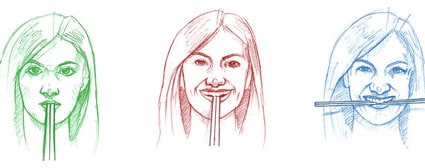
Bonus: the article includes this compelling image, explaining “Holding the sticks in the mouth activates the same muscles we use for smiling.”
chopstick-smile

Interview with Steve posted on Ethnography Matters

Here’s an interview with me at Ethnography Matters. We talked about the book, the writing process and other aspects of how interviewing users is playing out in the corporate world.

EM: How much heterogeneity is there between companies / clients? Are there any broad typological characterizations of companies and their attitude towards user research? Does this inform different ways of delivering research results, different ways of “talking to” these companies?

SP: There are no doubt dozens of frameworks (see for example, Jess McMullin’s Design Maturity Model on page 142) for characterizing the organization. But let me throw out a new one: in the Passover Haggadah there is the example of the four sons. One wise, one wicked, one simple and one who does not know how to ask a question. The wise son asks to have all of the history, insight and other findings explained to him. We’re encouraged to explain everything to him. The wicked son separates himself from the issue by asking why it’s important to you. We’re told to tell him why it’s important to us (and not persuade him that it should be important to him). The simple son doesn’t even focus in on the issue and just asks “What is this?” so we’re to give him the headline. We’re told to approach the son who doesn’t even know how to ask a question and take the initiative to explain things to him. And one scholar writes about a fifth son who isn’t even in the room and it’s up to us to seek him out and give him the lowdown.

Sure, it may be a bit forced but it’s not hard to see those sons as archetypes of individuals, departments or entire workplace cultures. Whatever your framework is, you obviously need to understand the specifics of who you are dealing with and have a range of approaches for responding. All of this stuff with people (be they clients or research subjects) is messy and I’m not so comfortable with pre-emptive categorization and its resultant tactical choices.

Thanks to Tricia Wang and Jenna Burrell and everyone else at Ethnography Matters for a great discussion.

Series

About Steve