ChittahChattah Quickies

online pharmacy furosemide over the counter with best prices today in the USA
online pharmacy bactrim online with best prices today in the USA

Making the familiar unfamiliar, or traveling the continuum of appetizing-ness

While in Japan, in a Mitsukoshi food hall, we came across Konopizza, pizza (and desserts!) in a cone.
kono.jpg

It’s not just a Japanese company, and they are aiming for the English speaking market with “the future of pizza, the pizza of the future.” I have seen the future of pizza and its name is Kono? Personally, I hope not. Think about biting into one and managing the mass of bubbling cheese goo. I foresee burning messy gagging.

Here are some variations on the hot dog from Ginza.
hotdogandstickpizza.jpg

Coney dog, okay. Cheese dog, sure. Bacon potato, I dunno?

seasonhotdogs.jpg
Egg? Zucchini? These are rather elegant reinterpretations of the serviceable wiener, but they read so unappealing and dissonant. I’m all for elegant reinterpretations of fast food but these struck me as very foreign (granted, I was the foreigner, trying to find the symbols of home in another environment).

Stay tuned for our Taiwan snack food experiences.

And one more that I’ve been hanging onto for a very long time. Family Boat appears to be a concept restaurant, with a website intended to appeal to investors and future franchisees. They’ve opened one pilot store in Holland. The concept is all around providing food in “boats.”

potato-boat-chicken-mushroom.jpg
Potatoboats

beef.jpg
Sandwichboats

icecream02.jpg
Ice boats

Lots of designy stuff on the site as well:
img_vending.jpg

Anyone ever tried any of these foods? What do you think?

ChittahChattah Quickies

There is nothing new under the (rising) sun

A few years ago, Gene asked what happened to the IDEO shopping cart?

online pharmacy buy wegovy with best prices today in the USA

Well, look what we saw in Japan!

cart2.jpg
Anne demonstrates how the basket mates with the cart

cart1.jpg
Minimal cart hardware stacks tightly

Is this the cart, finally? Or did their design partly reflect a solution already in place in other parts of the world?

Raise a glass to the hardworking people

winedrinker.jpg
Unsurprisingly to anyone who knows of the early Louis Cheskin work, a recent Stanford study established that the more wine costs, the more people enjoy it, regardless of how it tastes.

Expectations of quality trigger activity in the medial orbitofrontal cortex, the part of the brain that registers pleasure. This happens even though the part of our brain that interprets taste is not affected. While many studies have looked at how marketing affects behavior, this is the first to show that it has a direct effect on the brain.
…
“We have known for a long time that people’s perceptions are affected by marketing, but now we know that the brain itself is modulated by price,” said Baba Shiv, an associate professor at the Stanford Graduate School of Business.

online pharmacy https://red-slice.com/wp-content/uploads/2009/10/81.html no prescription pharmacy

When we worked with a wine brand recently, we sought to understand the complete wine “usage” process, from planning, through shopping, to storage, to opening, to serving and drinking. We looked specifically at people who were interested in lower-priced wines and most of them were limited in their knowledge and/or experience.

In other categories when the customer is new and is presented with enormous product choice (the amount of wine choice dwarfs most other categories I can think of) we might feel sympathetic for the learning/selection/usage learning curve they would face; with wine people spoke very enthusiastically about the journey. Each trial experience involved drinking wine…something they liked to do! A social, tasty, and rewarding experience. Even a wine they “didn’t care for” (the typical critique) wasn’t a failure, because it still carried all the symbolic meaning.

The marketers were hampered by a limiting view of their customers; the market had been sliced into ridiculously narrow price points and this inevtiably drove discussions of people characterized exclusively within those $3 slots (as in, “I’m a $7.99 to $10.99 drinker”). While our client no doubt had cash register data to support their segmentation, it was completely at odds with how people saw themselves. They purchased across a much broader price range, and their primary concern was their own knowledge and accumulated experience. We were given a great opportunity to offer this different view and illustrate some of the unmet opportunities this presented.

The bear that saluted me

bearshot.jpg
I thought this advertising bear in Shinjuku was cool, and so stopped to take a picture. The bear saw me and posed with the typical Asian two-fingered V-gesture. After I took the photo, I did my best gaijin attempt at a bow. The bear returned the bow, and then saluted me.

Without a common language (indeed without a common species) we had an interesting opportunity to share our knowledge of each other’s culture in gestures. And although I rarely salute my friends and family, I understood its intent as a gesture-of-Western-origin.

Japan is quite impenetrable to the outsider, and it’s easy to subsist on a parallel layer, free from the possibility or opportunity for everyday interactions. In our two weeks that moat was crossed less than a dozen times (i.e., the couple in a cafe who smiled and waved at me when I peered in the window and inadvertently triggered the sliding door, letting in some very cold air; the couple who saw us eating Taiyaki (cooked sweet batter filled with bean paste in the sahpe of a fish) and explained what it was, what is was called, and compared camera models) and each time was rewarding in its own small way.

But making this connection with a bear, in the land of kawaii, was briefly and intensely magical.

ChittahChattah Quickies

Trend Ecosystem

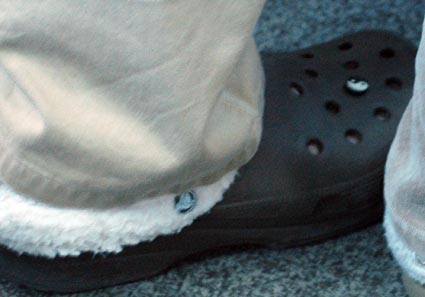
It’s fascinating how most successful products lead to an ecosystem of supporting products. The Crocs fad has provided the fan-base to support charms, little decorations that attach to the holes on the shoe’s surface and let the wearer further establish their individual identity within the trend of people who have established a unique identity by wearing Crocs in the first place.

Acknowledging that following a trend has a very different meaning in Japan, we bring you the Crocs family, who we saw on a bus in Kyoto, each with their own charms.

dsc_0117.jpg
Dad

dsc_0116.jpg
Mom

dsc_0120.jpg
Son

dsc_0118.jpg
Baby

In addition to aftermarket personalization, many trends also generate a safety backlash meme (iPod muggings, anyone?). In Taipei, it’s dangerous to wear Crocs on escalators.
img_1855.jpg

Manufacturers like Apple are very savvy about creating/controlling their aftermarket, but I wonder about the backlashes. Are PR people planting those stories or doing damage control or not realizing their significance?

Update: Karl Long on the Crocs backlash (safety and others) here

Registration open: Design Research Methods on March 1

Registration is now open for the full-day Design Research Methods class that I’ll be teaching. It’s a full-day event on Saturday March 1, 2008 in at Involution Studios in Sunnyvale, CA. Not local to the Bay Area? Well, why not hop on a plane for the weekend?

This course will provide first-hand knowledge and training in core design research methods. At its root, design research emphasizes learning about people and using the insights gained to inform and inspire design. We will focus on exemplary models of what research is, what it looks like, its role in concept generation, and what it produces.

From the official announcement:
The Involution Master Academy recently released its Winter 2008 semester for open registration. A post-secondary education program designed for mid-career professionals, Involution Master Academy focuses on direct, one-to-one interaction and training between the instructor and students. To ensure maximum interaction and an intimate educational setting, each course only accepts nine participants.

The Winter 2008 course schedule features five courses taught by well-known user experience thought leaders:

Product Architecture Symposium
Instructor Andrei Herasimchuk
Saturday February 23, 2008
10:00 AM-6:00 PM

Design Research Methods

Instructor Steve Portigal
Saturday March 1, 2008
10:00 AM-6:00 PM

Applied Empathy: An Experience Design Framework
Instructor Dirk Knemeyer
Saturday March 8, 2008
10:00 AM-6:00 PM

Web Form Design Best Practices
Instructor Luke Wroblewski
Saturday March 15, 2008
10:00 AM-6:00 PM

Site Search Analytics for a Better User Experience
Instructor Lou Rosenfeld
Tuesday March 18, 2008
10:00 AM-6:00 PM

Past courses have sold out. Given the small class sizes, you are
encouraged to register well in advance.

Series

About Steve