ChittahChattah Quickies
- “It is not inconceivable that Page Rank code might be running in search 600 years, operating beneath massive other bits.”
online pharmacy buy spiriva no prescription with best prices today in the USA
I had to replace one of the toilets in my house recently. On the advice of a friend who’s a builder, I went to Home Depot seeking an American Standard brand toilet.
Replacing a toilet is surprisingly easy. It’s really quite something that the toilet is such a simple device, considering its significance in enabling modern life to be as pleasant as it is.
I had bought all the pieces I needed separately, and by the time I finished my installation, had forgotten that I’d bought a seat that was also made by American Standard.
I experienced a little warm flash of joy when I raised the seat of my new toilet for the first time and saw that the logo on the bottom of the seat matched the logo on the toilet itself.

That I would feel spontaneous pleasure at having the brands of components on my toilet match–is it not testament to the primacy of place that branding and labeling have in our culture?
That this positive feeling was caused by something I never could have told you I cared the least bit about–something that seems so silly to me that I’m chuckling inside as I write this–really shows the power of the larger culture to influence emotional responses.
It also illustrates the necessity of being in real places with real people doing real things, if one wants to witness these types of dynamics.
The coda on this little story is an ironic one:
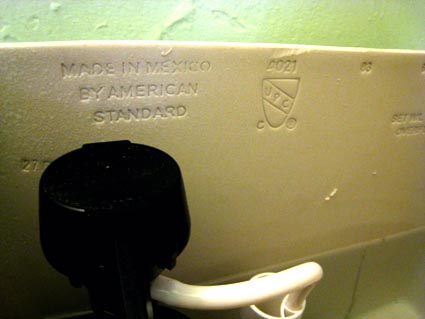
Does it matter to me that my American Standard toilet was made in Mexico? Not really. I’m just happy that the logos all match.


Covers for outdoor electrical outlets adapted to gently lock-out some light switches in a market research facility observation room. Behind a two-way mirror, the room must be kept darkened, and so the use-with-caution light switches are kept separated from the use-at-will light switches. The cover hardware, adapted from its intended use, doesn’t prevent operation of the light switches, but you have to think more deliberately before flicking them. This is a reasonable example of a forcing function.

I was taken aback when reading this NYT piece on Starbucks loyalty card
Jeffrey D. Lipp, president and chief executive of Chockstone. His company helps customers, including some Starbucks competitors, build and run their own loyalty programs.
What he has found is that it doesn’t take a lot to get diners, for example, to do what restaurants want. One Chockstone gambit involves using the customer’s receipt to make an offer. Return within 10 days, perhaps, and you can get a free dessert, the slip says.
“It’s amazing this stuff works so well,” Mr. Lipp said. “What we’ve found is that people can be bought for a cookie.”
Pardon? You’re an expert in loyalty, but you refer to people being bought? It’s such a Winston Smith moment when the word loyalty – in the context of companies inducing you to return – has no connection with the actual meaning of the word “A feeling or attitude of devoted attachment and affection.” I guess brand and loyalty are completely divorced in the modern corporation.
Note: the picture above comes from our local Safeway store where I have developed an almost Pavlovian association with their free cookie box, which has sat behind the bakery counter to be reached into by slightly sneaky customers. Avoiding sweets most of the time has really pumped up the anticipation I feel when I head to Safeway to pick up groceries or visit the ATM.
So I was stunned to see the sign and realize the free ride was over. If they’ve got me making such a powerful emotional/gustatory association with visiting their store, isn’t that worth a few boxes of cookies per day?
And so, am I being bought for a cookie? I don’t know, really. But the timing of the outrageous quote in the article and the outrageous sign at Safeway suggest some dystopian cookie Happening may be upon us. I’ll keep you all posted.
A writer is a person for whom writing is more difficult than it is for other people.
Thomas Mann

Poet Kenneth Goldsmith calls himself an “uncreative writer,” and his works include: everything he said for a week; every move his body made during a thirteen-hour period; a year of transcribed weather reports, and the September 10, 2001 issue of The New York Times, transcribed.
My first reaction to Goldsmith’s work was that it seemed like a good piece of conceptual art scamming, but then I heard him read one of his transcribed weather reports on the radio.
Before he read the piece, Goldsmith explained that the process of transcribing these artifacts creates an experience for him of the poetry in everyday language use. And it was true-as Goldsmith read the weather report, in a fairly rapid, uncadenced style, I was struck by how vividly evocative the place names, the verbs of wind and temperature, the homey advice to “stay indoors” all were.
I think what Goldsmith is doing is a word-focused parallel to what we do in contextual research practice: we carefully observe and document the everyday, as much as possible suspending our own preconceptions of what is and is not significant, in order to see in new ways.
When I was younger, I effortlessly seemed to think in a more lyrical and poetic way than I do now. My hypothesis has been that this change is a result of being more involved with “putting my hands on things” than I was in my 20s. My creative energy now goes much more towards describing and solving problems-juxtaposing complex alternatives, articulating ideas that have the potential for real impact-and there’s just not the same kind of energy available for playing with language.
I’m happy with the direction my way of thinking has evolved, but at the same time, I feel a certain sense of loss for that earlier version of myself, and the ease with which I used to make words do tricks.
Hearing Goldsmith reminded me that I needn’t draw a hard line between between playing with language and solving problems, between the lyrical and the practical-that it’s all out there, evocative and full of potential.

The NYT has a story about self-selecting airport security lines.
…a black diamond line for expert travelers, defined as those who fly more than twice a month and are skilled at security procedures, always ready with items removed; a blue square for casual travelers, who are familiar with the screening process; and a green circle for families and those needing assistance or more time.
I think this is an exciting idea, although it doesn’t appear to be working perfectly. It seems that people are overestimating their own expert-ness (or perhaps fudging their self-analysis in favor of a perceived “express line”) although families feel relief from the pressure of other travelers.
This seems like a classic web design problem, with different types of users (who have very different abilities, needs, and expectations) coming in the same front door. And when there’s a choice, people will obviously act in their own perceived self-interest.
I think separating “normal” from “expert” is going to be a tough thing to figure out in any situation; unless “expert” carries with it an intimidation factor, I suspect most people will escalate their capability. Otherwise “normal” starts shifting to “stupid.”
Again, an interesting approach to a problem, and as with most prototyping efforts, lots of learning about how the proposed solution is and isn’t working, yet.
I signed up for a webinar but was unable to attend. But I got a copy of the presentation, and although I’m sure it made a lot more sense when the presenter was explaining it, I had to laugh at this screen

The source is Productscan
, so one can assume it has something to do with the success of new product introductions. But a product launch and an idea are not the same, are they? And how are they using innovative vs. not-so-innovative? And what’s the vertical axis, exactly?
Next week I’ll be in Orlando, giving an early-morning keynote at the Nortel Technical Conference. After that, I’ll be in Miami for a few days. I’ve got some time in both cities and would love to meet up with locals o chat about what we do and look for ways we might work together.
Drop an email (or leave a comment)!