Parody as Time Capsule

Here are two cartoon shorts that reveal powerful and dated perspectives on consumer culture and the automotive industry. Dated isn’t bad; in these cases it tells us a lot about what the concerns of the time were.

From 1974, a pilot for a MAD television special. It’s the credits and the first segment, a cynical interview with an automotive executive. The theme of poor quality screams out loud and clear.

From 1951, Tex Avery’s Car of Tomorrow. Silly concepts that speak to social attitudes and concerns from that period. Which ones have changed? Unlike the MAD piece which frames its critique by being very current, this cartoon looks to the future and reveals these values somewhat more indirectly.

Japan: URLs Are Not Totally Out

In Japan: URL’s Are Totally Out we see an emerging form of advertising a web presence in Japan: showing a search bar rather than the actual URL. I looked through my recent photos and pulled some examples that show this, but also several examples that use the more traditional (if that’s the right word?!) presentation of URLs.

Search bar:
dsc_0573.JPG
dsc_0039.JPG

Traditional URL:
dsc_0167.JPG
dsc_0485.JPG
dsc_0089.JPG
dsc_0390.JPG
dsc_0237.JPG
dsc_0559.JPG
dsc_0352.JPG

And finally, an ad for a search company (Excite? Who knew they were still around) that uses a URL, and also the increasingly popular QR code (see Rob Walker’s recent Consumed column).
dsc_0085.JPG

(As a side note, I couldn’t find any pictures in my collection but I also remember seeing many examples of a graphical presentation of a URL that (similar to the search version above) used the visual elements of a browser’s address bar with the URL itself being typed in, complete with cursor hovering over the “go” button)

You Say You Want a Revolution . . .

Alan Cooper spoke earlier this week at a meeting of the San Francisco Interaction Design Association chapter. Cooper talked about programming as a craft, and Interaction Designers as potential facilitators of that craft within the business world.

Cooper is advocating what he calls an “insurgency of quality,” which he describes as being about how software design and production processes can and should be evolving-specifically, increasing the time spent refining products before they’re released as “finished.”

It’s an old carpenters’ adage to “measure twice, cut once.” The current software production model Cooper is speaking out against might be described as: measure once, cut once, ship once, repeat all steps for version 2.

Based on the insurgency Cooper is advocating, in which Interaction Designers and Programmers would take more time to get it right before a product goes to market, the development model would become: measure twice, cut twice (e.g. validate and iterate), ship once. The idea being that what gets shipped would be of higher quality then what generally gets produced in the current way, which prioritizes time-to-market.

We work with a lot of clients who are operating within very tight timelines. I’d be curious to know what kinds of successes and failures Cooper and his firm’s consultants have been having with their clients in trying to implement this new development model on actual projects. Are the Cooper folks finding that client organizations are ready, willing and able to add more development time to the front end? If not, what kinds of strategies are working and not working in trying to encourage that kind of change?

A lot of theoretical revolutions break down or dissolve when they meet real world complexities and constraints. It would be great to have some stories detailing how the ideas Cooper is advocating are getting played out in real project engagements.

Yeah, I think she worked here or somethin’

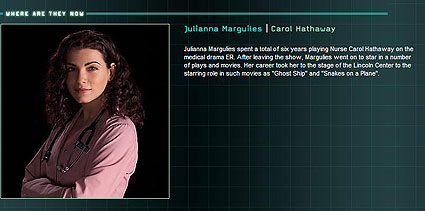
In a nice attempt at transparency, NBC’s official site for ER includes a section about former cast members, entitled (of course) Where Are They Now (sans question mark)
er.jpg

buy anafranil online anafranil no prescription

So where’s Julianna Margulies now?
er2.jpg

(emphasis mine)

Julianna Margulies spent a total of six years playing Nurse Carol Hathaway on the medical drama ER. After leaving the show, Margulies went on to star in a number of plays and movies. Her career took her to the stage of the Lincoln Center to the starring role in such movies as “Ghost Ship” and “Snakes on a Plane”.

Note the horrendous grammar, the highlighting of some poor films and of course, no mention of her new starring role in Canterbury’s Law (on FOX). Maybe NBC isn’t quite as genuine/generous with its transparency as we’re supposed to believe. Don’t publicists check up on stuff like this? Or are they totally powerless once the contract with NBC is over?

We need a new term like greenwashing that describes the false transparency such as what we see here from NBC (and whether it’s ineptitude or malice, the lack of care and finish tell us something about what NBC cares about).

ChittahChattah Quickies

  • Can’t tell exactly what this is, but it seems IDEO is offering cultural immersion tours, location-specific books, and a user-generated content web-project about noticing things in your environment.
  • Tired of all the unpleasant and troubling news about Tibet? Then check out Tibette.com, and catch up with the all the news and opinions about Tina and Bette, the on-and-off couple on Showtime’s The L Word.

Series

About Steve