Posts tagged “japan”

What I Read On My Vacation

zine.gif
Where Were You by Rob Walker
Walker collects a year’s worth of reactions to various obituaries. While I admire his lo-fi approach to turning a habit into a publication, and acknowledge that he promised very little except “here it is” I mostly found this unsatisfying. Walker is a good storyteller, journalist, writer, etc. He gets his facts in line and then tells us what it means. He (by design) doesn’t do that here. And so you get a lot of “I didn’t really know this…” or “I don’t really care about that” which mostly generates a squawk reaction in me. What?! How could you not know….how could you think that…etc. etc. And that isn’t pleasant. It was a quick experiment as a reader, so no regrets.

41kg4yws6fl_ss500_.jpg
How to Think Like a Great Graphic Designer by Debbie Millman
This is the sort of book I’d imagined writing someday – sitting down with a bunch of folks in a similar field and interviewing them. I ran an impromptu panel discussion at a regional IDSA event in 2004 where I did just that. And I’ve done a few podcasts for Core77 (including one with Debbie Millman). For the most part, this book was fascinating. It’s a powerful demonstration of how crucial rapport is to a good interview. In many cases, Debbie is interviewing people with whom she has a historical relationship, and so that rapport comes from friendship/colleagueship. In other cases, she’s encountering them for the first time in their (in-person or email) interview. I’m not sure, but I think I can tell the difference; certainly the in-person interviews range wider and allow for more following up and clarification, and that’s often where the good stuff comes out.

The subjects are all prominent in the graphic design field (although many of them were names I did not know) and many of the questions are exactly the same; this reveals itself more in the email interviews where the lack of opportunity to follow-up creates a disappointing sameness. By the end of the book, I was pretty bored in the same questions over and over again. I could see cutting out some of the interviews and letting the remaining ones go a little longer.

The book is mostly fascinating, however. Some themes and characteristics emerge: relevance, ego, humility and insecurity, thoughts on creativity and collaboration, and what I found to be the biggest personal a-ha – the relationship of other professional-level endeavors to support the primary one. These folks all identify as designers, but most of them also express themselves as painters or writers, and tell a coherent story as to how that activity is a critical complementary pillar to their design process/identity. Maybe that’s true for many of us; do we talk about it enough or is there a concern that this will dilute our perceived quality in our primary professional identity. Certainly for me, writing and photography feed into the work I do with our clients. I’ve advocated for others to develop these secondary pieces in order to support their main work. Still, it was gratifying to see that emerge strongly and consistently across these thought leaders.

41n1b3qq7wl_ss500_.jpg
Rochdale: The Runaway College by David Sharpe
My time at University of Toronto was blocks away from this rather drab senior center; one day I heard from one of my residence pals that said building had once been a den of hippiedom, an out-of-control social experiment. I picked up bits and pieces over the years, but this was my first chance to read an in-depth history of the Rochdale experiment. It’s a perfect artifact of the 60s idealism/naivete giving way to abuse, crime, drugs, financial ruin, and every other form of entropy.

41tgpp0g1xl_bo2204203200_pisitb-dp-500-arrowtopright45-64_ou01_aa240_sh20_.jpg
Cat’s Cradle by Kurt Vonnegut
I know we’re supposed to love Vonnegut for his sadly wry commentary about the nature of man, but this is my third Vonnegut in a short time and I have been left wanting each time.

dogsdemons.jpg
Dogs and Demons: Tales from the Dark Side of Japan by Alex Kerr
I just started this book in advance of our trip to Japan in just a couple of weeks!

51rpbt1twul_ss500_.jpg
Around the World in 57 1/2 Gigs by Dave Bidini
What is it about the Canadian book publishing industry that they can’t afford copy editors? Bidini tells a story about how in the early days of his band (the Rheostatics) they blew off a record exec who got the name of an XTC album wrong. But Bidini makes a couple of errors himself when referring to the titles of popular rock songs (while he’s being dismissive of those songs, even); his publisher should make sure he doesn’t look like a hypocrite! Anyway, it’s another round-the-world book from Bidini. In 2002 he went across the globe to play hockey in strange places, here he’s playing rock-n-roll in strange places. His adventures are great, his writing is improving (editing notwithstanding), and he’s fairly fearless in engaging with strangers across the barriers of culture, politics, alcohol, and hunger.

51kcg5lgu3l_ss500_.jpg
Woken Furies by Richard K. Morgan
All the books in this series are complex, mysterious, hardboiled, techy, and filled with action. I love ’em.

412qkekhwnl_ss500_.jpg
JPod by Douglas Coupland
I’m already on record objecting to this book, since Coupland figures as a character. I finally read the book (rather than criticizing it without having read it) and it was…okay. The parts with Coupland were extremely distracting, taking you out of the narrative to wonder why the author put himself in the book, why the author had the narrator despise Coupland so. Is that clever irony, oh, Coupland wrote the book but he’s using someone else to talk crap about him? It’s really him that’s saying that? See…distracting. Otherwise, it was a satisfactory Coupland romp, without the soul-cutting brilliance that a third of his books reaches. Oh, and J-pod has nothing to do with Japan or iPods. Phew.
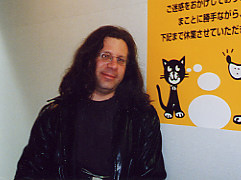
Biiru in Tokyo (or Kyoto)?

steveintokyo.jpg
Steve in Tokyo, 2000

Although we’re still recovering from Bali and Taipei (more pictures and stories coming soon), we’re headed back to Asia at the end of this month. If any folks out there would like to meet for hot-coffee-in-a-can or biiru in Tokyo (Dec. 25 to Jan 2.) or Kyoto (Jan 2. to Jan. 5), let me know.

Keep Your Hands Off My Power Supply

“Anti-Groping Appli” by games developer Takahashi

was released in late 2005 but has only recently climbed up popularity rankings, reaching No. 7 in this week’s top-10 cell phone applications list.

The application flashes increasingly threatening messages in bold print on the phone’s screen to show to the offender: “Excuse me, did you just grope me?” “Groping is a crime,” and finally, “Shall we head to the police?”

Users press an “Anger” icon in the program to progress to the next threat. A warning chime accompanies the messages.

The application, which can be downloaded for free on Web-enabled phones, is for women who want to scare away perverts with minimum hassle and without attracting attention.

In 2000 I made my first trip to Japan to help our client understand the role of mobile phones (“ketai”) in Japanese culture (in order to discover unmet opportunities for the company with their own customer base). We learned a great deal (both from participation and from observation!) about the indirect manner of communication (for example, the absence of “no”) and heard many stories about how the mobile, through its email capability, had enabled ways to circumvent this. People told us stories of negative feedback from a boss to an employee, or a relationship breakup taking place via the phone, and how that was acceptable.

If it’s culturally difficult to scream “Take your hands off me, you @#$%^$ freak!” on a subway train, then this application makes sense. It seems to acknowledge a need and a culturally-appropriate vector for responding to that need.

steveintokyo.jpg
Steve in Tokyo in 2000

Communication Confusion over Confirmation Confusion

Andrew points out that Kyoto and Osaka are near each other and that was probably behind the offers from Expedia that I had complained about. Helpful info that I didn’t have, but unfortunately, it got worse.

A few days later I received email from Expedia

To: Steve Portigal
Subject: Steve, here is your itinerary confirmation for your 01/02/08 Osaka trip
[deletia that makes reference to our Osaka trip multiple times]

Even more concerned than before, I wrote them and received this message

Dear Expedia Customer,
Thank you for contacting us.

We regret that your experience with Expedia.com was not satisfying. Comments such as yours are read by numerous people within Expedia and help shape our policies and practices as we learn and grow.
If you have further questions, feel free to reply to this e-mail or contact Expedia customer services at 1-800-397-3342 and reference case ID 36793797.

In other words, I submitted a complaint and they aren’t going to act on it, unless I submit it AGAIN. Okay, I do that.

The next message is even worse.

Dear Expedia Customer,

Thank you for contacting us.

Kyoto, Kyoto-fu (Change name) Expedia.com itinerary number: 121380781812

If you have further questions, feel free to reply to this e-mail…

No actual communication. Is anyone out there? I try again.

Dear Expedia Customer,

Thank you for your immediate response.

Please accept our apologies for the misunderstanding with your hotel reservation. We regret any inconvenience this may have caused you.

Your itinerary serves as a confirmation of your purchase, and we’ve sent an updated copy of it in a separate e-mail. You can also access your itinerary online at any time. Here’s how:
…

Again, no one is addressing my key question: why does my Kyoto reservation keep getting referred to as my trip to Osaka? Once more into the breach…

Dear Steve,

Thank you for your reply.

Please accept our apologies in regards to the misunderstanding with your reservation. We regret any inconvenience that may have occurred and would like to assure you that every reservation is important to us.

Your problem may stem from incompatibility between your browser and our system. We have already escalated this technical issue to the appropriate department.

In the interim, your hotel reservation at the Hotel Monterey Kyoto is confirmed while the “OSAKA” tag line have caused you such inconvenience, the printed itinerary of your reservation is still binding and a confirmed reservation for a hotel in Kyoto, Japan and not in Osaka.
…

So somehow my browser is causing them to send me email messages about a different city? The crucial piece of info (thanks, Andrew), that these are nearby cities, never appeared, and a spurious technical issue was blamed (it’s not a browser issue; perhaps they want to blame the model of car I’m driving for the emails they are sending?) but at least a human being intervened and confirmed that what I thought I bought was indeed what I bought.

Great job, Expedia people! Ridiculously poor support to go with a rather silly system! Let’s hope we don’t have an actual problem at any point.

Confirmation Confusion

We’re sorting out the accommodations for our Dec/Jan trip to Japan, and I noticed this distressing bit of interaction with Expedia.

After booking our hotel in Kyoto, we get an itinerary named (loosely) Kyoto, and details of the hotel (including its name, which has the word Kyoto in it), and just generally good confirmatory feedback.
66f49031.jpg

Further on down the page comes the upsell.
66f4e2d1.jpg
Osaka? But we’re not going to Osaka?! This caused a definite brief panic verifying the rest of the information in the itinerary to be sure that Expedia didn’t just put us in some other hotel in some other city.

Tip: if you provide automated upsell information that appears to reflect some contextual understanding of your customer, make sure it’s right, or you will cause them distress and extra work, reducing confidence

Wash that patriarchal and limiting perception right out of your hair

This story

online pharmacy zocor no prescription with best prices today in the USA

(link may expire) about an evolution in Japanese shampoo marketing points to a loosening of traditional advertising personas (and an associated shift in beliefs about who their customer really is).

Kaori Sasaki, who heads a communication consulting company, said Japanese businesses long viewed female consumers in three oversimplified categories – the housewife, office worker and schoolgirl.

But that formula is rapidly growing obsolete as more women pursue ambitious careers and more mothers join the work force, she said.

“Marketing is changing to reflect a changing lifestyle,” Sasaki said. She noted a recent TV commercial for detergent that depicts a man doing the wash – something once virtually unthinkable in male-dominated Japan.

If it does not fit…

As Japan prepares to switch to a jury system, the government has been running mock trials to expose people to the idea. There’s a big cultural challenge, though.

“I think there is also the matter of how much he has repented,” one of the judges said. “Has he genuinely, deeply repented, or has the defendant repented in his own way? What’s the degree? I mean, some could even say that he hasn’t repented at all.”

Hoping for some response, the judge waited 14 seconds, then said, “What does everybody think?”

Nine seconds passed. “Doesn’t anyone have any opinions?”

After six more seconds, one woman questioned whether repentance should lead to a reduced sentence. “The way the defendant expresses himself and such, it could be viewed as someone who’s not good at it,” she said. “So there’s no way for us to know what is the degree of repentance from how he has repented in his own way.”

I’m reminded of our work with consumers in Japan; we got a lot of warning from people about what kind of answers the Japanese wouldn’t give us. I was somewhat nervous that things would tank entirely, but in fact, an open-ended conversational approach (with lots of follow up) worked out very well. The two situations (trials and design research sessions) are completely different; we didn’t represent the state, for one thing! Still, there’s a cultural layer to this story that many will no doubt recognize.

Our readers write

Charles Frith emailed a question that he hoped I could address here

Is ethnography more suited to shedding light and depth on peoples relationships with some products or services over others? Are there times when it’s completely unnecessary?

That’s a two-parter! I’ll take a shot at this all, but I hope that others will jump in to clarify, correct, disagree, or whatever.

Are there times when ethnography is completely unnecessary?! Absolutely. But your second part is about time and your first part is about category. In terms of time, in terms of the process of developing a product or service, there are different types of research that may be more or less appropriate at different points along that process. There’s no overall answer, for me, it always depends.

For example, who is the organization? What do they know about the category, or the customer, or the channel, or the market, at this point? Is it a new product in a new category, or a redesign of something they’ve been doing before that they are improving? These are all facets of “what do you need to know more about?” I guess.

The best times to do any sort of customer research (and sorry if this is obvious) is when you can take some action with the results. If there are decisions to be made and they need informing by a user/customer perspective, then try to do that research ahead of time.

Depending on how you define ethnography, you may wish to see it only as a discovery process, as something that happens early on to define needs so that you can create solutions to match those needs. But putting solutions – prototypes – back into that conversation as a way to further validate the needs or dive deeper into them is a great way to go. You can read a case study of ours here that relates how an early prototype was taken into homes in order to have a more meaningful discussion about what the needs were and how this product could address those needs. You can always hold back your artifact for some portion of your session; that’s a standard technique we use.

As far as categories of products and services go, I don’t see that as a big dividing line in terms of the usefulness of research (and I’m speaking about research in general, whatever methodology you want to consider, some way of bringing customer perspectives into your design and decision process). I’d point again to the organization and its process as the crucial gating factors.

And

Also, are there precedents for ethnographic research in Asia?

Wow – two opportunities to cite DUX conference papers in one blog post. This PDF

online pharmacy buy augmentin online no prescription pharmacy

uses research in Japan (conducted by us, and by Adobe, over several years) as a template for considering research in global locations.

I think there’s two flavors here: Global companies coming to Asia to understand these markets, and Asian companies doing for their own domestic markets something like ethnography. For the first, absolutely. Japan, China, and India have all been high-profile destinations for user research (and in case anyone wonders, we are very keen to go back and do some more). For the second, I hear more about India, specifically, with an increasing drive by Indian companies to understand how their products and services will be received. A colleague in India does a regular audit of teenager attitudes for MTV India. I don’t know in much more detail the market for this sort of thing in any part of Asia, only the different anecdotes I’ve collected from various Asian colleagues.

Should I also re-plug CultureVenture at this point? For companies looking to get a handle on these other markets, this is our service to drive inspiration through immersion. Facilitated hanging out, if you will?

How’s that Charles? I hope you’ll add some follow up questions in the comments.

Tokyo: 2002

In 2002 I travelled to Tokyo a couple of times with clients in order to do in-home ethnographic research, participatory design sessions, and general cultural immersion. Here’s some of my walking-around pictures. The entire set is here.

fam.jpg
Community Safety Family

buyus.jpg
You must be 20 to buy us!

delicious.jpg
Delicious

latenightsnack.jpg

online pharmacy buy ozempic no prescription with best prices today in the USA

Late night snack

latenight.jpg
Late night

harajukugirls.jpg
Harajuku girls

shibuya.jpg
Strolling Through Shibuya

school.jpg
Coming home from school>

online pharmacy cenforce for sale with best prices today in the USA

Series

About Steve